Home
Class 11
PHYSICS
Explain by drawing graphs of displacemen...

Explain by drawing graphs of displacement `x(t) to t`, velocity `v(t) to t` and acceleration `a(t) to t` of SHM for initial phase zero.

Text Solution

Verified by Experts
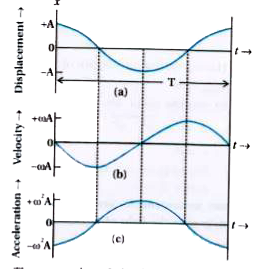
The following graphs of the displacement `x(t) = A cos omega t`, velocity `v(t)= -A omega sin omega t` and acceleration `a(t)= -A omega cos omega t` versus time t of SHM for initial phase zero are shown in figures.
These graphs of displacement, velocity and acceleration of a particle in simple harmonic motion have the same period T, but they differ in phase.
All the quantities change periodically with time according to sine.
In this graphs for all three quantities have their maxima differ and differ in phase.
x varies between `-A" to "+A, v(t)` varies from `-A omega" to "A omega" and "a(t)` from `-A omega^(2)" to "+A omega^(2)`.
With respect to displacement plot, velocity plot has a phase difference of `(pi)/(2)` and acceleration plot has a phase difference of `pi`.
Promotional Banner

Topper's Solved these Questions

  • OSCILLATIONS

    KUMAR PRAKASHAN|Exercise SECTION-A (TRY YOURSELF)|64 Videos
  • OSCILLATIONS

    KUMAR PRAKASHAN|Exercise SECTION-B (NUMERICAL FROM TEXTUAL ILLUSTRATIONS)|40 Videos
  • OBJECTIVE QUESTIONS AS PER NEW PAPER STYLE

    KUMAR PRAKASHAN|Exercise CHAPTER - 8 (Match Type questions)|5 Videos
  • PHYSICAL WORLD

    KUMAR PRAKASHAN|Exercise SECTION-E (QUESTIONS FROM MODULE)|9 Videos

Similar Questions

Explore conceptually related problems

Define phase at time t and initial phase.

If the displacement at time 't' is x = acost, the acceleration is .......

If x denotes displacement in time t and x=a cost, then acceleration is :-

Relation between displacement x and time t is x=2-5t+6t^(2) , the initial acceleration will be :-

If v=(t+2)(t+3) then acceleration (i.e(dv)/(dt)) at t=1 sec.

Let bar(v)(t) be the velocity of a particle at time t. Then :

S=v_(0)t+(1)/(2)(at)^(s) . s = displacement, v_(0) = initial velocity, a= acceleration and t= time. Check the dimensional validity of the following equation.

Draw v to t graph for constant velocity and explain it.

Draw and explain the v to t graphs for uniformly accelerated motion.

Draw the x to t graphs for positive, negative and zero acceleration.

