Home
Class 11
PHYSICS
Figures depicts two circular motions. Th...

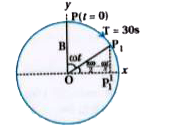
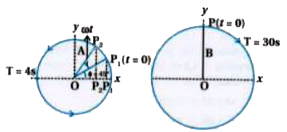
Figures depicts two circular motions. The radius of the circle, the period of revolution, the initial position and the sense of revolution are indicated on the figures. Obtain the simple harmonic motions of the x-projection of the radius vector of the rotating particle P in each case.

Text Solution

Verified by Experts
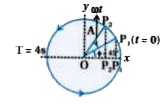
(a) As shown in figure, suppose a particle moving with uniform circular motion is at `P_1` at time t=0 and makes and angle `phi = 45^(@)((pi)/(4)rad)` with positive x-axis. After time `t_1` it covers an angle `omega t` and reaches at `P_2` and makes an angle `theta = omega t + phi` with positive x-axis.

Makes an angle `theta = (2pi)/(T)t+ (pi)/(4)`
The projection of OP on the x-axis at time t is given by `x (t) = A cos ((2pi)/(T)t+(pi)/(4))" have "OP_(2) = A cos (omega t+phi)`
It `t= 4s` then, `x(t) = A cos ((2pi)/(4)t+(pi)/(4)) = A cos ((pi)/(4)+(pi)/(4)) = A sin (pi)/(4)`.
Which is a SHM of amplitude A, period 4s and an initial phase `= (pi)/(4) rad`.
(b) As shown in figure, suppose a particle moving with uniform circular motion is on P at time t=0 and makes an angle `phi = 90^(@) =(pi/2)` with positive x-axis after a time t, it covers an angle of `omega t` and reaches at `P_1` with clockwise direction and makes an angle of `theta = (pi)/(2) - omega t`. The projection of `P._1` on the x-axis `OP._1`.

`x(t) = B cos theta = B cos((pi)/(2)- omega t)= B sin omega t`
`= B cos (omega t-(pi)/(2))" "[therefore cos(-theta)= cos theta]`
`therefore x(t) = B cos ((pi)/(15)t- (pi)/(2))`
This represents a SHM of amplitude B, period T= 30s and an initial phase of `-(pi)/(2)`.
Promotional Banner

Topper's Solved these Questions

  • OSCILLATIONS

    KUMAR PRAKASHAN|Exercise SECTION-B (NUMERICAL FROM TEXTUAL EXERCISE)|48 Videos
  • OSCILLATIONS

    KUMAR PRAKASHAN|Exercise SECTION-B (ADDITIONAL EXERCISE)|9 Videos
  • OSCILLATIONS

    KUMAR PRAKASHAN|Exercise SECTION-A (TRY YOURSELF)|64 Videos
  • OBJECTIVE QUESTIONS AS PER NEW PAPER STYLE

    KUMAR PRAKASHAN|Exercise CHAPTER - 8 (Match Type questions)|5 Videos
  • PHYSICAL WORLD

    KUMAR PRAKASHAN|Exercise SECTION-E (QUESTIONS FROM MODULE)|9 Videos

Similar Questions

Explore conceptually related problems

Figure shows the circular motion of a particle. The radius of the circle, the period, sense of revolution and the initial position are indicated on the figure. The simple harmonic motion of the x-projection of the radius vector of the rotating particle P is..........

Figures 14.25 correspond to two circular motions. The radius of the circle, the period of revolution, the initial position, and the sense of revolution (i.e. clockwise or anti-clockwise) are indicated on each figure. Obtain the corresponding simple harmonic motions of the x-projection of the radius vector of the revolving particle P, in each case.

Obtain the equation for SHM of the Y-projection of the radius vector of the revolving particle P in case (a) and (b) of figure.

Explain that simple harmonic motion is the projection of uniform circular motion on a diameter of the reference circle and obtain the velocity and acceleration.

The plot of velocity (v) versus displacement (x) of a particle executing simple harmonic motion is shown in figure. The time period of oscillation of particle is :-

KUMAR PRAKASHAN-OSCILLATIONS-SECTION-B (NUMERICAL FROM TEXTUAL ILLUSTRATIONS)
  1. Which of the following functions of time represent (a) simple harmonic...

    Text Solution

    |

  2. Which of the following functions of time represent (a) simple harmonic...

    Text Solution

    |

  3. Figures depicts two circular motions. The radius of the circle, the pe...

    Text Solution

    |

  4. Obtain the equation for SHM of the Y-projection of the radius vector o...

    Text Solution

    |

  5. A body oscillates with SHM according to the equation (in SI units), ...

    Text Solution

    |

  6. A body oscillates with SHM according to the equation (in SI units), ...

    Text Solution

    |

  7. A body oscillates with SHM according to the equation (in SI units), ...

    Text Solution

    |

  8. A body oscillator with SHM according to the equation (in SI units) x...

    Text Solution

    |

  9. A body oscillator with SHM according to the equation (in SI units) x...

    Text Solution

    |

  10. A body oscillator with SHM according to the equation (in SI units) x...

    Text Solution

    |

  11. Two identical springs of spring constant k are attached to a block of ...

    Text Solution

    |

  12. A block whose mass is 1kg is fastened to a spring. The spring has a sp...

    Text Solution

    |

  13. A block whose mass is 2kg is fastened to a spring. The spring has a sp...

    Text Solution

    |

  14. A block whose mass is 1kg is fastened to a spring. The spring has a sp...

    Text Solution

    |

  15. A 5kg collar is attached to a spring of spring constant 500 Nm^(-1). I...

    Text Solution

    |

  16. A 5 kg collar is attached to a spring of spring constant 500 N m^(-1)....

    Text Solution

    |

  17. A 5 kg collar is attached to a spring of spring constant 500 N m^(-1)....

    Text Solution

    |

  18. A 2kg collar is attached to a spring of spring constant 800 Nm^(-1). I...

    Text Solution

    |

  19. A 2kg collar is attached to a spring of spring constant 800 Nm^(-1). I...

    Text Solution

    |

  20. A 2kg collar is attached to a spring of spring constant 800 Nm^(-1). I...

    Text Solution

    |