Home
Class 11
PHYSICS
A particle is in linear simple harmonic ...

A particle is in linear simple harmonic motion between two points, A and B, 10 cm apart. Take the direction from A to B as the positive direction and give the signs of velocity, acceleration and force on the particle when it is
at 4 cm away from B going towards A.

Text Solution

Verified by Experts
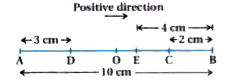
In the figure, the point A and B, 10 cm apart, are the the extreme positions of the particle in SHM, and the point O is the mean position. The direction from A to B is positive, as indicated. The direction of velocity, displacement and acceleration from A to B is positive.

At a distance of 4 cm from B to A means at point E, velocity is negative, acceleration and force both are negative. (-, -, -).
Promotional Banner

Topper's Solved these Questions

  • OSCILLATIONS

    KUMAR PRAKASHAN|Exercise SECTION-B (ADDITIONAL EXERCISE)|9 Videos
  • OSCILLATIONS

    KUMAR PRAKASHAN|Exercise SECTION-B (NUMERICAL FROM DARPAN BASED ON TEXTBOOK)|15 Videos
  • OSCILLATIONS

    KUMAR PRAKASHAN|Exercise SECTION-B (NUMERICAL FROM TEXTUAL ILLUSTRATIONS)|40 Videos
  • OBJECTIVE QUESTIONS AS PER NEW PAPER STYLE

    KUMAR PRAKASHAN|Exercise CHAPTER - 8 (Match Type questions)|5 Videos
  • PHYSICAL WORLD

    KUMAR PRAKASHAN|Exercise SECTION-E (QUESTIONS FROM MODULE)|9 Videos

Similar Questions

Explore conceptually related problems

A particle is in linear simple harmonic motion between two points, A and B, 10 cm apart. Take the direction from A to B as the positive direction and give the signs of velocity, acceleration and force on the particle when it is at 3 cm away from A going towards B.

A particle is in linear simple harmonic motion between two points, A and B, 10 cm apart. Take the direction from A to B as the positive direction and give the signs of velocity, acceleration and force on the particle when it is at the end B.

A particle is in linear simple harmonic motion between two points, A and B, 10 cm apart. Take the direction from A to B as the positive direction and give the signs of velocity, acceleration and force on the particle when it is at the end A.

A particle is in linear simple harmonic motion between two points, A and B, 10 cm apart. Take the direction from A to B as the positive direction and give the signs of velocity, acceleration and force on the particle when it is at the mid-point of AB going towards A.

A particle is in linear simple harmonic motion between two points. A and B, 10 cm apart (figure) take the direction from A to B as the positive direction and choose the correct statements.

A particle executes simple harmonic motion between x = -A and x = + A . The time taken for it to go from 0 to A//2 is T_1 and to go from A//2 to A is T_2 . Then.

A particle executes linear simple harmonic motion with an amplitude of 3 cm. When the particle is at 2 cm from the mean position, the magnitude of its velocity is equal to that of its acceleration. Then its time period in second is…….

KUMAR PRAKASHAN-OSCILLATIONS-SECTION-B (NUMERICAL FROM TEXTUAL EXERCISE)
  1. A particle is in linear simple harmonic motion between two points, A a...

    Text Solution

    |

  2. A particle is in linear simple harmonic motion between two points, A a...

    Text Solution

    |

  3. A particle is in linear simple harmonic motion between two points, A a...

    Text Solution

    |

  4. Which of the followng relationships between the acceleration a and th...

    Text Solution

    |

  5. Which of the following relationships between the acceleration a and th...

    Text Solution

    |

  6. Which of the followng relationships between the acceleration a and th...

    Text Solution

    |

  7. Which of the following relationships between the acceleration a and th...

    Text Solution

    |

  8. The motion of a particle executing simple harmonic motion is described...

    Text Solution

    |

  9. A spring balance has a scale that reads from 0 to 50 kg. The length of...

    Text Solution

    |

  10. A spring having with a spring constant 1200 N m^(-1) is mounted on a h...

    Text Solution

    |

  11. A spring having with a spring constant 1200 N m^(-1) is mounted on a h...

    Text Solution

    |

  12. A spring having with a spring constant 1200 N m^(-1) is mounted on a h...

    Text Solution

    |

  13. In Exercise 9, let us take the position of mass when the spring is un...

    Text Solution

    |

  14. In Exercise 9, let us take the position of mass when the spring is un...

    Text Solution

    |

  15. In Exercise 9, let us take the position of mass when the spring is un...

    Text Solution

    |

  16. Figures 14.25 correspond to two circular motions. The radius of the ci...

    Text Solution

    |

  17. Plot the corresponding reference circle for each of the following simp...

    Text Solution

    |

  18. Plot the corresponding reference circle for each of the following simp...

    Text Solution

    |

  19. Plot the corresponding reference circle for each of the following simp...

    Text Solution

    |

  20. Plot the corresponding reference circle for each of the following simp...

    Text Solution

    |

