Home
Class 11
PHYSICS
A cylindrical piece of cork of density o...

A cylindrical piece of cork of density of base area A and height h floats in a liquid of density `p_(l)`. The cork is depressed slightly and then released. Show that the cork oscillates up and down simple harmonically with a period
`T=2pisqrt((hp)/(p_(1)g))`
where p is the density of cork. (Ignore damping due to viscosity of the liquid).

Text Solution

Verified by Experts
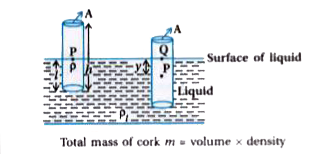

Total mass of cork m = volume `xx` density
= Area `xx` height `xx` density
`therefore m = Ahp " ""……"(1)`
When the cork is depressed in liquid, the mass of displacement liquid,
m. = cross sectional area of cork `xx` length of depressed part of cork `xx` density of liquid `xx` g
`therefore m. = Alp_(l)`
From the floating law of body.
Weight of cork in air = weight of cork in liquid
`mg - m.g, Ahpg = Alp_(l)g`
`therefore h= (lp_(l))/(p)" ""........"(2)`
Suppose the cork is depressed by `PQ = y`, then the restoring force acting on it,
`F= -[" mass of cylindrical height of liquid "] xx g xx y`
`= -(Ayp_(l) g)y = -ky`
Where force constant `k= Ap_(l) g" ""......."(3)`
The time period of oscillation of cork, `T= 2pi sqrt((m)/(k))`
`= 2pi sqrt((Ahp)/(Ap_(l)g))" "[therefore " From equation (1) and (2) "]`
`therefore T= 2pi sqrt((hp)/(p_(l)g))` is proved
This formula is the time period of simple pendulum because,
`T= 2pi sqrt((p_(l)l)/(p)xx (p)/(p_(l)g)" "` (from equation (2))
`therfore T= 2pi sqrt((l)/(g))`.
Promotional Banner

Topper's Solved these Questions

  • OSCILLATIONS

    KUMAR PRAKASHAN|Exercise SECTION-B (ADDITIONAL EXERCISE)|9 Videos
  • OSCILLATIONS

    KUMAR PRAKASHAN|Exercise SECTION-B (NUMERICAL FROM DARPAN BASED ON TEXTBOOK)|15 Videos
  • OSCILLATIONS

    KUMAR PRAKASHAN|Exercise SECTION-B (NUMERICAL FROM TEXTUAL ILLUSTRATIONS)|40 Videos
  • OBJECTIVE QUESTIONS AS PER NEW PAPER STYLE

    KUMAR PRAKASHAN|Exercise CHAPTER - 8 (Match Type questions)|5 Videos
  • PHYSICAL WORLD

    KUMAR PRAKASHAN|Exercise SECTION-E (QUESTIONS FROM MODULE)|9 Videos

Similar Questions

Explore conceptually related problems

A cylindrical of wood (density = 600 kg m^(-3) ) of base area 30 cm^(2) and height 54 cm , floats in a liquid of density 900 kg^(-3) The block is displaced slightly and then released. The time period of the resulting oscillations of the block would be equal to that of a simple pendulum of length (nearly) :

A cylindrical log of wood of height h and area of cross-section A floats in water. It is pressed and then released. Show that the log would execute SHM with a time period. T= 2pi sqrt((m)/(A p g)) where, m is mass of the body and p is density of the liquid. .

A wooden cube (density of wood 'd' ) of side 'l' flotes in a liquid of density 'rho' with its upper and lower surfaces horizonta. If the cube is pushed slightly down and released, it performs simple harmonic motion of period 'T' . Then, 'T' is equal to :-

Two identical cylindrical vessels with their bases at the same level each, contain a liquid of density rho . The area of either base is A but in one vessel the liquid heigth is h_(1) and in the other liquid height is h_(2)(h_(2)lth_(1)) . If the two vessel are connected, the work done by gravity in equalizing the level is

A cylinderical rod of length l=2m & density (rho)/(2) floats vertically in a liquid of density rho as shown in figure (i). Show that it performs SHM when pulled slightly up & released find its time period. Neglect change in liquid level. (ii). Find the time taken by the rod to completely immerse when released from position shown in (b). Assume that it remains vertical throughout its motion (take g=pi^(2)m//s^(2) )

A small spherical monoatomic ideal gas bubble (gamma= (5)/(3)) is trapped inside a liquid of density rho_(l) (see figure) . Assume that the bubble does not exchange any heat with the liquid. The bubble contains n moles of gas. The temperature of the gas when the bubble is at the bottom is T_(0) , the height of the liquid is H and the atmospheric pressure is P_(0) (Neglect surface tension). When the gas bubble is at a height y from the bottom , its temperature is :-

A homogeneous solid cylinder of length L(LltH/2), cross-sectional area A/5 is immersed such that it floats with its axis vertical at the liquid-liquid interface with length L/4 in the denser liquid as shown in the figure. The lower density liquid is open to atmosphere having pressure P_0 . Then density D of solid is given by

Two spheres P and Q of equal radii have densities rho_1 and rho_2 , respectively. The spheres are connected by a massless string and placed in liquids L_1 and L_2 of densities sigma_1 and sigma_2 and viscosities eta_1 and eta_2 , respectively. They float in equilibrium with the sphere P in L_1 and sphere Q in L_2 and the string being taut(see figure). If sphere P alone in L_2 has terminal velocity vecV_p and Q alone in L_1 has terminal velocity vecV_Q , then

A container of large uniform cross-sectional area A resting on a horizontal surface, holes two immiscible, non-viscon and incompressible liquids of densities d and 2d each of height H//2 as shown in the figure. The lower density liquid is open to the atmosphere having pressure P_(0) . A homogeneous solid cylinder of length L(LltH//2) and cross-sectional area A//5 is immeresed such that it floats with its axis vertical at the liquid-liquid interface with length L//4 in the denser liquid, The cylinder is then removed and the original arrangement is restroed. a tiny hole of area s(sltltA) is punched on the vertical side of the container at a height h(hltH//2) . As a result of this, liquid starts flowing out of the hole with a range x on the horizontal surface. The total pressure with cylinder, at the bottom of the container is

A non-viscous liquid of constant density 1000kg//m^3 flows in a streamline motion along a tube of variable cross section. The tube is kept inclined in the vertical plane as shown in Figure. The area of cross section of the tube two point P and Q at heights of 2 metres and 5 metres are respectively 4xx10^-3m^2 and 8xx10^-3m^2 . The velocity of the liquid at point P is 1m//s . Find the work done per unit volume by the pressure and the gravity forces as the fluid flows from point P to Q.

KUMAR PRAKASHAN-OSCILLATIONS-SECTION-B (NUMERICAL FROM TEXTUAL EXERCISE)
  1. A spring having with a spring constant 1200 N m^(-1) is mounted on a h...

    Text Solution

    |

  2. A spring having with a spring constant 1200 N m^(-1) is mounted on a h...

    Text Solution

    |

  3. In Exercise 9, let us take the position of mass when the spring is un...

    Text Solution

    |

  4. In Exercise 9, let us take the position of mass when the spring is un...

    Text Solution

    |

  5. In Exercise 9, let us take the position of mass when the spring is un...

    Text Solution

    |

  6. Figures 14.25 correspond to two circular motions. The radius of the ci...

    Text Solution

    |

  7. Plot the corresponding reference circle for each of the following simp...

    Text Solution

    |

  8. Plot the corresponding reference circle for each of the following simp...

    Text Solution

    |

  9. Plot the corresponding reference circle for each of the following simp...

    Text Solution

    |

  10. Plot the corresponding reference circle for each of the following simp...

    Text Solution

    |

  11. Figure 14.26 (a) shows a spring of force constant k clamped rigidly at...

    Text Solution

    |

  12. The piston in the cylinder head of a locomotive has a stroke (twice th...

    Text Solution

    |

  13. The acceleration due to gravity on the surface of moon is 1.7 m s^(-2)...

    Text Solution

    |

  14. Answer the following question : Time period of a particle in SHM dep...

    Text Solution

    |

  15. Answer the following question : The motion of a simple pendulum is a...

    Text Solution

    |

  16. Answer the following question : A man with a wristwatch on his hand ...

    Text Solution

    |

  17. Answer the following question : What is the frequency of oscillation...

    Text Solution

    |

  18. A simple pendulum of length l and having a bob of mass M is suspended ...

    Text Solution

    |

  19. A cylindrical piece of cork of density of base area A and height h flo...

    Text Solution

    |

  20. One end of a U-tube containing mercury is connected to a suction pump ...

    Text Solution

    |

