Home
Class 11
PHYSICS
Four pendulums A, B, C and D are suspend...

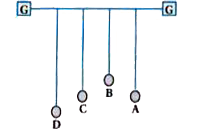
Four pendulums A, B, C and D are suspended from the same elastic support as shown in figure. A and C are of the same length, while B is smaller than A and D is larger them A. If A is given a transverse displacement,

A

D will vibrate with maximum amplitude

B

C will vibrate with maximum amlitude

C

B vibrate with maximum amplitude

D

All the four will oscillate with equal amplitude

Text Solution

Verified by Experts

The correct Answer is:

C

Though the elastic support the disturbance is transferred to all the pendulum. A and C are having same length, hence they will be in resonance and so its amlitude of A and C will be maximum. Here we have assessed that support is completely elastic and hence no damped oscillation occur.
Since length of pendulum A and C is same and amplitude of A and C are maximum. Here we have assessed that support is completely elastic and hence no damped oscillation.
Promotional Banner

Topper's Solved these Questions

  • OSCILLATIONS

    KUMAR PRAKASHAN|Exercise SECTION-D (NCERT EXEMPLAR SOLUTION MCQs MORE THAN ONE OPTIONS)|8 Videos
  • OSCILLATIONS

    KUMAR PRAKASHAN|Exercise SECTION-D (NCERT EXEMPLAR SOLUTION VERY SHORT ANSWER QUESTIONS)|10 Videos
  • OSCILLATIONS

    KUMAR PRAKASHAN|Exercise SECTION-C (OBJECTIVE QUESTIONS ASSERTION OR REASION)|7 Videos
  • OBJECTIVE QUESTIONS AS PER NEW PAPER STYLE

    KUMAR PRAKASHAN|Exercise CHAPTER - 8 (Match Type questions)|5 Videos
  • PHYSICAL WORLD

    KUMAR PRAKASHAN|Exercise SECTION-E (QUESTIONS FROM MODULE)|9 Videos

Similar Questions

Explore conceptually related problems

Three point particle A, B and C are projected from same point with same speed at t=0 as shown in figure. For this situation select correct statement(s).

Four motorcars A, B, C and D are moving on a road in the same direction. Their graphs for distance-time are shown in the same graph paper, which of the following state is true ?

Identify the following figure with A,B,C and D

Identify A,B,C and D in given flow chart:-

Three projectile A, B and C are thrwon from the same point in the same plane. Their trajectories are shown in the figure. Then which of the following statement is true:-

A charged metallic sphere A is suspended by a nylon thread. Another charged metallic sphere B held by an insulating handle is brought close to A such that the distance between their centres is 10 cm, as shown in figure (a). The resulting repulsion of A is noted (for example, by shining a beam of light and measuring the deflection of its shadow on a screen). Spheres A and B are touched by uncharged spheres C and D respectively, as shown in figure (b). C and D are then removed and B is brought closer to A to a distance of 5.0 cm between their centres, as shown in figure (c). What is the expected repulsion of A on the basis of Coulomb's law ? Spheres A and C and spheres B and D have identical sizes. Ignore the sizes of A and B in comparison to the separation between their centres.

Two pendulums with identical bobs and lengths are suspended from a common support such that in real position the two bobs are in contact (figure). One of the bobs is released after being displaced by 10^(@) so that it collides elastically head-on with the other bob. (a) Describe the motion of two bobs. (b) Draw a graph showing variation in energy of either pendumlum with time, for 0 le t le 2T , where T is the period of each pendulum.

Four candidates A, B, C, D have applied for the assignment to coach a school cricket team. If A is twice as likely to be selected as B, and B and C are given about the same chance of being selected, while C is twice as likely to be selected as D, what are the probabilities that (i) C will be selected ? (ii) A will not be selected ?

Three rods made of the same material and having the same cross-section have been joined as shown in the figure. Each rod is of the same length. The left and right ends are kept at 0^@C and 90^@C , respectively. The temperature of junction of the three rods will be (a) 45^@C (b) 60^@C (c) 30^@C (d) 20^@C .
