Home
Class 11
PHYSICS
A mass 2kg is attached to the spring of ...

A mass 2kg is attached to the spring of spring constant `50 Nm^(-1)`. The block is pulled to a distance of 5 cm from its equilibrium position at x= 0 on a horizontal frictionless surface from rest at t=0. Write the expression for its displacement at anytime t.

Text Solution

Verified by Experts
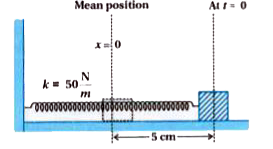
Spring block system is shwon as in figure and it executes SHM with amplitude of 5 cm from mean position.

Here, spring constant `k= 50 N"/"m`, amplitude A= 5cm, mass attached m = 2 kg.
Angular frequency `omega = sqrt((k)/(m))= sqrt((50)/(2))= 5 rad"/"s`.
Displacement of block at time t,
`y(t) = A sin (omega t+ phi)," where "phi=` initial phase at time t=0
`y(0)= A sin (phi)`
`A= A sin phi" "[therefore " at time "t=0, y= +A]`
`therefore 1= sin phi`
`therefore phi = (pi)/(2) rad`
Required equation, `y(t) = A sin(omega t+phi)`
`= 5sin (omega t+(pi)/(2))`
`therefore y(t) = 5 cos omega t`
`y(t)= 5 cos 5t` is a required equation where t is in second and y is in cm.
Promotional Banner

Topper's Solved these Questions

  • OSCILLATIONS

    KUMAR PRAKASHAN|Exercise SECTION-D (NCERT EXEMPLAR SOLUTION LONG ANSWER QUESTIONS)|8 Videos
  • OSCILLATIONS

    KUMAR PRAKASHAN|Exercise SECTION-E (MCQs ASKED IN GUJARAT BOARD AND COMPETITIVE EXAMS)|66 Videos
  • OSCILLATIONS

    KUMAR PRAKASHAN|Exercise SECTION-D (NCERT EXEMPLAR SOLUTION VERY SHORT ANSWER QUESTIONS)|10 Videos
  • OBJECTIVE QUESTIONS AS PER NEW PAPER STYLE

    KUMAR PRAKASHAN|Exercise CHAPTER - 8 (Match Type questions)|5 Videos
  • PHYSICAL WORLD

    KUMAR PRAKASHAN|Exercise SECTION-E (QUESTIONS FROM MODULE)|9 Videos

Similar Questions

Explore conceptually related problems

A block whose mass is 1kg is fastened to a spring. The spring has a spring constant of 50 Nm^(-1) . The block is pulled to a distance x=10 cm from its equilibrium position at x=0 on a frictionless surface from rest at t=0. Calculate the kinetic, potential and total energies of the block when it is 5 cm away from the mean position.

A block whose mass is 2kg is fastened to a spring. The spring has a spring constant of 100 Nm^(-1) . The block is pulled to a distance x=10 cm from its equilibrium position at x=0 on a frictionless surface from rest at t=0. Calculate the kinetic, potential and total energies of the block when it is 5 cm away from the mean position.

A block whose mass is 1kg is fastened to a spring. The spring has a spring constant of 50 Nm^(-1) . The block is pulled to a distance x=10 cm from its equilibrium position at x=0 on a frictionless surface from rest at t=0. Calculate the kinetic, potential and total energies of the block when it is 7.07 cm away from the mean position.

A block whose mass is 1 kg is fastened to a spring. The spring has a spring constant of 50 N m^(-1) . The block is pulled to a distance x = 10 cm from its equilibrium position at x = 0 on a frictionless surface from rest at t = 0. Calculate the kinetic, potential and total energies of the block when it is 5 cm away from the mean position.

A 2kg collar is attached to a spring of spring constant 800 Nm^(-1) . It slides without friction over a horizontal rod. The collar is displaced from its equilibrium position by 10.0 cm and released. Calculate the period of the oscillation.

A 5kg collar is attached to a spring of spring constant 500 Nm^(-1) . It slides without friction over a horizontal rod. The collar is displaced from its equilibrium position by 10.0 cm and released. Calculate the period of oscillation.

A 2kg collar is attached to a spring of spring constant 800 Nm^(-1) . It slides without friction over a horizontal rod. The collar is displaced from its equilibrium position by 10.0 cm and released. Calculate the maximum speed.

A 2kg collar is attached to a spring of spring constant 800 Nm^(-1) . It slides without friction over a horizontal rod. The collar is displaced from its equilibrium position by 10.0 cm and released. Calculate maximum acceleration of the collar.

A 5 kg collar is attached to a spring of spring constant 500 N m^(-1) . It slides without friction over a horizontal rod. The collar is displaced from its equilibrium position by 10.0 cm and released. Calculate (a) the period of oscillation, (b) the maximum speed and (c) maximum acceleration of the collar.

