Home
Class 11
PHYSICS
Consider a pair of identical pendulums, ...

Consider a pair of identical pendulums, which oscillate with equal amplitude independently such that when one pendulum is at its extreme position making an angle of `2^(@)` to the right with the vertical, the other pendulum makes an angle of `1^(@)` to the left of the vertical. What is the phase difference between the pendulums?

Text Solution

Verified by Experts
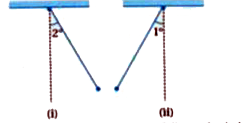
Given situation are shown in given below figures (i) and (ii)

Suppose both the pendulums follows the below functions,
`theta_(1) = theta_(0) sin (omega t+ phi_(1))" ""…….."(1)`
`theta_(2) = theta_(0) sin (omega t+phi_(2))" ""........."(2)`
where, `theta_(0)=` amplitude
For first pendulum at any time t,
`theta_(1)= +theta_(0)" "` (Right side)
From equation (1)
`+ theta_(1)= theta_(0) sin (omega t+phi_(1))`
`therefore +1 = sin(omega t+phi_(1))`
`therefore omega t + phi_(1) = (pi)/(2)" "".........."(3)`
Similarly for second pendulum at time t,
`theta_(2) = -(theta_0)/(2)" "` (left side)
From equation (2)
`-(theta_0)/(2)= theta_(0) sin (omega t+ phi_(2))`
`therefore -(1)/(2)= sin (omega t+ phi_(2))`
`therefore omega +phi_(2)= -(pi)/(6)" or "(7pi)/(6)" ""......."(4)[i.e. = 2pi-(pi)/(6)]`
the difference in phases from equ. (3) and (4)
`(omega + phi_(2))-(omega t-phi_(1))= (7pi)/(6)-(pi)/(2)`
`therefore phi_(2)-phi_(1)= (4pi)/(6)= (2pi)/(3)`
`therefore phi_(2)-phi_(1)= 120^(@)`.
Promotional Banner

Topper's Solved these Questions

  • OSCILLATIONS

    KUMAR PRAKASHAN|Exercise SECTION-D (NCERT EXEMPLAR SOLUTION LONG ANSWER QUESTIONS)|8 Videos
  • OSCILLATIONS

    KUMAR PRAKASHAN|Exercise SECTION-E (MCQs ASKED IN GUJARAT BOARD AND COMPETITIVE EXAMS)|66 Videos
  • OSCILLATIONS

    KUMAR PRAKASHAN|Exercise SECTION-D (NCERT EXEMPLAR SOLUTION VERY SHORT ANSWER QUESTIONS)|10 Videos
  • OBJECTIVE QUESTIONS AS PER NEW PAPER STYLE

    KUMAR PRAKASHAN|Exercise CHAPTER - 8 (Match Type questions)|5 Videos
  • PHYSICAL WORLD

    KUMAR PRAKASHAN|Exercise SECTION-E (QUESTIONS FROM MODULE)|9 Videos

Similar Questions

Explore conceptually related problems

Two simple pendulums of equal length cross each other at mean position. What is their phase difference?

A passenger on a large ship sailing in a quiet sea hangs a ball from the celling of her cabin by means of a long thread. Whenever the ship acceleration when the pendulum stands at an angle of 5^(@) to the vertical ?

A simple pendulum of length 1m is allowed to oscillate with amplitude 2^(@) . it collides at T to the vertical its time period will be (use g = pi^(2) )

A pendulum is suspended in a lift and its period of oscillation when the lift is stationary is T_(0) . What must be the accleraion of the lift for the period of oscillation of the pendulum to be T_(0)//2 ?

A 100 turn closely wound circular coil of radius 10 cm carries a current of 3.2 A. (a) What is the field at the centre of the coil? (b) What is the magnetic moment of this coil? The coil is placed in a vertical plane and is free to rotate about a horizontal axis which coincides with its diameter. A uniform magnetic field of 2T in the horizontal direction exists such that initially the axis of the coil is in the direction of the field. The coil rotates through an angle of 90^@ under the influence of the magnetic field. (c) What are the magnitudes of the torques on the coil in the initial and final position? (d) What is the angular speed acquired by the coil when it has rotated by 90^@ ? The moment of inertia of the coil is 0.1 kg m^2 .

A simple pendulum of length 40 cm oscillates with an angular amplitude of 0.04 rad. Find a. the time period b. the linear amplitude of the bob, c. The speed of the bob when the strig makes 0.02 rad with the vertical and d. the angular acceleration when the bob is in moemntary rest. Take g=10 ms^-2 .

Two identically charged spheres are suspended by strings of equal length. The strings make an angle of 30^(@) with each other. When suspended in a liquid of density 0.8 g// c c the angle remains same. What is the dielectric constant of liquid. Density of sphere =1.6 g//c c

When a particle is undergoing motion, the diplacement of the particle has a magnitude that is equal to or smaller than the total distance travelled by the particle. In many cases the displacement of the particle may actually be zero, while the distance travelled by it is non-zero. Both these quantities, however depend on the frame of reference in which motion of the particle is being observed. Consider a particle which is projected in the earth's gravitational field, close to its surface, with a speed of 100sqrt(2) m//s , at an angle of 45^(@) with the horizontal in the eastward direction. Ignore air resistance and assume that the acceleration due to gravity is 10 m//s^(2) . " A third observer (C) close to the surface of the reports that particle is initially travelling at a speed of 100sqrt(2) m//s making on angle of 45^(@) with the horizontal, but its horizontal motion is northward". The third observer is moving in :-

When a particle is undergoing motion, the diplacement of the particle has a magnitude that is equal to or smaller than the total distance travelled by the particle. In many cases the displacement of the particle may actually be zero, while the distance travelled by it is non-zero. Both these quantities, however depend on the frame of reference in which motion of the particle is being observed. Consider a particle which is projected in the earth's gravitational field, close to its surface, with a speed of 100sqrt(2) m//s , at an angle of 45^(@) with the horizontal in the eastward direction. Ignore air resistance and assume that the acceleration due to gravity is 10 m//s^(2) . The motion of the particle is observed in two different frames: one in the ground frame (A) and another frame (B), in which the horizontal component of the displacement is always zero. Two observers locates in these frames ill agree on :-

