Home
Class 11
PHYSICS
A person normally weighing 50kg stands o...

A person normally weighing 50kg stands on a massless platform which oscillates up and down harmonically at a frequency of `2.0 s^(-1)` and an amplitude `5.0 cm`. A weighing machine on the platform gives the persons weight against time.
If answer of part (1) is yes, what will be the maximum and minimum reading in the machine and at which position?

Text Solution

Verified by Experts
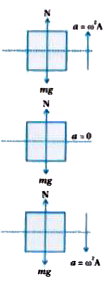
Here, oscillations are periodic hence acceleration changes. The weight of man depend on direction of acceleration and its magnitude in up and down motion.
(b) The acceleration is maximum at two extreme points of the platform.
At upper extreme point acceleration on platform is in downward,
From equation of motion
`N= mg - ma`
`N= mg - m omega^(2) A`
`therefore N= m[g- omega^(2)A]`
`=50[9.8-4pi^(2)v^(2)A]`
`=50[9.8-4xx(3.14)^(2) xx 4 xx 5xx 10^(-2)]`
`=50[9.8-7.88]= 50[1.92]`
Weight = 96N and at mean position
`N= mg`
`=50xx 9.8`
Weight = 490 N
At lower extreme point,
`N= mg+ ma`
`= m(g+a)`
`=m(g + omega^(2)A)`
`=m(g+ 4pi^(2)v^(2)A)`
`=50(9.8+4xx(3.14)^(2)xx (2)^(2)xx5 xx 10^(-2))`
`=50(9.8+7.88)`
`=50(17.68)`
Weight = 884 N.
Promotional Banner

Topper's Solved these Questions

  • OSCILLATIONS

    KUMAR PRAKASHAN|Exercise SECTION-E (MCQs ASKED IN GUJARAT BOARD AND COMPETITIVE EXAMS)|66 Videos
  • OSCILLATIONS

    KUMAR PRAKASHAN|Exercise SECTION-F (QUESTIONS FROM MODULE SIMPLE QUESTIONS)|20 Videos
  • OSCILLATIONS

    KUMAR PRAKASHAN|Exercise SECTION-D (NCERT EXEMPLAR SOLUTION SHORT ANSWER QUESTIONS)|6 Videos
  • OBJECTIVE QUESTIONS AS PER NEW PAPER STYLE

    KUMAR PRAKASHAN|Exercise CHAPTER - 8 (Match Type questions)|5 Videos
  • PHYSICAL WORLD

    KUMAR PRAKASHAN|Exercise SECTION-E (QUESTIONS FROM MODULE)|9 Videos

Similar Questions

Explore conceptually related problems

A person normally weighing 50kg stands on a massless platform which oscillates up and down harmonically at a frequency of 2.0 s^(-1) and an amplitude 5.0 cm . A weighing machine on the platform gives the persons weight against time. Will there be any change in weight of the body, during the oscillation?

A man of mass 70 kg stands on a weighing scale in a lift which is moving (a) upwards with a uniform speed of 10 m s 1, (b) downwards with a uniform acceleration of 5 ms^(2) , (c) upwards with a uniform acceleration of 5 ms^(2) . What would be the readings on the scale in each case ? (d) What would be the reading if the lift mechanism failed and it hurtled down freely under gravity ?

A particle is performing SHM. Its path length is 8 cm, amplitude is 4/1 th the path length and time period 0.2s. If the particle is initially in the mean position, the time at which it will be at 1 cm will be

On a long horizontally moving belt, a child runs to an fro with a speed 9 kmh^(-1) ( with respect to the belt) between his father and mother located 50m a part on the moving belt. The belt moves with a speed of 4 kmh^(-1) . For an observer on a stationery platform outside, what is the (i) speed of the child running in the direction of motion of the belt, (ii) speed of the child running opposited to the direction of motion of the belt , and (iii) time taken by child in (i) and (ii) ? which of the answers alter if motion is viewed by one of the parents?

In a human pyramid in a circus, the entire weight of the balanced group is supported by the legs of a performer who is lying on his back. The combined mass of all the persons performing the act, and the tables, plaques etc. involved is 280 kg. The mass of the performer lying on his back at the bottom of the pyramid is 80 kg. Each thighbone (femur) of this performer has a length of 50 cm and an effective radius of 2.0 cm. Determine the amount by which each thighbone gets compressed under the extra load. (g=9.8 ms^(-2)) Young's Modulus for bone Y =9.4 xx 10 ^(9) Nm ^(-2)

In a human pyramid in a circus, the entire weight of the balanced group is supported by the legs of a performer who is lying on his back. The combined mass of all the persons performing the act, and the tables, plaques etc. involved is 280 kg. The mass of the performer lying on his back at the bottom of the pyramid is 60 kg. Each thighbone (femur) of this performer has a length of 50 cm and an effective radius of 2.0 cm. Determine the amount by which each thighbone gets compressed under the extra load. (g = 9.8 ms ^(-2)) Young's Modulus for bone Y=9.4xx 10 ^(9) Nm^(-2).

A horizontal straight wire 10 m long extending from east to west is falling with a speed of 5.0 "m s"^(-1) , at right angles to the horizontal component of the earth's magnetic field, 0.30 xx 10^(-4) "Wb m"^(-2) . (a) What is the instantaneous value of the emf induced in the wire ? (b) What is the direction of the emf ? (c) Which end of the wire is at the higher electrical potential ?

The ciliary muscles of eye control the curvature of the lens in the eye and hence can alter the effective focal length of the system. When the muscles are fully relaxed, the focal length is maximum. When the muscles are strained, the curvature of lens increases. That means radius of curvature decreases and focal length decreases. For a clear vision, the image must be on the retina. The image distance is therefore fixed for clear vision and it equals the distance of retina from eye lens. It is about 2.5cm for a grown up person. A perosn can theoretically have clear vision of an object situated at any large distance from the eye. The smallest distance at which a person can clearly see is related to minimum possible focal length. The ciliary muscles are most strained in this position. For an average grown up person, minimum distance of the object should be around 25cm. A person suffering from eye defects uses spectacles (eye glass). The function of lens of spectacles is to form the image of the objects within the range in which the person can see clearly. The image o the spectacle lens becomes object for the eye lens and whose image is formed on the retina. The number of spectacle lens used for th eremedy of eye defect is decided by the power fo the lens required and the number of spectacle lens is equal to the numerical value of the power of lens with sign. For example, if power of the lens required is +3D (converging lens of focal length 100//3cm ), then number of lens will be +3 . For all the calculations required, you can use the lens formula and lensmaker's formula. Assume that the eye lens is equiconvex lens. Neglect the distance between the eye lens and the spectacle lens. Q. Maximum focal length of a eye lens of a normal person is

The ciliary muscles of eye control the curvature of the lens in the eye and hence can alter the effective focal length of the system. When the muscles are fully relaxed, the focal length is maximum. When the muscles are strained, the curvature of lens increases. That means radius of curvature decreases and focal length decreases. For a clear vision, the image must be on the retina. The image distance is therefore fixed for clear vision and it equals the distance of retina from eye lens. It is about 2.5cm for a grown up person. A perosn can theoretically have clear vision of an object situated at any large distance from the eye. The smallest distance at which a person can clearly see is related to minimum possible focal length. The ciliary muscles are most strained in this position. For an average grown up person, minimum distance of the object should be around 25cm. A person suffering from eye defects uses spectacles (eye glass). The function of lens of spectacles is to form the image of the objects within the range in which the person can see clearly. The image o the spectacle lens becomes object for the eye lens and whose image is formed on the retina. The number of spectacle lens used for th eremedy of eye defect is decided by the power fo the lens required and the number of spectacle lens is equal to the numerical value of the power of lens with sign. For example, if power of the lens required is +3D (converging lens of focal length 100//3cm ), then number of lens will be +3 . For all the calculations required, you can use the lens formula and lensmaker's formula. Assume that the eye lens is equiconvex lens. Neglect the distance between the eye lens and the spectacle lens. Q. Maximum focal length of a eye lens of a normal person is

