Home
Class 11
PHYSICS
A cylindrical log of wood of height h an...

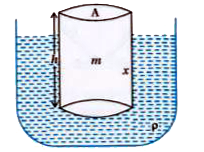
A cylindrical log of wood of height h and area of cross-section A floats in water. It is pressed and then released. Show that the log would execute SHM with a time period.
`T= 2pi sqrt((m)/(A p g))`
where, m is mass of the body and p is density of the liquid.
.

Text Solution

Verified by Experts

Suppose, log is pressed downward to y, the volume of liquid displaced by block will be yA.
The mass of displaced water `M= Vp`
`=yA p" "[therefore y xx A= " volume V "]`
Buoyant force the upward by displaced water = weight of displaced water
`therefore F= -Mg" "`(Weight and Buoyant force are opposite to each other)
`= -y A pg`
`therefore = -(A pg )y`
`therefore F propto -y`
where `Ap g =k` constant
Hence, force acting on log is directly proportional to the displacement and opposite it. So motion of log is SHM
Now, period of SHM particle `T= 2pi sqrt((m)/(k))`
but `k= A p g`
`therefore T= 2pi sqrt((m)/(A p g))` is proved.
Promotional Banner

Topper's Solved these Questions

  • OSCILLATIONS

    KUMAR PRAKASHAN|Exercise SECTION-E (MCQs ASKED IN GUJARAT BOARD AND COMPETITIVE EXAMS)|66 Videos
  • OSCILLATIONS

    KUMAR PRAKASHAN|Exercise SECTION-F (QUESTIONS FROM MODULE SIMPLE QUESTIONS)|20 Videos
  • OSCILLATIONS

    KUMAR PRAKASHAN|Exercise SECTION-D (NCERT EXEMPLAR SOLUTION SHORT ANSWER QUESTIONS)|6 Videos
  • OBJECTIVE QUESTIONS AS PER NEW PAPER STYLE

    KUMAR PRAKASHAN|Exercise CHAPTER - 8 (Match Type questions)|5 Videos
  • PHYSICAL WORLD

    KUMAR PRAKASHAN|Exercise SECTION-E (QUESTIONS FROM MODULE)|9 Videos

Similar Questions

Explore conceptually related problems

A cylindrical piece of cork of density of base area A and height h floats in a liquid of density p_(l) . The cork is depressed slightly and then released. Show that the cork oscillates up and down simple harmonically with a period T=2pisqrt((hp)/(p_(1)g)) where p is the density of cork. (Ignore damping due to viscosity of the liquid).

A mass (M) is suspended from a spring of negligible mass. The spring is pulled a little and then released so that the mass executes SHM of time period T. If the mass is increased by m, the time period becomes (5T)/3 . Then the ratio of m/M is .

A cylindrical of wood (density = 600 kg m^(-3) ) of base area 30 cm^(2) and height 54 cm , floats in a liquid of density 900 kg^(-3) The block is displaced slightly and then released. The time period of the resulting oscillations of the block would be equal to that of a simple pendulum of length (nearly) :

An air chamber of volume V has a neck area of cross section a into which a ball of mass m just fits and can move up and down without any friction (Fig.14.27). Show that when the ball is pressed down a little and released , it executes SHM. Obtain an expression for the time period of oscillations assuming pressure-volume variations of air to be isothermal [see Fig. 14.27].

Show that if a body is projected vertically upward from the surface of the earth so as to reach a height nR above the surface (i) the increase in its potential energy is ((n)/(n + 1)) mgR , (ii) the velocity with which it must be projected is sqrt((2ngR)/(n + 1)) , where r is the radius of the earth and m the mass of body.

Assertion: If a body is dropped from the top of a twoer of height h and another body is thrown up simultaneously with velocity u from the foot of the tower, then both of them would meet after a time (h)/(u) . Reason: For a body projected upwards, the distance covered by the body in the last second of its upwards journey is always 4.9m irrespective of velocity of projection (g=9.8 m//s^(2))

Water is filled in a cylindrical container to a height of 3m . The ratio of the cross-sectional area of the orifice and the beaker is 0.1 . The square of the speed of the liquid coming out from the orifice is (g=10m//s^(2)) .

A container of large uniform cross-sectional area A resting on a horizontal surface, holes two immiscible, non-viscon and incompressible liquids of densities d and 2d each of height H//2 as shown in the figure. The lower density liquid is open to the atmosphere having pressure P_(0) . A homogeneous solid cylinder of length L(LltH//2) and cross-sectional area A//5 is immeresed such that it floats with its axis vertical at the liquid-liquid interface with length L//4 in the denser liquid, The cylinder is then removed and the original arrangement is restroed. a tiny hole of area s(sltltA) is punched on the vertical side of the container at a height h(hltH//2) . As a result of this, liquid starts flowing out of the hole with a range x on the horizontal surface. The total pressure with cylinder, at the bottom of the container is

A cylindrical vessel of height 500mm has an orifice (small hole) at its bottom. The orifice is initially closed and water is filled in it up to height H. Now the top is completely sealed with a cap and the orifice at the bottom is opened. Some water comes out from the orifice and the water level in the vessel becomes steady with height of water column being 200mm. Find the fall in height(in mm) of water level due to opening of the orifice. [Take atmospheric pressure =1.0xx10^5N//m^2 , density of water=1000kg//m^3 and g=10m//s^2 . Neglect any effect of surface tension.]

