Home
Class 11
PHYSICS
One end of V-tube containing mercury is ...

One end of V-tube containing mercury is connected to a suction pump and the other end to atmosphere. The two arms of the tube are inclined to horizental at an angle of `45^(@)` each. A small pressure difference is created between two columns when the suction pump is removed. Will the column of mercury in V-tube execute simple harmonic motion? Neglect capillary and viscous forces. Find the time period of oscillation.

Text Solution

Verified by Experts
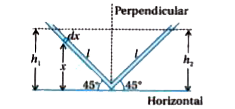
Figure shown as below

Let small liquid column of length dx is in the left of tube at x height from horizontal
Potential energy due to dx element,
`d(PE)= dmgx" "[PE=" from mgh "]`
`=p V gx " "[therefore m= pV" and "V= A dx]`
`=p A dx gx`
`= pA g x dx`
Total potential energy of liquid in left column
`P.E= int_(0)^(h_1) Ap gx"" dx`
`=A pg int_(0)^(h_1) x dx`
`=A pg[(x^2)/(2)]_(0)^(h_1)= (A pg h_(1)^(2))/(2)`
From figure `h_(1)= l sin 45^(@)= (l)/(sqrt(2))`
`therefore P.E = (A p gl^(2))/(4)`
Total potential energy of liquid in V-tube
`P.E= (A pg l^(2))/(4)+ (Apg l^(2))/(4)`
Initial `P.E. = (A pg l^(2))/(4)" ""......."(1)`
When the suction pump is removed and due to pressure difference, let element moves towards right side by y unit.
Then the liquid column in left arm `=(l-y)`
And the liquid in right arm `=l+y`
Total potential energy `=Ap g(l-y)^(2) sin^(2) 45^(@)+ Ap g (l+y)^(2) sin^(2)45^(@)`
Final `P.E. = (A pg (l-y)^(2))/(2)+ (Ap g(l+y)^(2))/(2)" ""......"(2)`
Potential energy difference
`triangle PE =` final P.E. - initial P.E.
`=(A pg)/(2)[(l-y)^(2)+(l+y)^(2)-l^(2)]" "` [From equation (1) and (2) ]
`=(Apg )/(2) [2l^(2)+2y^(2)-l^(2)]`
`=(A pg )/(2) [l^(2)+2y^(2)]" ""........"(3)`
If change in velocity v of total liquid column
`triangle KE= (1)/(2)mv^(2)" "[" where "m= pV= pA xx 2l]`
`triangle KE = Ap lv^(2)" ""......."(4)`
From law of conservation of energy,
`triangle PE + triangle KE= 0`
`A pg (l^(2)+2y^(2))+ Apl v^(2) = 0" ""........."(5)`
Difference w.r.t time .t.
`Apg [(d)/(dt)(l^(2)+2y^(2))]+ Apl (d)/(dt)(v^2)=0`
`Apg (0+2y(dy)/(dt))+Apl (2v(dv)/(dt))=0`
`2A pg y v + Apl (2v)a=0`
Dividing by `2Apv`,
`gy+la=0" "[therefore 2Apv ne 0]`
`therefore a= -(g)/(l)y`, comparing with this to
`(d^(2)y)/(dt^(2))= -omega^(2)y`
`therefore omega = sqrt((g)/(l))`
`therefore (2pi)/(T)= sqrt((g)/(l))`
`therefore T= 2pi sqrt((l)/(g))` is time period.
Promotional Banner

Topper's Solved these Questions

  • OSCILLATIONS

    KUMAR PRAKASHAN|Exercise SECTION-E (MCQs ASKED IN GUJARAT BOARD AND COMPETITIVE EXAMS)|66 Videos
  • OSCILLATIONS

    KUMAR PRAKASHAN|Exercise SECTION-F (QUESTIONS FROM MODULE SIMPLE QUESTIONS)|20 Videos
  • OSCILLATIONS

    KUMAR PRAKASHAN|Exercise SECTION-D (NCERT EXEMPLAR SOLUTION SHORT ANSWER QUESTIONS)|6 Videos
  • OBJECTIVE QUESTIONS AS PER NEW PAPER STYLE

    KUMAR PRAKASHAN|Exercise CHAPTER - 8 (Match Type questions)|5 Videos
  • PHYSICAL WORLD

    KUMAR PRAKASHAN|Exercise SECTION-E (QUESTIONS FROM MODULE)|9 Videos

Similar Questions

Explore conceptually related problems

One end of a U-tube containing mercury is connected to a suction pump and the other end to atmosphere. A small pressure difference is maintained between the two columns. Show that, when the suction pump is removed, the column of mercury in the U-tube executes simple harmonic motion.

Give the formula of force acting on a particle executes simple harmonic motion.

Write the differences between periodic and simple harmonic motion.

Explain by plats the position of particle executing simple harmonic motion at different time.

The plot of velocity (v) versus displacement (x) of a particle executing simple harmonic motion is shown in figure. The time period of oscillation of particle is :-

Difference between periodic motion and simple harmonic motion.

If two radit of a circle are inclined to each other at an angle of 70^(@), then the tangents at the end points of those radii are inclined to each other at an angle of……..

If maximum velocity of a particle executes simple harmonic motion v_m then its average velocity will be……….

