Home
Class 11
PHYSICS
A ball is suspended by a thread of lengt...

A ball is suspended by a thread of length L at the point O on a wall which in indeed to the vertical by `alpha`. The thread with the ball is displaced by a small angle `beta` away from the vertical and also away from the wall. If the ball is released, the period of observation of the pendulum when `beta gt alpha` will be...........

A

`sqrt((L)/(g)) [pi + 2 sin ^(-1) (alpha/beta)]`

B

`sqrt((L)/(g)) [pi - 2 sin ^(-1) (alpha/beta)]`

C

`sqrt((L)/(g)) [2 sin ^(-1) (alpha/beta)-pi]`

D

`sqrt((L)/(g)) [2sin ^(-1) (alpha/beta)+pi]`

Text Solution

Verified by Experts

The correct Answer is:
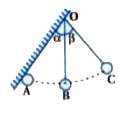
A

Angular position `theta= theta_(0) sin omega t" and " omega = sqrt((g)/(L))`
`therefore T= 2pi sqrt((L)/(g))`
When `beta propto alpha`, time taken by pendulum from B to C and C to B
`t_(1)= (T)/(2)= (1)/(2)xx 2pi sqrt((L)/(g))= pi sqrt((L)/(g))" ""........"(1)`
Time taken by pendulum from B to A and A to B,
`t_(2)= 2t = (2)/(omega)sin^(-1) (alpha/beta)" "(" using " theta = theta_(0) sin omega t)`
`therefore alpha= beta sin omega t" or "t= (1)/(omega) sin^(-1) (alpha/beta) = sqrt((L)/(g)) sin^(-1) (alpha)/(beta)`
`t_(2)= 2t = 2sqrt((L)/(g)) sin^(-1) (alpha/beta)" ""........"(2)`
Time period of motion,
`T= t_(1)+t_(2)`
`= sqrt((L)/(g)) [pi + 2 sin^(-1) (alpha)/(beta)]`.
Promotional Banner

Topper's Solved these Questions

  • OSCILLATIONS

    KUMAR PRAKASHAN|Exercise SECTION-F (QUESTIONS FROM MODULE SIMPLE QUESTIONS)|20 Videos
  • OSCILLATIONS

    KUMAR PRAKASHAN|Exercise QUESTION PAPER (SECTION - A)|6 Videos
  • OSCILLATIONS

    KUMAR PRAKASHAN|Exercise SECTION-D (NCERT EXEMPLAR SOLUTION LONG ANSWER QUESTIONS)|8 Videos
  • OBJECTIVE QUESTIONS AS PER NEW PAPER STYLE

    KUMAR PRAKASHAN|Exercise CHAPTER - 8 (Match Type questions)|5 Videos
  • PHYSICAL WORLD

    KUMAR PRAKASHAN|Exercise SECTION-E (QUESTIONS FROM MODULE)|9 Videos

Similar Questions

Explore conceptually related problems

A ball is suspended by a thread of length l at the point O on an incline wall as shown. The inclination of the wall with the vertical is α.The thread is displaced through a small angle β away from the vertical and the ball is released. Find the period of oscillation of pendulum. Consider both cases a. alpha gt beta b. alpha lt beta Assuming that any impact between the wall and the ball is elastic.

Two identical small balls each of mass m are rigidly affixed at the ends of light rigid rod of length 1.5 m and the assmebly is placed symmetrically on an elevated protrusion of width l as shown in the figure. The rod-ball assmebly is titled by a small angle theta in the vertical plane as shown in the figure and released. Estimate time-period (in seconds) of the oscillation of the rod-ball assembly assuming collisions of the rod with corners of the protrusion to be perfectly elastic and the rod does not slide on the corners. Assume theta=gl (numerically in radians), where g is the acceleration of free fall.

A ball is thrown from the ground to clear a wall 3 m high at a distance of 6 m and falls 18 m away from the wall. Find the angle of projection of ball.

A passenger on a large ship sailing in a quiet sea hangs a ball from the celling of her cabin by means of a long thread. Whenever the ship acceleration when the pendulum stands at an angle of 5^(@) to the vertical ?

A small elecrtrically charged sphere is suspended vertically from a thread. An oppositely charged rod is brought close to the sphere such that the sphere is the sphere is in equlibrium displaced from the vertical by an angle of 30^(@). When one of the following best represents the free body diagram for the sphere?

Two metallic balls of mass m are suspended by two strings of length L . The distance between upper ends is l . The angle at which the string will be inclined with vertical due to attraction is (m lt lt M where M is the mass of Earth)

On end of a light spring of natural length d and spring constant k is fixed on a rigid wall and the other is attached to a smooth ring of mass m which can slide without friction on a vertical rod fixed at a distance d from the wall. Initially the spring makes an angle of 37^@ with the horizontal. as shown in figure. When the system is released from rest, find the speed of the ring when the spring becomes horizontal. (sin 37^@=3/5) .

Two identical balls A and B each of mass 0.1 kg are attached to two identical mass less is springs. The spring-mass system is constrained to move inside a right smooth pipe bent in the form of a circle as shown in figure . The pipe is fixed in a horizontal plane. The center of the balls can move in a circle of radius 0.06 m . Each spring has a natural length of 0.06 pi m and force constant 0.1 N//m . Initially, both the balls are displaced by an angle theta = pi//6 radians with respect to diameter PQ of the circle and released from rest. a. Calculate the frequency of oscillation of the ball B. b. What is the total energy of the system ? c. Find the speed of the ball A when A and B are at the two ends of the diameter PQ.

A ball of mass 1kg is suspended by an inextensible string 1m long attached to a point O of a smooth horizontal bar resting on fixed smooth supports A and B. The ball is released from rest from the position when the string makes an angle 30^@ with the vertical. The mass of the bar is 4kg . The displacement of bar when ball reaches the other extreme position (in m) is

On a frictionless horizontal surface , assumed to be the x-y plane , a small trolley A is moving along a straight line parallel to the y-axis ( see figure) with a constant velocity of (sqrt(3)-1) m//s . At a particular instant , when the line OA makes an angle of 45(@) with the x - axis , a ball is thrown along the surface from the origin O . Its velocity makes an angle phi with the x -axis and it hits the trolley . (a) The motion of the ball is observed from the frame of the trolley . Calculate the angle theta made by the velocity vector of the ball with the x-axis in this frame . (b) Find the speed of the ball with respect to the surface , if phi = (4 theta )//(4) .

KUMAR PRAKASHAN-OSCILLATIONS-SECTION-E (MCQs ASKED IN GUJARAT BOARD AND COMPETITIVE EXAMS)
  1. A horizontal surface moves up and down in SHM with an amplitude of 1 c...

    Text Solution

    |

  2. A particle executes SHM of period T and amplitude l along a rod AB of ...

    Text Solution

    |

  3. A ball is suspended by a thread of length L at the point O on a wall w...

    Text Solution

    |

  4. Let T(1)" and "T(2) be the time periods of spring A and B when mass M ...

    Text Solution

    |

  5. In the equation of motion of waves in x-direction is given by y= 10^(-...

    Text Solution

    |

  6. Total energy of SHM particle…….

    Text Solution

    |

  7. Two springs of spring constant k(1)" and "k(2) are joined in series. H...

    Text Solution

    |

  8. Two simple harmonic motion are represented by the equation y(1)= 0.1 s...

    Text Solution

    |

  9. The circular motion of a particle with uniform speed is…………

    Text Solution

    |

  10. A silver atom in a solid oscillaties in simple harmonic motion in some...

    Text Solution

    |

  11. A simple harmonic motion of a particle is represented by an equation x...

    Text Solution

    |

  12. A mass M is suspended from a spring of negligible mass. The spring is ...

    Text Solution

    |

  13. A simple harmonic motion of a particle is represented by an equation x...

    Text Solution

    |

  14. A block of mass m be placed on a frictionless surface of a table. Spri...

    Text Solution

    |

  15. Acceleration of a particle a= -bx, where x is the displacement of part...

    Text Solution

    |

  16. A mass m suspended at the end of spring of spring constant k and oscil...

    Text Solution

    |

  17. The displacement of a particle performing SHM x= 3sin 2t+4 cos 2t. The...

    Text Solution

    |

  18. A body is moving in a room with velocity 20 m"/"s perpendicular to the...

    Text Solution

    |

  19. A lift is ascending with acceleration (g)/(3). Find the time period of...

    Text Solution

    |

  20. The ratio of maximum velocity and maximum acceleration of a particle o...

    Text Solution

    |

