Home
Class 11
PHYSICS
Two particle are oscillating along two c...

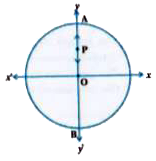
Two particle are oscillating along two close parallel straight lines side by side, with the same frequency and amplitude. They pass each other, moving on opposite directions when their displacement is half of the amplitude. The mean positions of the two particles lie on a straight line perpendicular to the paths of the two particles. The phase difference is.........

A

`30^(@)`

B

`60^(@)`

C

`90^(@)`

D

`120^(@)`

Text Solution

Verified by Experts

The correct Answer is:
D

Equation of motion of simple harmonic oscillator in Y-axis
`y= a sin (omega t+phi)`
`y= a sin theta`
where, `omega t+phi = theta` (phase)
According to question,
`therefore (a)/(2) = a sin theta`
`therefore sin theta = (1)/(2)`
`theta = (pi)/(6)" or "(5pi)/(6)`
At `theta_(1)= (pi)/(6)`, particle is at P and move toward A.
At `theta_(2) = (5pi)/(6)`, particle is at P and move toward O.
Hence, phase difference between both particle at `P= theta_(2)- theta_(1)`
`=(5pi)/(2)-(pi)/(6)`
`=(4pi)/(6)`
`= (2pi)/(3)= (2xx 180^(@))/(3)`
`=120^(@)`.
Promotional Banner

Topper's Solved these Questions

  • OSCILLATIONS

    KUMAR PRAKASHAN|Exercise QUESTION PAPER (SECTION - A)|6 Videos
  • OSCILLATIONS

    KUMAR PRAKASHAN|Exercise QUESTION PAPER (SECTION - B)|2 Videos
  • OSCILLATIONS

    KUMAR PRAKASHAN|Exercise SECTION-E (MCQs ASKED IN GUJARAT BOARD AND COMPETITIVE EXAMS)|66 Videos
  • OBJECTIVE QUESTIONS AS PER NEW PAPER STYLE

    KUMAR PRAKASHAN|Exercise CHAPTER - 8 (Match Type questions)|5 Videos
  • PHYSICAL WORLD

    KUMAR PRAKASHAN|Exercise SECTION-E (QUESTIONS FROM MODULE)|9 Videos

Similar Questions

Explore conceptually related problems

Two particles execute SHM of same amplitude and frequency on parallel lines. They pass one another when moving in opposite directions each time their displacement is one third their amplitude. What is the phase difference between them?

Two particles executing SHM of same frequency meet at x=+(sqrt(3)A)/(2) , while moving in opposite directions. Phase difference between the particles is :-

In the wave propagation phenomenon, phase difference of oscillation of two particles having distance à from each other is ......

Two particle P and Q describe S.H.M. of same amplitude a same frequency f along the same straight line .The maximum distance between the two particles is asqrt(2) The phase difference between the two particle is

A particle of mass m performs SHM along a straight line with frequency f and amplitude A:-

Two particles A to B perform SHM along the same stright line with the same amplitude 'a' same frequency 'f' and same equilbrium position 'O' . The greatest distance between them is found to be 3a//2 . At some instant of time they have the same displacement from mean position. what is the displacement?

Two particles each of mass m are connected by a light inextensible string and a particle of mass M is attached to the midpoint of the string. The system is at rest on a smooth horizontal table with string just taut and in a straight line. The particle M is given a velocity v along the table perpendicular to the string. Prove that when the two particles are about to collide : (i) The velocity of M is (Mv)/((M + 2m)) (ii) The speed of each of the other particles is ((sqrt2M (M + m))/((M + 2m)))v .

Two forces, while acting on particle in opposite directions,have the resultant of 10N. If they act at right angles to each other, the resultant is found to be 50N. Find the two forces?

Two engines pass each other moving in opposite directions with uniform speed of of them is blowing a whistle of frequency 540 Hz. Calculate the frequency heard by driver of second engine before they pass each other. Speed of sound is 300 m/sec :

In a region, steady and uniform electric and magnetic fields are present. These two fields are parallel to each other. A charged particle is released from rest in the region. The path of the particle will be a.......

KUMAR PRAKASHAN-OSCILLATIONS-SECTION-F (QUESTIONS FROM MODULE SIMPLE QUESTIONS)
  1. A particle executes simple harmonic motion with an amplitude A. The pe...

    Text Solution

    |

  2. A spring of force constant k is cut into two parts such that length of...

    Text Solution

    |

  3. What is the phase difference the velocity and acceleration of a partic...

    Text Solution

    |

  4. Two particle are oscillating along two close parallel straight lines s...

    Text Solution

    |

  5. A horizontal platform with an object placed on it is executing SHM in ...

    Text Solution

    |

  6. The length of a simple pendulum executing simple harmonic motion is in...

    Text Solution

    |

  7. Two spring of force constants k and 2k are connected to a mass as show...

    Text Solution

    |

  8. Two simple harmonic motions of angular frequency 100 and 1000 rad s^(-...

    Text Solution

    |

  9. A simple pendulum perform simple harmonic motion about x=0 with an amp...

    Text Solution

    |

  10. The time period of mass suspended from a spring is T. If the spring is...

    Text Solution

    |

  11. The potential energy of a simple harmonic oscillator when the particle...

    Text Solution

    |

  12. A particle executes simple harmonic motion with frequency f. The frequ...

    Text Solution

    |

  13. A particle executing simple harmonic motion of amplitude 5 cm has maxi...

    Text Solution

    |

  14. If maximum velocity of a particle executes simple harmonic motion vm t...

    Text Solution

    |

  15. Two pendulums of lengths 100 cm and 121 cm suspended side by side. A s...

    Text Solution

    |

  16. A particle performs simple harmonic motion with speed v and accelerati...

    Text Solution

    |

  17. Find the maximum velocity of a SHM particle having amplitude 'A' and p...

    Text Solution

    |

  18. The amplitude of a damped oscillator becomes half in one minute. The a...

    Text Solution

    |

  19. The period of oscillation of a mass m suspended from a spring of negli...

    Text Solution

    |

  20. The displacement of a SHM particle is y= 3 sin omega t+4 cos omega t t...

    Text Solution

    |

