Home
Class 11
PHYSICS
In the coefficient of friction between ...

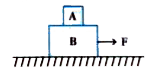
In the coefficient of friction between the floor and the body B is 0.1. The coefficient of friction between the bodies B and A is 0.2. A force F is applied as shown on B. The mass of m A is `1/2`and of B is m. Which of the following statements are true ?

A

The bodies will move together if F = 0.25 mg

B

The body A will slip with respect to B if F = 0.5 mg

C

The bodies will move together if F = 0.5 mg

D

The bodies will be at rest if F = 0.1 mg

Text Solution

Verified by Experts

The correct Answer is:
A, B, D

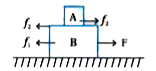
Consider diagram shown in figure
Let frictional force on B be `F_(1)` and friction
Force on A be `F_(2)`
F= external force

Common acceleration of system be a
`a= (F-f_(1))/(M_(a) +m_(3)) = (F-F_(1))/((m)/(2)+m) = 2(F-f_(1))/(3m)`
Pseudo force on A
The force ( f) will be maximum when pseudo force on A= frictional force on A
`=0.2 ((m)/(2))g`
`F_(max) - F_(1) = 3 xx 0.1 mg = 0 .3 mg`
`=0.3 mg + (0-1) ((3)/(2)) mg`
Hence maximum force upto which bodies will move together is `F_(max) = 0.45 mg`
( a) Hence for F= 0.15 `lt F_(max)` hodies will moves together
(b ) For F = 0 .5 mg `gt F_(max)` body A will slip with respect to B
( d ) Given force F=- 0.1 mg `lt F`
System (both block ) will be at rest
(e ) Maximum force required tomove both block
`F_(max) = 0.45 mg`
Promotional Banner

Topper's Solved these Questions

  • LAW OF MOTION

    KUMAR PRAKASHAN|Exercise SECTION -E(MULTIPLE CHOICE QUESTIONS) (MCQS)|69 Videos
  • LAW OF MOTION

    KUMAR PRAKASHAN|Exercise SECTION-F (QUESTIONS FROM MODULE)|22 Videos
  • LAW OF MOTION

    KUMAR PRAKASHAN|Exercise SECTION-C(OBJECTIVE QUESTIONS) (VSQS)|55 Videos
  • GRAVITATION

    KUMAR PRAKASHAN|Exercise QUESTIONS PAPER Section - D|1 Videos
  • MACHANICAL PROPERTIES OF SOLIDS

    KUMAR PRAKASHAN|Exercise QUESTION PAPER|11 Videos

Similar Questions

Explore conceptually related problems

Coefficient of friction between 5 kg and 10 kg block is 0.5 . If friction between them is 20 N . What is the value of force being applied on 5 kg ? The floor is frictionless

In the arrangement shown in figure coefficient of friction between 5kg block and incline plane is mu=0.5 . Friction force acting on the 5kg block is

A block of mass m1 = 1 kg another mass m2 = 2 kg, are placed together (see figure) on an inclined plane with angle of inclination theta . Various values of theta are given in List I. The coefficient of friction between the block m_(1) and the plane is always zero. The coefficient of static and dynamic friction between the block m_(2) and the plane are equal to mu = 0.3 . In List II expressions for the friction on block m_(2) are given. Match the correct expression of the friction in List II with the angles given in List I, and choose the correct option. The acceleration due to gravity is denoted by g [Useful information : tan (5.5^(@)) ~~ 0.1, tan (11.5^(@)) ~~ 0.2 , tan (16.5^(@))~~ 0.3 ].

Two bodies A and B of masses 5 kg and 10 kg in contact with each other rest on a table against a rigid wall as shown in figure. The coefficient of friction between the bodies and the table is 0.15. A force of 200 N is applied horizontally to A. What are (a) the reaction of the partition, (b) The action-reaction forces between A and B ? What happens when the wall is removed ? Does the answer to (b) change, when the bodies are in motion ? Ignore the difference between p_(s) and p_(k) .

Two bodies A and B of mass 5 kg and 10 kg contact with each other rest on a table against a rigid The coefficient of friction between the bodies and the table is 0.05 A force of 200 N is applied horizontal on A What are (a) the reaction of thee wall (b) the the action , reaction forces between A & B ? What happens when the wall is removed ? Does the answer to (b) Change , when the bodies are in motion ? Ignore differnce between mu_(s) and mu_(k) .

In the figure masses m_(1),m_(2) and M are kg. 5 kg and 50 kg respectively. The co-efficient of friction between M and ground is zero. The co-efficient of friction between m_(1) and M and that between m_(2) and ground is 0.3. The pulleys and the string are massless. The string is perfectly horizontal between P_(1) and m_(1) and also between P_(2) and m_(2). The string is perfectly verticle between P_(1) and P_(2). An externam horizontal force F is applied to the mass M. Take g=10m//s^(2). (i) Drew a free-body diagram for mass M, clearly showing all the forces. (ii) Let the magnitude of the force of friction between m_(1) and M be f_(1) and that between m,_(2) and ground be f_(2). For a particular F it is found that f_(1)=2f_(2). Find f_(1) and f_(2). Write down equations of motion of all the masses. Find F, tension in the string and accelerations of the masses.

A motorcycle is travelling on a curved track of radius 500 m. If the coefficient of friction between road and tyres is 0.5, the speed avoiding skidding will be

Mass moves on a slope making an angle 9 with the horizontal and is attached to mass m_(2) by a string passing over a frictionless pulley . The coefficient of friction between nq and the sloping surface is mu . Which of the following statements are true ?

A horizontal force of 10N is necessary to just hold a block stationary against as well. The coefficient of friction between the block and the wall is 0.2. The weight of the block is

A man of mass 80kg pushes box of mass 20kg horizontaly. The man moves the box with a constant acceleration of 2 m//s^(2) but his foot does not slip on the ground. There is no friction between the box and the ground. There is no friction between the box and the ground. whereas there is sufficient friction between the man's foot and the ground to prevent him from slipping. Assertion:- The force applied by the man on the box is equal and opposite to the force applied by the force applid by the box on the man. Reason:- Friction force applied by the ground on the man is 200N.

KUMAR PRAKASHAN-LAW OF MOTION-SECTION-D(NCERT EXEMPLAR SOLUTIONS)
  1. A car of mass m starts from rest and acquires a velocity along east, v...

    Text Solution

    |

  2. The motion of a particle of mass m is given by x = 0 for t lt 0 s, x(t...

    Text Solution

    |

  3. In the coefficient of friction between the floor and the body B is 0....

    Text Solution

    |

  4. Mass moves on a slope making an angle 9 with the horizontal and is att...

    Text Solution

    |

  5. In a body A of mass tn slides on plane inclined at angle theta(1), to...

    Text Solution

    |

  6. Two billiard balls A and B, each of mass 50g and moving in opposite di...

    Text Solution

    |

  7. A body of mass 10 kg is acted upon by two perpendicular forces, 6N and...

    Text Solution

    |

  8. A girl riding a bicycle along a straight road with a speed of 5 ms^(-1...

    Text Solution

    |

  9. A person of mass 50 kg stands on a weighing scale on a lift. If the li...

    Text Solution

    |

  10. The position-time graph of a body of mass 2 kg is as given in figure. ...

    Text Solution

    |

  11. A person driving a car suddenly applies the brakes on seeing a child o...

    Text Solution

    |

  12. The velocity of a body of mass 2 kg as a function of t is given by v(t...

    Text Solution

    |

  13. A block placed on a rough horizontal surface is pulled by a horizontal...

    Text Solution

    |

  14. Why are porcelain objects wrapped in paper or straw before packing for...

    Text Solution

    |

  15. Why does a child feel more pain when she falls down on a hard cement f...

    Text Solution

    |

  16. A women throws an object of mass 500 g with a speed of 25 ms- 1 . (a...

    Text Solution

    |

  17. Why are mountain roads generally made winding upwards rather than goin...

    Text Solution

    |

  18. A mass of 2 kg suspended with thread AB (figure). Thread CD of the sam...

    Text Solution

    |

  19. In the above given problem if the lower thread is pulled with a jerk, ...

    Text Solution

    |

  20. Two masses of 5 kg and 3 kg are suspended with help of massless inexte...

    Text Solution

    |

