Home
Class 11
PHYSICS
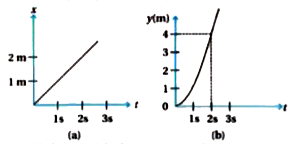
(x, t), (y, t) diagram of a particle mov...

(x, t), (y, t) diagram of a particle moving in 2-dimensions
If the particle has a mass of 500 g, find the force (direction and magnitude) acting on the particle.

Text Solution

Verified by Experts

From figure ( a)
Velocity `v= (Delta x )/( Delta t) = (2-0)/( 2-0) = 1 m//s`
`Delta v = 0 , a_(x ) = 0`
From figure ( b)
Matchematical relation y =`t^(2)`
`a= (dv )/( dy ) = 200 = 2`
`f_(x ) = ma_(x ) `
Resultant force
`F=sqrt(F_(x)^(2) + F_(y)^(2))`
`=1N`
Promotional Banner

Topper's Solved these Questions

  • LAW OF MOTION

    KUMAR PRAKASHAN|Exercise SECTION -E(MULTIPLE CHOICE QUESTIONS) (MCQS)|69 Videos
  • LAW OF MOTION

    KUMAR PRAKASHAN|Exercise SECTION-F (QUESTIONS FROM MODULE)|22 Videos
  • LAW OF MOTION

    KUMAR PRAKASHAN|Exercise SECTION-C(OBJECTIVE QUESTIONS) (VSQS)|55 Videos
  • GRAVITATION

    KUMAR PRAKASHAN|Exercise QUESTIONS PAPER Section - D|1 Videos
  • MACHANICAL PROPERTIES OF SOLIDS

    KUMAR PRAKASHAN|Exercise QUESTION PAPER|11 Videos

Similar Questions

Explore conceptually related problems

Obtainwork energy theorem of a particle moving in one dimension under the variable force .

The motion of a particle of mass m is described by y = ut + 1/2 "gt"^2 . Find the force acting on the particle.

(v_(x) ,t) , and (v_(y) t) diagram for a body of unit mass. Find the force as a function of time.

A particle moves in a circle of radius 1.0cm with a speed given by v=2t , where v is in cm//s and t in seconds. (a) Find the radial acceleration of the particle at t=1s . (b) Find the tangential acceleration of the particle at t=1s . (c) Find the magnitude of net acceleration of the particle at t=1s .

The coordinates of a particle moving in XY-plane very with time as x=4t^(2),y=2t . The locus of the particle is

Linear momentum of a particle given by relation p = a + b t^(2) , where a, b are constant and t is time, then force acting on particle is ………..

Path traced by a moving particle in space is called trajectory of the particle. Shape of trajectiry is decided by the forces acting on the particle. When a coordinate system is associated with a particle motion, the curve equation in which the particle moves [y=f(x)] is called equation of trajectory. It is just giving us the relation among x and y coordinates of the particle i.e. the locus of particle. To find equation of trajectory of a particle, find first x and y coordinates of the particle as a function of time eliminate the time factor. The position vector of car w.r.t. its starting point is given as vec(r)=at hat(i)- bt^(2) hat(j) where a and b are positive constants. The locus of a particle is:-

Path traced by a moving particle in space is called trajectory of the particle. Shape of trajectiry is decided by the forces acting on the particle. When a coordinate system is associated with a particle motion, the curve equation in which the particle moves [y=f(x)] is called equation of trajectory. It is just giving us the relation among x and y coordinates of the particle i.e. the locus of particle. To find equation of trajectory of a particle, find first x and y coordinates of the particle as a function of time eliminate the time factor. In above the velocity (i.e. (dvec(r))/(dt)) at t=0 is :-

The linear momentum of a particle at time t is given by the equation P = x + yt^(2) , where x and y are constants. The instantaneous force acting on the particle during its motion is .....

Path traced by a moving particle in space is called trajectory of the particle. Shape of trajectiry is decided by the forces acting on the particle. When a coordinate system is associated with a particle motion, the curve equation in which the particle moves [y=f(x)] is called equation of trajectory. It is just giving us the relation among x and y coordinates of the particle i.e. the locus of particle. To find equation of trajectory of a particle, find first x and y coordinates of the particle as a function of time eliminate the time factor. In above question initial acceleration (i.e. (d^(2)vec(r))/(dt^(2))) of particle is :-

KUMAR PRAKASHAN-LAW OF MOTION-SECTION-D(NCERT EXEMPLAR SOLUTIONS)
  1. Why does a child feel more pain when she falls down on a hard cement f...

    Text Solution

    |

  2. A women throws an object of mass 500 g with a speed of 25 ms- 1 . (a...

    Text Solution

    |

  3. Why are mountain roads generally made winding upwards rather than goin...

    Text Solution

    |

  4. A mass of 2 kg suspended with thread AB (figure). Thread CD of the sam...

    Text Solution

    |

  5. In the above given problem if the lower thread is pulled with a jerk, ...

    Text Solution

    |

  6. Two masses of 5 kg and 3 kg are suspended with help of massless inexte...

    Text Solution

    |

  7. Block A of weight 100 N rests on a frictionless inclined plane of slop...

    Text Solution

    |

  8. A block of mass M is held against a rough vertical well by pressing it...

    Text Solution

    |

  9. A 100 kg gun fires a ball of 1 kg horizontally from a cliff of height ...

    Text Solution

    |

  10. (x, t), (y, t) diagram of a particle moving in 2-dimensions If the...

    Text Solution

    |

  11. A person in an elevator accelerating upwards with an acceleration of 2...

    Text Solution

    |

  12. There are three forces F(1) F(2) and F(3) acting on a body, all acting...

    Text Solution

    |

  13. When a body slides down from rest along a smooth inclined plane making...

    Text Solution

    |

  14. (v(x) ,t), and (v(y) t) diagram for a body of unit mass. Find the forc...

    Text Solution

    |

  15. A racing car travels on a track (without banking) ABCDEFA. ABC is a ci...

    Text Solution

    |

  16. The displacement vector of a particle of mass m is given by r(t) = hat...

    Text Solution

    |

  17. A cricket bowler releases the ball in two different ways (a) giving it...

    Text Solution

    |

  18. There are four forces acting at a point P produced by strings as shown...

    Text Solution

    |

  19. A rectangular box lies on a rough inclined surface. The coefficient of...

    Text Solution

    |

  20. A helicopter of m ass 1000 kg rises with a vertical a c c ele ra tio n...

    Text Solution

    |

