Home
Class 11
PHYSICS
F rarr t graph for a body is shown in f...

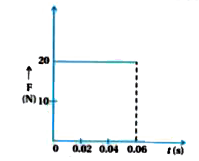
F `rarr` t graph for a body is shown in figure. The change in value of momentum of the body in the interval 0.02 s to 0.06 s is ..

A

1.2 kg `ms^(-1)`

B

0.3 kg `ms^(-1)`

C

0.8 kg `ms^(-1)`

D

0.4 kg `ms^(-1)`

Text Solution

Verified by Experts

The correct Answer is:

C

Change in value of momentum `Delta p = F Delta t`
f= 20 N and `Delta t = 0.06 -0.02 =0.04 s`
`:. , Delta p = 20 xx 0.04 = 0 .8 kg ms^(-1)`
Promotional Banner

Topper's Solved these Questions

  • LAW OF MOTION

    KUMAR PRAKASHAN|Exercise SECTION-F (QUESTIONS FROM MODULE)|22 Videos
  • LAW OF MOTION

    KUMAR PRAKASHAN|Exercise (QUESTION PAPER) SECTION-A|5 Videos
  • LAW OF MOTION

    KUMAR PRAKASHAN|Exercise SECTION-D(NCERT EXEMPLAR SOLUTIONS)|42 Videos
  • GRAVITATION

    KUMAR PRAKASHAN|Exercise QUESTIONS PAPER Section - D|1 Videos
  • MACHANICAL PROPERTIES OF SOLIDS

    KUMAR PRAKASHAN|Exercise QUESTION PAPER|11 Videos

Similar Questions

Explore conceptually related problems

F rarr t graph for a body is shown in the . What is the change in the value of momentum in the intital tie interval of 0.03 sec .

A force-time graph for the motion of a body is shown in fig. change in linear momentum between 0 and 8 s is:-

Velocity versus time graph of a body is shown in figure. It explains that

The force ‘F’ acting on a particle o f mass ‘m ’ is indicated by the force-time graph shown below. The change in momentum of the particle over the time interval from zero to 8 s is

Two bodies A and B of masses 5 kg and 10 kg in contact with each other rest on a table against a rigid wall as shown in figure. The coefficient of friction between the bodies and the table is 0.15. A force of 200 N is applied horizontally to A. What are (a) the reaction of the partition, (b) The action-reaction forces between A and B ? What happens when the wall is removed ? Does the answer to (b) change, when the bodies are in motion ? Ignore the difference between p_(s) and p_(k) .

The position-time graph of a body of mass 2 kg is as given in figure. What is the impulse on the body at t = 0 s and t = 4s.

For body of 50 kg. mass, the velocity time graph is shown in figure. Then force acting on the body is :-

Position time graph of a particle of mass 2 kg is shown in figrure. Total work done on the particle from t=0 to t=4s is

The dependence of the acceleration of a body with time is shown in Figure. At t=0 , the velocity of the body is -3m//s and position is x=0 m .

The acceleration time graph of a body moving in a straight is shown in figure. Assertion :- Velocity of the body is continously increasing over the time interval shown. Reason :- Acceleration is positive for all shown value of t .

KUMAR PRAKASHAN-LAW OF MOTION-SECTION -E(MULTIPLE CHOICE QUESTIONS) (MCQS)
  1. The linear momentum of a particle at time t is given by the equation P...

    Text Solution

    |

  2. If linear momentum of a body is increased by 0.5% its kinetic energy i...

    Text Solution

    |

  3. F rarr t graph for a body is shown in figure. The change in value of ...

    Text Solution

    |

  4. When a force acts on a body of mass 200 gram the change in its velocit...

    Text Solution

    |

  5. A car of mass 1000 kg is moving with a velocity 20m /s on a horizontal...

    Text Solution

    |

  6. The value of co-efficient of static friction (mu(s)) is in the range b...

    Text Solution

    |

  7. A force acts on an object of mass 2 kg at rest, for 0.5 s. After the f...

    Text Solution

    |

  8. A person of mass 60 kg is standing on a raft of mass 40 kg in a lake. ...

    Text Solution

    |

  9. A block of 50 kg on a smooth plane inclined at 60^(@) and another bloc...

    Text Solution

    |

  10. If the speed of a vehicle become 3 times for a given deceleration its ...

    Text Solution

    |

  11. If vectors are vecA = 2 hati + 3 hatJ - hatk and hatB = 4 hati + 6 hat...

    Text Solution

    |

  12. vecA = 2 hati +3 hatJ +4 hatk and vecB =4 hati +5 hatj +3 hatk , then ...

    Text Solution

    |

  13. Find the vector product of vectors vecA = 4hati + 2 hatJ - hatk ,vecB ...

    Text Solution

    |

  14. A body of mass 20 kg at one end and another of 60 kg at the other end ...

    Text Solution

    |

  15. If vector vecA =4 hati -6 hatJ +2hatk and vecB =6hati +8 hatj +mhatk a...

    Text Solution

    |

  16. Ramesh with mass of 65 kg stands on a spring balance in a lift. If the...

    Text Solution

    |

  17. The potential energy of a projectile at its highest point is3/4 of the...

    Text Solution

    |

  18. A block of mass 20 kg is lying on an inclined plane of angle 30^(@). I...

    Text Solution

    |

  19. M = 5 kg. The co-efficient of static friction between the block and th...

    Text Solution

    |

  20. A body of mass 10 kg at rest is applied with perpendicular force of 4 ...

    Text Solution

    |
