Home
Class 11
PHYSICS
A body of mass 20 kg at one end and anot...

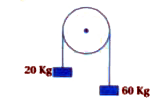
A body of mass 20 kg at one end and another of 60 kg at the other end of a string passing over a frictionless pully are suspended as shown in the figure. Acceleration of this system is `m/s^(2)`.

A

4.44

B

2.5

C

3

D

5

Text Solution

Verified by Experts

The correct Answer is:

D

`a= g(m_(1)-m_(2))/(m_(1)+m_(2))`
`=(10(60-20))/(60+20)`
`=(10xx 40)/(80)= 5 m//s^(2)`
Promotional Banner

Topper's Solved these Questions

  • LAW OF MOTION

    KUMAR PRAKASHAN|Exercise SECTION-F (QUESTIONS FROM MODULE)|22 Videos
  • LAW OF MOTION

    KUMAR PRAKASHAN|Exercise (QUESTION PAPER) SECTION-A|5 Videos
  • LAW OF MOTION

    KUMAR PRAKASHAN|Exercise SECTION-D(NCERT EXEMPLAR SOLUTIONS)|42 Videos
  • GRAVITATION

    KUMAR PRAKASHAN|Exercise QUESTIONS PAPER Section - D|1 Videos
  • MACHANICAL PROPERTIES OF SOLIDS

    KUMAR PRAKASHAN|Exercise QUESTION PAPER|11 Videos

Similar Questions

Explore conceptually related problems

A block of 50 kg on a smooth plane inclined at 60^(@) and another block of 30 kg on a smooth plane inclined at 30^(@) with horizontal are connected by a light string passing over a frictionless pully as shown in the figure. Take g = 10 ms^(-2) , sqrt(3) =1.7 . The acceleration of the blocks and tension in the string are.

Two masses m_(1) = 5 kg and m_(2) = 10 kg, connected by an inextensible string over a frictionless pulley are moving as shown in the figure. The coefficient of friction of horiztonal surface is 0.15. The minimum height m that should be put on top of m_(2) to stop the motion is

Two blocks of masses M_(1)=4 kg and M_(2)=6kg are connected by a string of negligible mass passing over a frictionless pulley as shown in the figure below. The coefficient of friction between the block M_(1) and the horizontal surface is 0.4. when the system is released, the masses M_(1) and M_(2) start accelrating. What additional mass m should be placed over M_(1) so that the masses (M_(1)+m) slide with a uniform speed?

Two bodies of mass 4kg and 6kg are attached to the ends of a string passing over a pulley. The 4kg mass is attached to the table top by another string. The tension in this string T_(1) is equal to: Take

Two particles of masses m and M(Mgtm) are connected by a cord that passes over a massless, frictionless pulley. The tension T in the string and the acceleration a of the particles is

Two moasses m_(1)=5kg and m_(2)=10kg, connected by an inextensible string over a frictionless pulley, are moving as shown in the figure. The coefficient of friction of horizontal surface is 0.15. The minimum weitght m that should be put on top of m_(2) to stop the motion is :-

Tow men of masses m_(1)and m_(2) hold on the opposite ends of a rope passing over a frictionless pulley. The men m_(1) climbs up the pore with an acceleration of 1.2m//s^(2) relative to the rope. The mann m_(2) climbs up the rope with an acceleration of 2m//s^(2) relative to the rope. Find the tension in the rope if m_(1)40 kg and m_(2)=60kg. Also find the time after the time after which they will be at same horizontal level if they start from rest and are initially separted by 5 m.

Two masses 8 kg and 12 kg are connected at the two ends of a light inextensible string that goes over a frictionless pulley. Find the acceleration of the masses, and the tension in the string when the masses are released.

Two masses 8 kg and 12 kg are connected at the two ends of a light inextensible string that goes over a frictionless pulley. Find the acceleration of the masses and the tension in the string when the masses are released.

Two masses m_(1) = 4.8 kg and m_(2) = 5 kg tied to a string are hanging over a light frictionless pully. What is the acceleration of masses when they are free to move ?

KUMAR PRAKASHAN-LAW OF MOTION-SECTION -E(MULTIPLE CHOICE QUESTIONS) (MCQS)
  1. vecA = 2 hati +3 hatJ +4 hatk and vecB =4 hati +5 hatj +3 hatk , then ...

    Text Solution

    |

  2. Find the vector product of vectors vecA = 4hati + 2 hatJ - hatk ,vecB ...

    Text Solution

    |

  3. A body of mass 20 kg at one end and another of 60 kg at the other end ...

    Text Solution

    |

  4. If vector vecA =4 hati -6 hatJ +2hatk and vecB =6hati +8 hatj +mhatk a...

    Text Solution

    |

  5. Ramesh with mass of 65 kg stands on a spring balance in a lift. If the...

    Text Solution

    |

  6. The potential energy of a projectile at its highest point is3/4 of the...

    Text Solution

    |

  7. A block of mass 20 kg is lying on an inclined plane of angle 30^(@). I...

    Text Solution

    |

  8. M = 5 kg. The co-efficient of static friction between the block and th...

    Text Solution

    |

  9. A body of mass 10 kg at rest is applied with perpendicular force of 4 ...

    Text Solution

    |

  10. The angle between vecF =(1,-3, 1)and vecd =(2,-3,-11) will b e ...... ...

    Text Solution

    |

  11. A disc is rotatin g aro u n d its cen tre in a horizontal plane at the...

    Text Solution

    |

  12. A bomb in the steady state explodes into three fragments. Two fragm en...

    Text Solution

    |

  13. Block of mass m is placed on frictionless slope with angle 0. Normal f...

    Text Solution

    |

  14. The upper half of an in clin ed plane of inclination 30^(@) is perfect...

    Text Solution

    |

  15. When a force acts on a body of mass 0.1 kg, the change in its velocity...

    Text Solution

    |

  16. A force of 8 N acts on an object of mass 2 kg in X-direction and anoth...

    Text Solution

    |

  17. Three blocks with masses m, 2m and 3m are connected by strings as show...

    Text Solution

    |

  18. A rod PQ of mass M and length L is hinged at end P. The rod is kept ho...

    Text Solution

    |

  19. An explosion breaks a rock into three parts in a horizontal plane. Two...

    Text Solution

    |

  20. The u p p er half of an in clin ed p lane of inclination theta is perf...

    Text Solution

    |
