Home
Class 12
PHYSICS
Determine the current in each branch of ...

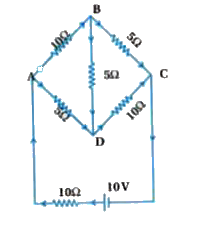
Determine the current in each branch of the given network.

Text Solution

Verified by Experts
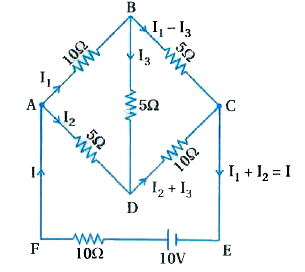

In above circuit, we have to find currents in different branches.
Applying KVL in the closed path ABDA,
`- 10I_(1) - 5I_(3) + 5I_(2) = 0 `
`therefore 10 I_(1) = 5I_(2) - 5I_(3)`
`therefore 2I_(1) = I_(2) - I_(3) " "` ... (1)
Applying KVL in the closed path BCDB,
` - 5 (I_(1) - I_(3)) + 10 (I_(2) + I_(3)) + 5I_(3) = 0 `
`therefore 5I_(1) = 20I_(3) + 10I_(2)`
`therefore I_(1) = 2I_(2) + 4I_(3)`
`therefore 2I_(1) = 4I_(2) + 8I_(3) " " `.... (2)
From equation (1) and (2),
`I_(1) - I_(3) = 4I_(2) + 8I_(3)`
`therefore 3I_(2) = - 9I_(3)`
`therefore I_(2) = - 3I_(3) " " `... (3)
From equation (1) and (3),
`2I_(1) = - 3I_(3) = - 4I_(3) `
`therefore I_(1) = - 2I_(3) " " ` .... (4)
Applying KVL in the closed path ADCEFA , we get,
`- 5I_(2) - 10 (I_(2) + I_(3)) - 10t = - 10`
`therefore 15 I_(2) + 10I_(3) + 10I = 10`
`therefore 15 I_(2) + 10 I_(3) + 10 (I_(1) + I_(2)) = 10 `
`therefore 10I_(1) + 25 I_(2) + 10 I_(3) = 10`
`therefore 10 (-2I_(3)) + 25 (- 3I_(3)) + 10I_(3) = 10`
`therefore - 85I_(3) = 10 `
`therefore I_(3) = - (10)/(85) = - (2)/(17) A " "` ... (5)
From equation (4) and (5).
From equation (4) and (5) ,
`I_(1) = - 2 (- (2)/(17)) = (4)/(17) A ` ... (6)
From equation (3) and (5)
`I_(2) = - 3 (- (2)/(17)) = (6)/(17) A " " `.... (7)
now ,
`I = I_(1) + I_(2) = (4)/(17) + (6)/(17) = (10)/(17) A " " `....(8)
From equation (5) ,
`| I_(3) | = (2)/(17)` A
(Direction of `I_(3)` will be opposite to the direction shown in the figure ).
Final answer :
(i) Current in branch AB is,
`I_(1) = (4)/(17) `A
(ii) Current in branch BC is,
`I_(1) - I_(3) = (4)/(17) - ( - (2)/(17)) = (6)/(17) A `
(iii) Current in branch CD is,
`I_(2) + I_(3) = (6)/(17) + (- (2)/(17)) = (4)/(17)` A
(iv) Current in branch DA is,
`I_(2) = (6)/(17) `A
(v) Current in branch BD is,
`| I_(3)| = (2)/(17) A ` (Direction will be from D to B)
(vi) Current in branch FE is,
I = `(10)/(17) A `
Promotional Banner

Topper's Solved these Questions

  • CURRENT ELECTRICITY

    KUMAR PRAKASHAN|Exercise SECTION [B] (NUMERICAL FROM .DARPAN. BASED ON TEXTBOOK)|13 Videos
  • CURRENT ELECTRICITY

    KUMAR PRAKASHAN|Exercise SECTION [B] (NUMERICAL)|10 Videos
  • CURRENT ELECTRICITY

    KUMAR PRAKASHAN|Exercise SECTION [B] NUMERICALS (NUMERICAL FROM TEXTUAL ILLUSTRATIONS)|14 Videos
  • BOARD'S QUESTION PAPER MARCH-2020

    KUMAR PRAKASHAN|Exercise PART-B SECTION -C|4 Videos
  • DUAL NATURE OF RADIATION AND MATTER

    KUMAR PRAKASHAN|Exercise Section-D (MCQs asked in GUJCET/Board Exam)|1 Videos

Similar Questions

Explore conceptually related problems

Determine the current in each brance of the network showin in

Calculate the current drawn from the battery in the given network

A bettery of 10 V and negligible internal resistance is connected across the diagonally opposite corners of a cubical network consisting of 12 resistors each of resistance 1Omega Determine the equivalent resistance of the network and the current along each edge of the cube.

A network of four 10 µF capacitors is connected to a 500 V supply, as shown in Fig. 2.29. Determine (a) the equivalent capacitance of the network and (b) the charge on each capacitor. (Note, the charge on a capacitor is the charge on the plate with higher potential, equal and opposite to the charge on the plate with lower potential.)

Keeping the source frequency equal to the resonating frequency of the series LCR circuit, if the three elements, L, C and R are arranged in parallel, show that the total current in the parallel LCR circuit is minimum at this frequency. Obtain the current rms value in each branch of the circuit for the elements and source specified in Exercise for this frequency.

Determine whether or not each of the definition of ** given below gives a binary operation. In the even that ** is not a binary operation , give justification for this . On Z^(+) , define ** by a" * " b = a - b

Determine whether or not each of the definition of ** given below gives a binary operation. In the even that ** is not a binary operation , give justification for this . On Z^(+) , define ** by a" * " b = ab

Determine whether or not each of the definition of ** given below gives a binary operation. In the even that ** is not a binary operation , give justification for this . On R , define ** by a" * " b = ab^2

KUMAR PRAKASHAN-CURRENT ELECTRICITY-SECTION [B] (NUMERICAL FROM TEXTUAL EXERCISE)
  1. A silver wire has a resistance of 2.1 Omega at 27.5^(@) C and a resist...

    Text Solution

    |

  2. An electric toaster uses nichrome for its heating element. When a negl...

    Text Solution

    |

  3. Determine the current in each branch of the given network.

    Text Solution

    |

  4. In a meter bridge as shown in figure, the balance point is found to be...

    Text Solution

    |

  5. What happens if the galvanometer and cell are interchanged at the bala...

    Text Solution

    |

  6. What happens if the galvanometer and cell are interchanged at the bala...

    Text Solution

    |

  7. A storage battery of emf 8.0 V and internal resistance 0.5 Omega is b...

    Text Solution

    |

  8. In a potentiometer arrangement, a cell of emf 1.25 V gives a balance p...

    Text Solution

    |

  9. The number density of free electrons in a copper conductor estimated ...

    Text Solution

    |

  10. The earth's surface has a negative surface charge density of 10^(-9)C ...

    Text Solution

    |

  11. (a) Six lead-acid type of secondary cells each of emf 2.0 V and intern...

    Text Solution

    |

  12. Two wires of equal length, one of aluminium and the other of copper ha...

    Text Solution

    |

  13. What conclusion can you draw from the follwing observation on a resist...

    Text Solution

    |

  14. A steady current flows in a metallic conductor of non-uniform cross-se...

    Text Solution

    |

  15. Is Ohm's law universally applicable for all conducting elements ? If n...

    Text Solution

    |

  16. A low voltage supply from which one needs high currents must have very...

    Text Solution

    |

  17. A high tension (HT) supply of, say, 6 kV must have a very large intern...

    Text Solution

    |

  18. Choose the correct alternative: (a) Alloys of metals usually have (g...

    Text Solution

    |

  19. Choose the correct alternative: (a) Alloys of metals usually have (g...

    Text Solution

    |

  20. Choose the correct alternative: (a) Alloys of metals usually have (g...

    Text Solution

    |

