Home
Class 12
PHYSICS
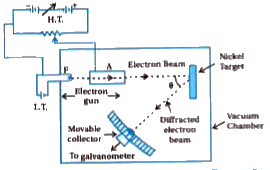
Consider arrangement shown In figure for...


Consider arrangement shown In figure for davisson-Germer experiment when voltage applied to A is increased in diffracted beam will have maximum number of electron for value diffraction angle `(theta)` such that…..

A

Will be larger than the earlier value.

B

Will be the same as the earlier value

C

Will be less than the earlier value

D

Will depend on the target

Text Solution

Verified by Experts

The correct Answer is:

C

In the present case ,Path diffrence between matter waves diffracted from the onsecutive atomic layers of targer element,separated by perpendiular distance d is equal to 2dsin`theta` (where `theta`=angle of diffraction).
Now ,as per the statement,for no.Of electrons getting diffracted at angle `theta` to become maximum,value of matter wavelength of moving electrons.`lambda` should be such that it can satisfy the condition of constructive interference.
Thus ,2din `theta lambda`
`therefore` 2din `theta=n((h)/(sqrt(2Vem)))`
`implies` As V increases, sin`theta` decreases and so `theta` will also decrease.
Second method:
In Dacisson-Germer experiment let voltage applied to andoe is V.De-Broglie wavelength assocaited wth electron,
`lambda=(12.27)/(sqrt(V))Å`.......(1)
For electron diffracted at angle `theta` condition for central maximum `lambda-2dsintheta`.......(2)
From equation (1) if V increase then `lambda` will decrease and from equation (2) in `lambda` decrease then `theta` will also decrease.
(For samll angle of diffraction sin`theta~~theta`).
Promotional Banner

Topper's Solved these Questions

  • DUAL NATURE OF RADIATION AND MATTER

    KUMAR PRAKASHAN|Exercise Section-C (multiple choice questions(more than one options)|5 Videos
  • DUAL NATURE OF RADIATION AND MATTER

    KUMAR PRAKASHAN|Exercise Section-C (Very short answer type questions)|11 Videos
  • DUAL NATURE OF RADIATION AND MATTER

    KUMAR PRAKASHAN|Exercise Section-B (QUESTIONS)|7 Videos
  • CURRENT ELECTRICITY

    KUMAR PRAKASHAN|Exercise SECTION [D] MULTIPLE CHOICE QUESTIONS (MCQs) (MCQs ASKED IN BOARD EXAM AND GUJCET)|23 Videos
  • ELECTRIC CHARGES AND FIELDS

    KUMAR PRAKASHAN|Exercise SECTION D MCQS ASKED IN COMPETITIVE EXAMES (MCQS AKSED IN BOARD EXAM AND GUJCET)|14 Videos

Similar Questions

Explore conceptually related problems

In Davisson-Germer experiment,for which value of accelerating voltage,intesity of electron beam was found to be maximum?

Consider the circuit arrangement shown in figure (1) for studying input and output characteristics of n-p-n transistor in CE configuration. Select the values of R_(B) and R_(C ) for a transistor whose V_(BE)=0.7V , so that the transistor is operating at point Q as shown in the characteristics shown in figure (2). Given that the input impedance of the transistor is very small and V_(C C)=V_(BB)=16V , also find the voltage gain and power gain of circuit making appropriate assumptions.

A ray of light enters a diamond (n=2) from air and is being internally reflected near the bottom as shown in the figure . Find the maximum value of angle theta possible.

A long solid cylindrical glass rod of refractive index 3/2 is immersed in a liquid of refractive index (3sqrt(3))/(4) . The ends of the rod are perpendicular to the central axis of the rod. A light enters one end of the rod at the central axis as shown in the figure . find the maximum value of angle theta for which total internal reflection occurs inside the rod?

Wave property of electron implies that they will show diffraction effected . Davisson and Germer demonstrated this by diffracting electron from crystals . The law governing the diffraction from a crystals is obtained by requiring that electron waves reflected from the planes of atoms in a crystal inter fere constructiely If a strong diffraction peak is observed when electrons are incident at an angle i from the normal to the crystal planes with distance d between them (see fig) de Brogle wavelength lambda_(dB) of electrons can be calculated by the relationship (n is an intenger)

In an interference arrangement similar to young's double slit experiment the slits S_(1) and S_(2) are illuminated with coherent microwave sources each of frequency 10^(6)Hz the sources are synchronized to have zero phase difference. the slits are separated by a distance d=150.0m. The intensity I(theta) is measured as a funtion of theta , where theta is defined as shown. if I_(0) is the maximum intensity then I(theta) for 0lethetale90^(@) is given by:

(a) Obtain the de Broglie wavelength of a neutron of kinetic energy 150 eV. As you have seen in Exercise 11.31, an electron beam of this energy is suitable for crystal diffraction experiments. Would a neutron beam of the same energy be equally suitable? Explain. (m_(n) = 1.675 xx 10^(-27) kg) (b) Obtain the de Broglie wavelength associated with thermal neutrons at room temperature (27^(@)C) . Hence explain why a fast neutron beam needs to be thermalised with the environment before it can be used for neutron diffraction experiments.

Light guidance in an optical fiber can be understood by considering a structure comprising of thin solid glass cylinder of refractive index n_(1) surrounded by a medium of lower refractive index n_(2) . The light guidance in the structure takes place due to successive total internal reflections at the interface of the media n_(1) and n_(2) as shown in the figure . all rays with the angle of incidence i less than a particular value of i_(m) are confined in the medium of refractive index n_(1) . The numerical aperture (NA) of the structure is defined as "sin"i_(m) If two structures of same cross - sectional area, but different numerical apertures NA_(1) and NA_(2)(NA_(2) lt NA_(1)) are joined longitudinally , the number aperture of the combined structure is

A slit of width a is illuminated by monochromatic light of wavelength 650 mm at normal incidence calculate the value of a when (a). The first minimum falls at an angle of diffraction of 30^(@) (b). The first maximum falls at an angle of diffraction of 30^(@) .

A circus wishes to develop a new clown act. Fig. (1) shows a diagram of the proposed setup. A clown will be shot out of a cannot with velocity v_(0) at a trajectory that makes an angle theta=45^(@) with the ground. At this angile, the clown will travell a maximum horizontal distance. The cannot will accelerate the clown by applying a constant force of 10, 000N over a very short time of 0.24s . The height above the ground at which the clown begins his trajectory is 10m . A large hoop is to be suspended from the celling by a massless cable at just the right place so that the clown will be able to dive through it when he reaches a maximum height above the ground. After passing through the hoop he will then continue on his trajectory until arriving at the safety net. Fig (2) shows a graph of the vertical component of the clown's velocity as a function of time between the cannon and the hoop. Since the velocity depends on the mass of the particular clown performing the act, the graph shows data for serveral different masses. If the angle the cannot makes with the horiaontal is increased from 45^(@) , the hoop will have to be
