Home
Class 12
PHYSICS
Consider an electron in front of metalli...

Consider an electron in front of metallic surface at a distance d(treated as an infinite plane surface).Assume the force of attraction by the plate is given as `(1)/(4)(q^(2))/(4piepsi_(0)d^(2))` .
Calculate work in taking the charge to an infinite distance from the plate.Taking d=0.1 nm,find the work done in electron volts.[Such a force law is not valid for d`lt` 0.1 nm].

Text Solution

Verified by Experts
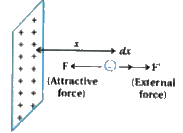

For the sake of simplicity,writing x in place d in the formula ,given in the statement,
`F=(1)/(4)((1)/(4piepsi_(0)))(q^(2))/(x^(2))`
Now ,as shown in the figure ,amount of work to be done by external force in order to displace electron by amount dx ,away from the surface is
dW=F.dx `cos0^(@)`
dW=F.dx
`therefore intdW=intF.dx`
`therefore W=underset(d)overset(oo)int(1)/(4)((1)/(4piepsi_(0)))(q^(2))/(x^(2))dx`
`=(1)/(4)((q^(2))/(4piepsi_(0))){-(1)/(x)}_(d)^(2)`
`=(1)/(4)((q^(2))/(4piepsi_(0))){-(1)/(oo)-(-(1)/(d))}`
`(1)/(4)((1)/(4piepsi_(0)))q^(2)xx(1)/(d)`
`=(1)/(4)xx9xx10^(9)xx(1.6xx10^(-19))^(2)xx(1)/(0.1xx10^(-9))`
`=5.76xx10^(-19)J`
`=(5.76xx10^(-19))/(1.6xx10^(-19))eV`
`therefore` W=3.6 eV
Promotional Banner

Topper's Solved these Questions

  • DUAL NATURE OF RADIATION AND MATTER

    KUMAR PRAKASHAN|Exercise Section-D (multiple choice questions (MCQs)|48 Videos
  • DUAL NATURE OF RADIATION AND MATTER

    KUMAR PRAKASHAN|Exercise Section-D (multiple choice questions (MCQs) (photo-electric effect)|1 Videos
  • DUAL NATURE OF RADIATION AND MATTER

    KUMAR PRAKASHAN|Exercise Section-C (Very short answer type questions)|11 Videos
  • CURRENT ELECTRICITY

    KUMAR PRAKASHAN|Exercise SECTION [D] MULTIPLE CHOICE QUESTIONS (MCQs) (MCQs ASKED IN BOARD EXAM AND GUJCET)|23 Videos
  • ELECTRIC CHARGES AND FIELDS

    KUMAR PRAKASHAN|Exercise SECTION D MCQS ASKED IN COMPETITIVE EXAMES (MCQS AKSED IN BOARD EXAM AND GUJCET)|14 Videos

Similar Questions

Explore conceptually related problems

Assuming that straight lines work as the plane mirror for a point, find the image of the point (1,2) in the line x - 3y + 4 =0 .

A classical model for the hydrogen atom consists of a singal electron of mass m_(e) in circular motion of radius r around the nucleous (proton). Since the electron is accelerated, the atom continuously radiates electromagnetic waves. The total power P radiated by the atom is given by P = P_(0)//r^(4) where P_(0) = (epsi^(6))/(96pi^(3)epsi_(0)^(3)c^(3)m_(epsi)^(2)) (c = velocity of light) (i) Find the total energy of the atom. (ii) Calculate an expression for the radius r(t) as a function of time. Assume that at t = 0 , the radiys is r_(0) = 10^(-10)m . (iii) Hence or otherwise find the time t_(0) when the atom collapses in a classical model of the hydrogen atom. Take: [2/(sqrt(3))(e^(2))/(4piepsi_(0))1/(m_(epsi)c^(2)) = r_(e) ~~ 3 xx 10^(-15) m]

The electric force between two electric charges is given by F= (1)/(4pi epsi_(0))(q_(1)q_(2))/(r^(2)) . where is a distance . between charges q_(1) and q_(2) . So, unit and dimensional formula of epsi_(0) , is ...... and...... respectively.

If the work done by a body on application of a constant force is directly proportional to the distance travelled by the body , express this in the form of an equation in two variables and draw the graph of the same by taking the constant force as 5 units. Also read from thte graph the work done when the distance travelled by the body is (1) 2 units (ii) 0 unit .

If an isolated infinite plate contains a charge Q_1 on one of its surfaces and a charge Q_2 on its other surface, then prove that electric field intensity at a point in front of the plate will be Q//2Aepsilon_0 , where Q = Q_1+Q_2

Two fixed, identical conducting plates (a and (3), each of surface area S are charged to - Q and q, respectively, where Q > q > 0. A third identical plate ( lambda ), free to move Is located on the other side of the plate with charge q at a distance d as per figure. The third plate is released and collides with the plate f_3 . Assume the collision is elastic and the time of collision is sufficient to redistribute charge amongst beta and gamma . (a) Find the electric field acting on the plate gamma before collision. (b) Find the charges on beta and gamma after the collision. (c) Find the velocity of the plate gamma after the collision and at a distance d from the plate beta

A square plate of 1m side moves parallel to a second plate with velocity 4m/s. A thin layer of water exist between plates. If the viscous force is 2N and the coefficient of viscosity is 0.01 poise then find the distance between the plates in mm.

The method of electrical images is used to solve the electrostatic problems, where charge distribution is not specified completely. The method consists of replacement of given charge distribution by a simplified charge distribution or a signal point charge or a number of point charges [rovided the original boundary conditions are still satisfied. For example consider a system consider a system containing a point charge q placed at a distance d of form an infinite conducting plane. The boundary conditions are : (i) Potential is zero at infinity (ii) Potential is zero at each point on the conducting plane If we replaced the conducting plane by a point charge (-q) placed at a distance 'd' opposite to conducting plane. The charge (-q) is called the electrical image. Now system consists of two charge +q an -q at seperation 2d . If charge +q moves to a distance 'y' from the boundary of conducting plane (now absent), the electrical image -q also moves to the same 'y' from the boundary of conducting plane, so that the new distance between +q and -q is 2y The work done in carrying charge q from distance d to distance y from earthed conducting plane is

