Home
Class 12
PHYSICS
Consider a 20 W bulb emitting light of w...

Consider a 20 W bulb emitting light of wavelength 5000 Å and shining on a metal surface kept at a distance 2m.Assume that the metal surface has work function of 2eV and that each atom on the metal surface can be treated as a circular disk of radius 1.5 Å.
(i)Estimate no. of photons emitted by the bulb per second.[Assume no other losses]
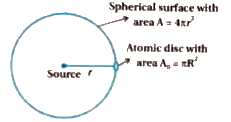
(ii)Will much time would be required by the atomic disk to receive energy equal to work function (2eV)?
(iv)How many photons would atomic disk receive within time duration calculated in (iii)above?
(v) Can you explain how photoelectric effect was observed instantaneously?

Text Solution

Verified by Experts
(i)`P=(E_(n))/(t)=(nhf)/(t)=(nhc)/(tlambda)`
`therefore ((n)/(t))=(lambda)/(nc)`
=`((20)(5000xx10^(-10)))/((6.625xx10^(-34)(3xx10^(8))`
`=5.03xx10^(19)` photon/second
(ii)Energy of one photon,
`E_(1)=hf=(hc)/(lambda)`
`therefore E_(1)=((6.625xx10^(-34))(3xx10^(8)))/((5000xx10^(-10))(1.6xx10^(-19)))eV`
`therefore E_(1)=2.49 eV`
Here `phi_(0)=2eV`
`therefore E_(1)gtphi_(0)`
`implies` Photo emission will take place.
(iii)
Intensity of radiation ,`I=(E_(0))/(A_(0)t_(0))=(P)/(A)`
`therefore t_(0)=(E_(0)A)/(PA_(0))`
`therefore t_(0)=((2xx1.6xx10^(-19))(4xx3.14xx(2)^(2)))/((20)(3.14xx(1.5xx10^(-10))^(2)))`
`therefore t_(0)=11.38 s`
(iv) Area `to` (No.of photons made incident in one second)
`therefore piR^(2)to(?)`
`implies` No. of photons made incident on atomic disc in one second,
`=(piR^(2)xx((n)/(t)))/(4pir^(2))=(1)/(4)xx(R^(2))/(r^(2))xx(n)/(t)`
`implies` No. of photons made incident in time `t_(0)`,
`=(1)/(4)xx(R^(2))/(r^(2))xx((n)/(t))xxt_(0)`
`=(1)/(4)xx((2)^(2))/((1.5xx10^(-10))^(2))xx5.03xx10^(19)xx11.38` `~~1`
(v)Above calculation is based upon the assumption "Photon behaves like a wave".If this assumption is true then we should get emission of photoelectrons,approximately after 11.38 second.But experimentally we get almost instantaneous emission of why we have to believe that in this phenomenon,photons must be behaving like particles.
Promotional Banner

Topper's Solved these Questions

  • DUAL NATURE OF RADIATION AND MATTER

    KUMAR PRAKASHAN|Exercise Section-D (multiple choice questions (MCQs)|48 Videos
  • DUAL NATURE OF RADIATION AND MATTER

    KUMAR PRAKASHAN|Exercise Section-D (multiple choice questions (MCQs) (photo-electric effect)|1 Videos
  • DUAL NATURE OF RADIATION AND MATTER

    KUMAR PRAKASHAN|Exercise Section-C (Very short answer type questions)|11 Videos
  • CURRENT ELECTRICITY

    KUMAR PRAKASHAN|Exercise SECTION [D] MULTIPLE CHOICE QUESTIONS (MCQs) (MCQs ASKED IN BOARD EXAM AND GUJCET)|23 Videos
  • ELECTRIC CHARGES AND FIELDS

    KUMAR PRAKASHAN|Exercise SECTION D MCQS ASKED IN COMPETITIVE EXAMES (MCQS AKSED IN BOARD EXAM AND GUJCET)|14 Videos

Similar Questions

Explore conceptually related problems

No .of photon emitted eery second from 60 W bulb will be ………

Light of wavelength 200 nm incident on a metal surface of threshold wavelength 400 nm kinetic energy of fastest photoelectron will be

Consider a beam of electrons (each electron with energy E_(0) )Incident on a metal surface kept in an evacuated chamber .Then

What will be maximum value of wavelength by which photo-electric emission can be obtained on metal surface with work function of 3.2 eV? ( h=6.625xx10^(-34) Js)

Calculate no. of photons emitted by 60W bulb in 10 hours that produces light of wavelength 6.626 Å

A 100 wart bulb emits monochromatic light of wavelength 400 bn, Calculate the number of photons emitted per second by the bulb.

When metal surface with 2.1 eV work function is irridated with photon of 6.0 eV energy.Value of stopping potential will be….

Light of wavelength 5000 Å incidents on reflecting surface, then for ...... value of incidence angle, reflected and incident ray will be perpendicular.

When light of wavelength lambda is incident on a metal surface, stopping potential is found to be x. When light of wavelength nlambda is incident on the same metal surface, stopping potential is found to be (x)/(n+1) . Find the threshold wavelength of the metal.

Light of wavelength 5000 Å falls on a plane reflecting surface. What are the wavelength and frequency of the reflected light? For what angle of incidence is the reflected ray normal to the incident ray?

