Home
Class 12
PHYSICS
In experiment of photoelectric effect wi...

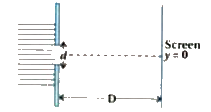
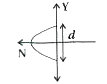
In experiment of photoelectric effect width of slit is equal to de-Broglie wavelength.Beam of light is incident normal to plane and by using detector D it is detected.Which of the following best represent number of electron (N) and position of detector (y)?

A

B

C

D

Text Solution

Verified by Experts

The correct Answer is:

D

Moving electron behave as were.Hence it should get diffracted .As a result width of central maximum should be greater then width of slit,which is in option (D).
Promotional Banner

Topper's Solved these Questions

  • DUAL NATURE OF RADIATION AND MATTER

    KUMAR PRAKASHAN|Exercise Section-D (MCQs asked in CBSE-PMT,AIPMT,NEET)|1 Videos
  • DUAL NATURE OF RADIATION AND MATTER

    KUMAR PRAKASHAN|Exercise Section-D (MCQs asked in AIIMS)|55 Videos
  • DUAL NATURE OF RADIATION AND MATTER

    KUMAR PRAKASHAN|Exercise Section-D (MCQ based on Textual Illustrations and Exercise)|1 Videos
  • CURRENT ELECTRICITY

    KUMAR PRAKASHAN|Exercise SECTION [D] MULTIPLE CHOICE QUESTIONS (MCQs) (MCQs ASKED IN BOARD EXAM AND GUJCET)|23 Videos
  • ELECTRIC CHARGES AND FIELDS

    KUMAR PRAKASHAN|Exercise SECTION D MCQS ASKED IN COMPETITIVE EXAMES (MCQS AKSED IN BOARD EXAM AND GUJCET)|14 Videos

Similar Questions

Explore conceptually related problems

In an experiment, electrons are made to pass through a narrow slit of width d comparable to their de Broglie wavelength. They are detected on a screen at a distance D from the slit (see figure) . Which of the following graphs can be expected to represent the number of electrons N detected as a function of the detector position y (y=0 corresponds to the middle of the slit ).

Young's double slit experiment is carried out using microwaves of wavelength lambda=3cm . Distance between the slits is d= 5cm and the distance between the plane of slits and the screen is D=100cm . (a) Find total number of maxima and (b) their positions on the screen.

Light of wavelength lambda_(ph) falls on a cathode plate inside a vacuum tube as shown in the figure .The work function of the cathode surface is phi and the anode is a wire mesh of conducting material kept at distance d from the cathode. A potential different V is maintained between the electrodes. If the minimum de Broglie wavelength of the electrons passing through the anode is lambda_(e) which of the following statement (s) is (are) true?

A screen is at distance D = 80 cm form a diaphragm having two narrow slits S_(1) and S_(2) which are d = 2 mm apart. Slit S_(1) is covered by a transparent sheet of thickness t_(1) = 2.5 mu m slit S_(2) is covered by another sheet of thikness t_(2) = 1.25 mu m as shown if Fig. 2.52. Both sheets are made of same material having refractive index mu = 1.40 Water is filled in the space between diaphragm and screen. Amondichromatic light beam of wavelength lambda = 5000 Å is incident normally on the diaphragm. Assuming intensity of beam to be uniform, calculate ratio of intensity of C to maximum intensity of interference pattern obtained on the screen (mu_(w) = 4//3)

An experimental setup of verification of photoelectric effect is shown in the diagram. The voltage across the electrode is measured with the help of an ideal voltmetar, and which can be varied by moving jockey 'J' on the potentiometer wire. The battery used in potentiometer circuit is of 20 V and its internal resistance is 2omega . The resistance of 100 cm long potentiometer wire is 8 omega . The photo current is measured with the help of an ideal ammeter. Two plates of potassium oxide of area 50 cm^(2) at separation 0.5 mm are used in the vacuum tube. Photo current in the circuit is very small so we can treat potentiometer circuit an indepdent circuit. The wavelength of various colours is as follows : |{:("Light",underset("Violet")(1),underset("Blue")(2),underset("Green")(3),underset("Yellow")(4),underset("Orange")(5),underset("Red")(6)),(lambda "in" Årarr,4000-4500,4500-5000,5000-5500,5500-6000,6000-6500,6500-7000):}| It is found that ammeter current remians unchanged (2muA) even when the jockey is moved from the 'P' to the middle point of the potentiometer wire. Assuming all the incident photons eject electron and the power of the light incident is 4 xx 10^(-6) W . Then colour of the incident light is :

An experimental setup of verification of photoelectric effect is shown in the diagram. The voltage across the electrode is measured with the help of an ideal voltmetar, and which can be varied by moving jockey 'J' on the potentiometer wire. The battery used in potentiometer circuit is of 20 V and its internal resistance is 2omega . The resistance of 100 cm long potentiometer wire is 8 omega . The photo current is measured with the help of an ideal ammeter. Two plates of potassium oxide of area 50 cm^(2) at separation 0.5 mm are used in the vacuum tube. Photo current in the circuit is very small so we can treat potentiometer circuit an indepdent circuit. The wavelength of various colours is as follows : |{:("Light",underset("Violet")(1),underset("Blue")(2),underset("Green")(3),underset("Yellow")(4),underset("Orange")(5),underset("Red")(6)),(lambda "in" Årarr,4000-4500,4500-5000,5000-5500,5500-6000,6000-6500,6500-7000):}| When other light falls on the anode plate the ammeter reading remains zero till, jockey till, jockey is moved from the end P to the middle point on the wire PQ. Thereafter the deflection is recorded in the ammeter. The maximum kinetic energy of the emitted electron is :

An experimental setup of verification of photoelectric effect is shown in the diagram. The voltage across the electrode is measured with the help of an ideal voltmetar, and which can be varied by moving jockey 'J' on the potentiometer wire. The battery used in potentiometer circuit is of 20 V and its internal resistance is 2omega . The resistance of 100 cm long potentiometer wire is 8 omega . The photo current is measured with the help of an ideal ammeter. Two plates of potassium oxide of area 50 cm^(2) at separation 0.5 mm are used in the vacuum tube. Photo current in the circuit is very small so we can treat potentiometer circuit an indepdent circuit. The wavelength of various colours is as follows : |{:("Light",underset("Violet")(1),underset("Blue")(2),underset("Green")(3),underset("Yellow")(4),underset("Orange")(5),underset("Red")(6)),(lambda "in" Årarr,4000-4500,4500-5000,5000-5500,5500-6000,6000-6500,6500-7000):}| The number of electrons appeared on the surface of the cathode plate, when the jockey is connected at the ened 'P' of the potentiometer wire. Assume that no radiation is falling on the plates.

Wave property of electron implies that they will show diffraction effected . Davisson and Germer demonstrated this by diffracting electron from crystals . The law governing the diffraction from a crystals is obtained by requiring that electron waves reflected from the planes of atoms in a crystal inter fere constructiely If a strong diffraction peak is observed when electrons are incident at an angle i from the normal to the crystal planes with distance d between them (see fig) de Brogle wavelength lambda_(dB) of electrons can be calculated by the relationship (n is an intenger)

Two parallel beams of light P and Q (separation d) containing radiations of wavelengts 4000Å and 5000 Å (which are mutually coherent in each wavelength separately) are incident normally on a prism as shown in figure the refractive index of the prism as a function of wavelength is given by the relation mu(lamda)=1.20+(b)/(lamda^(2)) where lamda is in Å and b is a positive constant. The value of b is such that the condition for total reflection at the face AC is just satisfied for one wavelength and is not satisfied for the other. A convergent lens is used to bring these transmitted beams into focus. If the intensities of the upper and the lower beams immediately after transmission from the face AC, are 4I and I respectively, find the resultant intensity at the focus.

KUMAR PRAKASHAN-DUAL NATURE OF RADIATION AND MATTER-Section-D (MCQs asked in competitve exams)
  1. When metal surface is incident with photon after how much time photoel...

    Text Solution

    |

  2. Momentum of photon with frequency f will be …..(where c is velocity o...

    Text Solution

    |

  3. In experiment of photoelectric effect width of slit is equal to de-Bro...

    Text Solution

    |

  4. When radiation of 400 nm wavelength Is incident on photocell ,emitter ...

    Text Solution

    |

  5. From source of power 4 kW,radiation emitted are such that photon are e...

    Text Solution

    |

  6. A nucleus of mass M is initially at rest.It absorb neutron having m(N)...

    Text Solution

    |

  7. The radiation corresponding to 3 to 2 transition of hydrogen atom fall...

    Text Solution

    |

  8. Radiation of wavelength lambda is incident on a photocell.The fastest ...

    Text Solution

    |

  9. A metal plate of area 1xx10^(-4)m^(2) is illuminated by a radiation 16...

    Text Solution

    |

  10. A beam of electromagnetic radiation intensity 6.4xx10^(-5)W//cm^(2) is...

    Text Solution

    |

  11. An electron (of mass m) and a photon have the same energy E in the ran...

    Text Solution

    |

  12. Two photons of energy 4 eV and 4.5 eV are incident on two metals A and...

    Text Solution

    |

  13. When electron with mass m is accelerated with volt V associated de-Bro...

    Text Solution

    |

  14. For wave concerned with proton ,de-Broglie wavelength changes by 0.25 ...

    Text Solution

    |

  15. Photocell is kept at distance of 1 m from the source and incident radi...

    Text Solution

    |

  16. Work function of photo sensitive is hf(0) If surface is incident with ...

    Text Solution

    |

  17. Work function of metal a,b and c are 1.92 eV 2.0 eV and 5 eV respectiv...

    Text Solution

    |

  18. Work function of aluminium plate is phi when radiation of hf energy is...

    Text Solution

    |

  19. Ionization in discharge tube us due to collision of ……..gas filled in ...

    Text Solution

    |

  20. Photoelectric effect in photocell convert….

    Text Solution

    |
