Home
Class 12
PHYSICS
In figure, assuming the diodes to be ide...


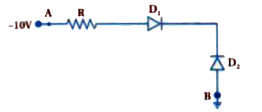
In figure, assuming the diodes to be ideal,

A

`D_(1)` is forward biased and `D_(2)` is reverse biased and hence current flows from A to B

B

`D_(2)` is forward biased and `D_(1)` is reverse biased and hence no current flows from B to A and vice versa.

C

`D_(1)` and `D_(2)` are both forward biased and hence current flows from A to B.

D

`D_(1) and D_(2)` are both reverse biased and hence no current flows from A to B and vice versa.

Text Solution

Verified by Experts

The correct Answer is:

B

`D_(2)` is forward biased and `D_(1)` is reverse biased and hence no current flows from B to A and vice versa.
For diode `D_(1), V_(A)= -10V and V_(K)=0 rArr V_(A) lt V_(R ) rArr D_(1) ` is reverse biased. Hence its resistance would be `R_(1) = oo (because D_(1)` is an ideal diode)
For diode `D_(2), V_(A)=0 and V_(K) =-10V rArr V_(A) gt V_(K) rArr D_(2) ` is forward biased. Hence its resistance would be `R_(2)=0. (because D_(2)` is an ideal diode)
Here, `D_(1) and D_(2)` are connected in series and so its equivalent resistance `R=R_(1)+R_(2)=oo +0=oo` and so current will not flow, neither from A to B nor from B to A.
`rArr` Option (B) is correct.
Promotional Banner

Topper's Solved these Questions

  • SEMICONDUCTOR ELECTRONICS : MATERIALS, DEVICES AND SIMPLE CIRCUITS

    KUMAR PRAKASHAN|Exercise Section-C: NCERT Exemplar Solution (Multiple Choice Qustion (More than One Options))|8 Videos
  • SEMICONDUCTOR ELECTRONICS : MATERIALS, DEVICES AND SIMPLE CIRCUITS

    KUMAR PRAKASHAN|Exercise Section-C: NCERT Exemplar Solution (Very Short Answer Type Questions)|6 Videos
  • SEMICONDUCTOR ELECTRONICS : MATERIALS, DEVICES AND SIMPLE CIRCUITS

    KUMAR PRAKASHAN|Exercise Section-B : Numericals (Numerical From .DARPAN. Based On Textbook)|14 Videos
  • SAMPLE QUESTION PAPER

    KUMAR PRAKASHAN|Exercise PART-B SECTION-C|5 Videos
  • WAVE OPTICS

    KUMAR PRAKASHAN|Exercise SECTION-D (MULTIPLCE CHOICE QUESTIONS (MCQS)) (MCQS FROM DARPAN BASED ON TEXTBOOK)|239 Videos

Similar Questions

Explore conceptually related problems

Two moles of helium gas are taken over the cycle ABCDA, as shown in the P-T diagram Assuming the gas to be ideal the work done on the gas in taking it form A to B is :

Two non-conducting hemispherical surface, which are having uniform charges density sigma are placed on smooth horizontal surface as shown in figure. Assuming springs are ideal, calculate comparession in each spring both the hemispherical surface are just touching each other

A fullwave P.N diode rectifier used load resistor of 1500 Omega . No filter is used. Assume each diode to have idealized characteristic with R_(f) = 10 Omega and R_(r) = ac . Since wave voltage applied to each diode has amplitude of 30 volts and frequency 50 Hz. Calculate. (i) Peak, d.c rms load current (ii) d.c power input (iii) A.C power input (iv) Rectifier efficiency.

In the circuit shown in figure, if the diode forward voltage drop is 0.3 V, the voltage difference between A and B is

A container of fixed volume has a mixture of a one mole of hydrogen and one mole of helium in equilibrium at temperature T. Assuming the gasses are ideal, the correct statement (s) is (are)

Helium gas goes through a cycle ABCDA (consisting of two isochoric and isobaric lines) as shown in figure Efficiency of this cycle is nearly: (Assume the gas to be close to ideal gas)

The figure shows the P-V plot of an ideal gas taken through a cycle ABCDA. The part ABC is a semi-circle and CDA is half of an ellipse. Then,

Zener diode use for ….

Zener diode is used as

See the figure given below and find the readings of ideal ammeter and ideal voltmeter. (There is no zero error.)
