

Home
Class 12
PHYSICS
Three containers C1, C2 and C3 have wa...

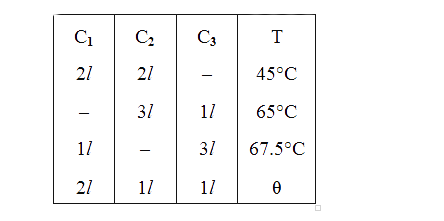
Three containers `C_1, C_2` and `C_3` have water at different temperatures. The table below shows the final temperature T when different amounts of water (given in litres) are taken from each containers and mixed (assume no loss of heat during the process)

The value of (in °C to the nearest integer) is …….

Promotional Banner

Similar Questions

Explore conceptually related problems

Three containers C_(1), C_(2) and C_(3) have water at different temperatures. The table below shows the final temperature T when different amounts of water (given in litres) are taken from each containers and mixed (assume no loss of heat during the process) The value of theta (in ""^(@)C to the nearest integer) is.......

Three containers C_(1) , C_(2) and C_(3) have water at different temperatures. The table below shows the final temperature T when different amounts of water (given in litres) are taken from each containers and mixed (assume no loss of heat during the process) The value of theta (in ^(@)C to the nearest integer) is …….

Three containers C_(1), C_(2) and C_(3) have water at different temperatures. The table below shows the final temperature T when different amounts water (given in liters) are taken from each container and mixed (assume no loss of heat during the process) The value of theta (in .^(@)C to the nearest integer) is ------------

Three containers C_(1), C_(2) and C_(3) have water at different temperatures. The table below shows the final temperature T when different amounts water (given in liters) are taken from each container and mixed (assume no loss of heat during the process) The value of theta (in .^(@)C to the nearest integer) is ------------

There are three containers C_1, C_2 and C_3 filled with same material at different constant temperature. When we mix then for different volume then we get some final temperature as shown in the below table. So find value of final temperature theta as shown in the table.

Two containers X and Y are filled with water at different temperature. When 10 g of water from container X is mixed with 20 g of water from container Y, the resultant temperature is found to be 20^(@)C . When 20 g of water from container X is mixed with 10 g of water from container Y, the resultant temperature is found to be 30^(@)C . Determine the inital temperature of water in container X and Y.

One gram of water at 100^(@)C is converted to steam at the same temperature. The amount of heat required is nearest to the value of