
Home
Class 12
CHEMISTRY
R - X + Mg overset("ether". Delta)(to) o...

`R - X + Mg overset("ether". Delta)(to) overset(delta-)( R) - overset(delta+)(Mg) X`
Grignand reagent may be prepared from `1^@, 2^@` and ` 3^@` halides as well as from Vinyl and Aryl halide, vicinal dihalides are those halides which contain acidic tail do not form Grignand reagent.

A

B

C

D

Text Solution

Verified by Experts

The correct Answer is:
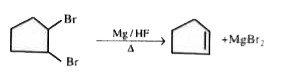
B

Promotional Banner

Similar Questions

Explore conceptually related problems

(A) : CO_(2) reacts with Grignard reagent followed by acid catalysed hydrolysis gives carboxylic acid . (R) : Alkyl halide reacts with Mg in the presence of ether gives Grignard reagent .

CH_3 - CH_2 - Cl underset(Delta)overset("Na/ether")(to) which of the following products may not be formed

Propyne overset("Na(l))underset(Delta)rarrX+1/2H_(2),Xoverset(CH_3)underset(Delta)rarrY Which of the following reagents can be used to distinguish Y from propyne?

(A) R-overset(O)overset(||)(C)-Cl fails to give ketone when treated with R-Mg-X, but with R_(2)Cd , ketones is obtained easily. (R) R-Mg-X reacts with acid chloride to form ketone, but R-Mg-X further reacts with ketone readily and form tertiary alcohol.

Alkane may be prepared from alkyl halide by Wurtz method where alkyl halide reacted with Na in presence of ether . 2R - X underset(Delta)overset("Ether")to R - R + 2NaX Which of the following compound is most reactive for Wurtz reaction ?

Alkane may be prepared from alkyl halide by Wurtz method where alkyl halide reacted with Na in presence of ether . 2R - X underset(Delta)overset("Ether")to R - R + 2NaX Which of the following compound is most reactive for Wurtz reaction ?

Equation of the sides overset(harr)("BC"), overset(harr)("CA"), overset(harr)("AB") of a triangle ABC are U_(r ) = a_(r )x+b_(r )y+c_(r )=0, r=1,2,3 respectively then equation of line parallel to overset(harr)("BC") and passing through A is

(CH_(3))_(3)C C(CH_(3))_(3) overset(Na,"ether")rarr R'-X overset(Mg)rarr D overset(H_(2)O)rarr E . What is E?

alpha - amino acids are high melting crystalline solids because of the zwitterion structure. They are moderately soluble in water. In acidic medium, alpha - amino acids exist as cations (I) and thus migrate towards cathode under the influence of an electric field. On the other hand, in alkaline medium, alpha - amino acids exist as anions (III) and thus migrate towards anode under the influence of an electric field. However, at some intermediate value of p^(H) , the concentration of the cationic form (I) and anionic form (III) will become equal and consequently the alpha - amino acid will exist primarily as the neutral dipolar ion (II). At this p^(H) , there would be no net migration of the amino acid in an electric field. This p^(H) at which there is no net migration of the amino acid under the influence of an applied electric field is called isoelectric point (pI). Each amino acid has a characteristic isoelectric point. The pH of an amino acid that does not have an ionisable side chain such as alanine isd average of pK_(a) values of the carboxyl group and the protonated amino group. H_(3)overset(+)(N)-overset("R")overset("|")("C")H-COOH overset(" "OH^(-)" ")underset(" "H^(+)" ")hArr H_(3)overset(+)(N)-underset("Zwitterion (II)")(overset("R")overset("|")("C")H)-COO^(-)overset(" "OH^(-)" ")underset(" "H^(+)" ")hArr underset((III))(overset(+)(N)-overset("R")overset("|")("C")H)-COO^(-) Further, the alpha - carbon of all the amino acids (except glycine) is chiral (asymmetric) and hence amino acids can exist in teo stereoisomeric forms i.e., D and L. However, all the nautrally occurring amino acids belong to the L - series. underset("L(-)Glyceraldehyde")(HO-overset("CHO ")overset("| ")underset(" "CH_(2)OH)underset("| ")("C ")-H)" " underset("L-Amino acid")(H_(2)N-overset("COOH")overset("| ")underset("R ")underset("| ")("C ")-H) In alanine, carboxyl group ionises at pK_(a1)=2.34 and ammonium ion at pK_(a2)=9.69 . The isoelectric point of the amino acid is at p^(H) .

