Home
Class 12
CHEMISTRY
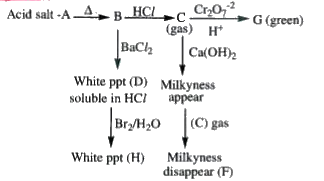
Passage-II: 'G' is...

Passage-II:

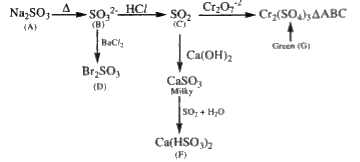
'G' is

A

`CrO_(4)^(-2)`

B

`Cr^(+3)`

C

`CrO_(5)`

D

`CrO_(3)`

Text Solution

Verified by Experts

The correct Answer is:
B


`:. C=SO_(2), D=BaSO_(4), G=Cr_(2)(SO_(4))_(3)(or) Cr^(+3)`
Promotional Banner

Topper's Solved these Questions

  • VIA GROUP ELEMENTS

    AAKASH SERIES|Exercise PRACTICE SHEET - 5 (Match the following questions)|2 Videos
  • VIA GROUP ELEMENTS

    AAKASH SERIES|Exercise PRACTICE SHEET - 5 ( Integer answer type Questions)|6 Videos
  • VIA GROUP ELEMENTS

    AAKASH SERIES|Exercise PRACTICE SHEET - 4 (Integer answer type Questions)|2 Videos
  • VA GROUP ELEMENTS

    AAKASH SERIES|Exercise PRACTICE EXERCISE|51 Videos
  • VII GROUP ELEMENTS

    AAKASH SERIES|Exercise OBJECTIVE EXERCISE -4|55 Videos

Similar Questions

Explore conceptually related problems

Passage-II: 'C' is

Passage-II: 'D' is

Passage - II : The oxidation state of 'Mn' in 'B' is

Passage - II : During its reaction with Cl_(2) , 'X' acts as

Passage - VIII : In this passage five observation are given. Question are asked with reference to the given observations Observation (i) Gaseous oxygen is colourless whereas liquid and solid oxygen are coloured substance. Observation (ii) When O_(2) is cooled below a certain temperature its paramagnetic character decreases. Observation (iii) In ice H_(2)O molecules are H bonded Observation (iv) Ozone is responsible for tailing of Hg(l) Observation (v) O_(3)(g) is almost unavailable in lower atmosphere Reference to observation (v) O_(3)(g) is unavailable in lower atmosphere because -

Passage - VIII : In this passage five observation are given. Question are asked with reference to the given observations Observation (i) Gaseous oxygen is colourless whereas liquid and solid oxygen are coloured substance. Observation (ii) When O_(2) is cooled below a certain temperature its paramagnetic character decreases. Observation (iii) In ice H_(2)O molecules are H bonded Observation (iv) Ozone is responsible for tailing of Hg(l) Observation (v) O_(3)(g) is almost unavailable in lower atmosphere Which of the following explain the observation (ii)?

Passage - II : The solid(A) is a laboratory reagent. Give the following reactions. i) On strongly heating it gives two oxides of sulphur ii) On adding aqueous NaOH solution to its aqueous solution a dirty green precipitate is obtained, which starts turning brown on exposure to air. What is compound in dirty green ppt.

AAKASH SERIES-VIA GROUP ELEMENTS-PRACTICE SHEET - 5 (Linked Comprehension type questions)
  1. Passage-II: 'C' is

    Text Solution

    |

  2. Passage-II: 'D' is

    Text Solution

    |

  3. Passage-II: 'G' is

    Text Solution

    |

