Home
Class 12
CHEMISTRY
{:("COLUMN-I","COLUMN-II"),("(Elements)"...

`{:("COLUMN-I","COLUMN-II"),("(Elements)","(Covalency)"),((A)'O' " atom in "O_(3),(p)1),((B)'S' " atom in hyposulphorous acid",(q)2),((C )'N'" atom in "NO^(+)and N_(2)O_(4),(r )3),((D)'N' " atom in "N_(3)H,(s) 4):}`

Text Solution

Verified by Experts

The correct Answer is:
A-p,q,r; B-s; C-r,s; D-q,r,s

A) Covalency = No. of covalent bond , Middle = 3, Oxygen (a) = 2, Oxygen (b) = 1
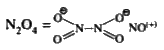
B) `H_(2)S_(2)O_(4)=` Hyposulphurous acid C) D) `H-overset(* *)N=overset(o+)N=overset(* *o+)(N: )`


Promotional Banner

Topper's Solved these Questions

  • VIA GROUP ELEMENTS

    AAKASH SERIES|Exercise PRACTICE SHEET - 5 ( Integer answer type Questions)|6 Videos
  • VIA GROUP ELEMENTS

    AAKASH SERIES|Exercise PRACTICE SHEET - 5 (Linked Comprehension type questions)|3 Videos
  • VA GROUP ELEMENTS

    AAKASH SERIES|Exercise PRACTICE EXERCISE|51 Videos
  • VII GROUP ELEMENTS

    AAKASH SERIES|Exercise OBJECTIVE EXERCISE -4|55 Videos

Similar Questions

Explore conceptually related problems

{:("COLUMN-I","COLUMN-II"),((A)"Oleum",(p)NO.HSO_(4)),((B)"Peroxy disulphuric acid",(q)H_(2)SO_(5)),((C )"Peroxy monosulphuric acid",(r )H_(2)S_(2)O_(8)),((D)"Chamber Crystals",(s)H_(2)SO_(4).xSO_(3)):}

{:("COLUMN-I","COLUMN-II"),("(Oxy-acid of S)","(Oxidation state of 'S'')"),((A)H_(2)SO_(3),(p)+2),((B)H_(2)S_(2)O_(6),(q)+3),((C )H_(2)S_(2)O_(3),(r )+4),((D)H_(2)S_(2)O_(4),(s) +5):}

{:("COLUMN-I","COLUMN-II"),((A)"Number of "p pi-dpi" type " pi " bondsin "SO_(2),(p)2),((B)"Number of "p pi-dpi" type "pi" bonds in "SO_(3),(q)1),((C )"Number of "p pi-dpi" type "pi" bonds in "H_(2)S_(2)O_(5),(r )4),((D) "Number of "p pi-dpi" type "pi " bonds in "H_(2)S_(2)O_(7) ,(s)3):}

{:("COLUMN-I","COLUMN-II"),((A)"Platinum",(p)"Decomposition of bleaching powder"),((B)V_(2)O_(5),(q)"Manufacturing of "HNO_(3)),((C )"Iron",(r )"Manufacturing of "H_(2)SO_(4)),((D)"Cobalt chloride",(s)"manufacturing of "NH_(3)):}

Match COLUMN-I (Species) with COLUMN-II (O-N-O angle) and select the correct answer using the codes given below the lists : {:("COLUMN - I","COLUMN - II"),("(Mixtures)","(Solution used for separation)"), ("A)" N_2 and CO,"p) Water"),("B)" N_2 and O_2,"p)"H_2SO_4),("C)" N_2 and NH_3,"r) Ammonical CuCl"),("D)" PH_3 and NH_3,"s) Pyrogallol"):}

{:("COLUMN-I","COLUMN-II"),((A)"Crown shape",(p)S_(2)Cl_(2)),((B)"Angular shape",(q)S_(8)" molecule"),((C )"Planar trigonal",(r )O_(3)" molecule"),((D) H_(2)O_(2)" like structure",(s) SO_(3)" molecule"):}

Na_(2)S_(2)O_(3) may react with the compound given in Column-I, Na_(2)S_(2)O_(3) exhibits the properties of the type give in the coloumn-II, matter the reactants given in column-I with the type of property, properties given in Column-II {:("COLUMN-I","COLUMN-II"),("(Reactant)","(Type of property)"),((A)Cl_(2),(p)"Complexing agent"),((B)AgBr,(q)"Disproportionation"),((C )HCl,(r )"Only as reductant"),((D)I_(2),(s) "An antichlor"):}

{:("COLUMN-I","COLUMN-II"),("A) Tear gas","p)" (C_(2)H_(4)Cl)_(2)S),("B) Musturd gas ","q)" COCl_(2)),("C) Phosgene","r)" C Cl_(3)NO_(2)),("D) Teflon","s)" (C_(2)F_(4))_(n)):}

{:("COLUMN-I","COLUMN-II"),("A)" PCl_(5),"p)" sp^(3)),("B)" ClO_(4)^(-),"q) Tetrahedral"),("C)" XeF_(2),"r) Trigonol bipyramidal"),("D)" SO_(4)^(-2),"s)" sp^(3)d):}

{:("COLUMN-I","COLUMN-II"),((A)SO_(2),(p)"+2 and '0' states of 'S' "),((B)H_(2)S,(q)"Trimer solid"),((C )SO_(3), (r )"Reductant"),((D)S_(6)O,(s)"Oxidant"),(,(t)sp^(2)"sulphur"):}