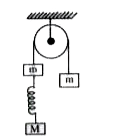
A
B
C
D
Text Solution
Verified by Experts
The correct Answer is:



Topper's Solved these Questions
NEWTONS LAWS OF MOTION
AAKASH SERIES|Exercise LECTURE SHEET (EXERCISE - III) (More than one correct answer Type Questions)|1 VideosNEWTONS LAWS OF MOTION
AAKASH SERIES|Exercise LECTURE SHEET (EXERCISE - III) ( Linked comprehension Type Questions)|3 VideosNEWTONS LAWS OF MOTION
AAKASH SERIES|Exercise LECTURE SHEET (EXERCISE - II) (Integer Type Questions )|1 VideosMOTION IN A STRAIGHT LINE
AAKASH SERIES|Exercise Questions for Descriptive Answers|7 VideosOSCILLATION
AAKASH SERIES|Exercise QUESTIONS FOR DESCRIPTIVE ANSWERS|12 Videos
Similar Questions
Explore conceptually related problems
AAKASH SERIES-NEWTONS LAWS OF MOTION -LECTURE SHEET (EXERCISE - III) (Straight Objective Type Questions)
- In the figure the blocks A, B and C of mass m each, have acceleration ...
Text Solution
|
- A horizontal uniform beam AB of length 4m and a mass of 20 kg is suppo...
Text Solution
|
- A block of mass 4kg is placed on a horizontal surface is connected to ...
Text Solution
|
- Two bodies of masses 15gm and 25gm are connected by means of a string ...
Text Solution
|
- Two blocks A and B of masses m& 2m respectively are held at rest such ...
Text Solution
|
- In the two systems as shown, what should be value of mass M so that ex...
Text Solution
|
- Two blocks m1 and m2 are in equilibrium. S1 is a string and S2 is ...
Text Solution
|
- In the arrangement shown, by what acceleration the boy must go up so t...
Text Solution
|
- The system shown in figure is released from rest when the spring was i...
Text Solution
|