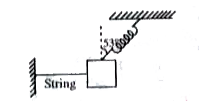
A
B
C
D
Text Solution
Verified by Experts
The correct Answer is:



Topper's Solved these Questions
NEWTONS LAWS OF MOTION
AAKASH SERIES|Exercise PRACTICE SHEET (EXERCISE - II) (LEVEL - II) ( More than one correct answer Type Questions )|4 VideosNEWTONS LAWS OF MOTION
AAKASH SERIES|Exercise PRACTICE SHEET (EXERCISE - II) (LEVEL - II) ( Linked Comprehension Type Questions )|4 VideosNEWTONS LAWS OF MOTION
AAKASH SERIES|Exercise PRACTICE SHEET (EXERCISE - II) (LEVEL - I) (Straight Objective Type Questions)|34 VideosMOTION IN A STRAIGHT LINE
AAKASH SERIES|Exercise Questions for Descriptive Answers|7 VideosOSCILLATION
AAKASH SERIES|Exercise QUESTIONS FOR DESCRIPTIVE ANSWERS|12 Videos
Similar Questions
Explore conceptually related problems
AAKASH SERIES-NEWTONS LAWS OF MOTION -PRACTICE SHEET (EXERCISE - II) (LEVEL - II) (Straight Objective Type Questions)
- The blocks A and B shown in the figure have masses MA = 5 kg and MB = ...
Text Solution
|
- Two insects each of mass m moves with accelerations a1 = a2 = g//2 re...
Text Solution
|
- The block A is pushed towards the wall by a distance and released. The...
Text Solution
|
- In the given fig, pulley is frictionless and massless. Both the spring...
Text Solution
|
- All surfaces shown in the figure are smooth. System is released with t...
Text Solution
|
- Two blocks are connected by a spring. The combination is suspended, at...
Text Solution
|
- The block shown in figure is in equilibrium cut. Find acceleration of ...
Text Solution
|