Home
Class 11
PHYSICS
Two cylindrical hollow drums of radii R ...

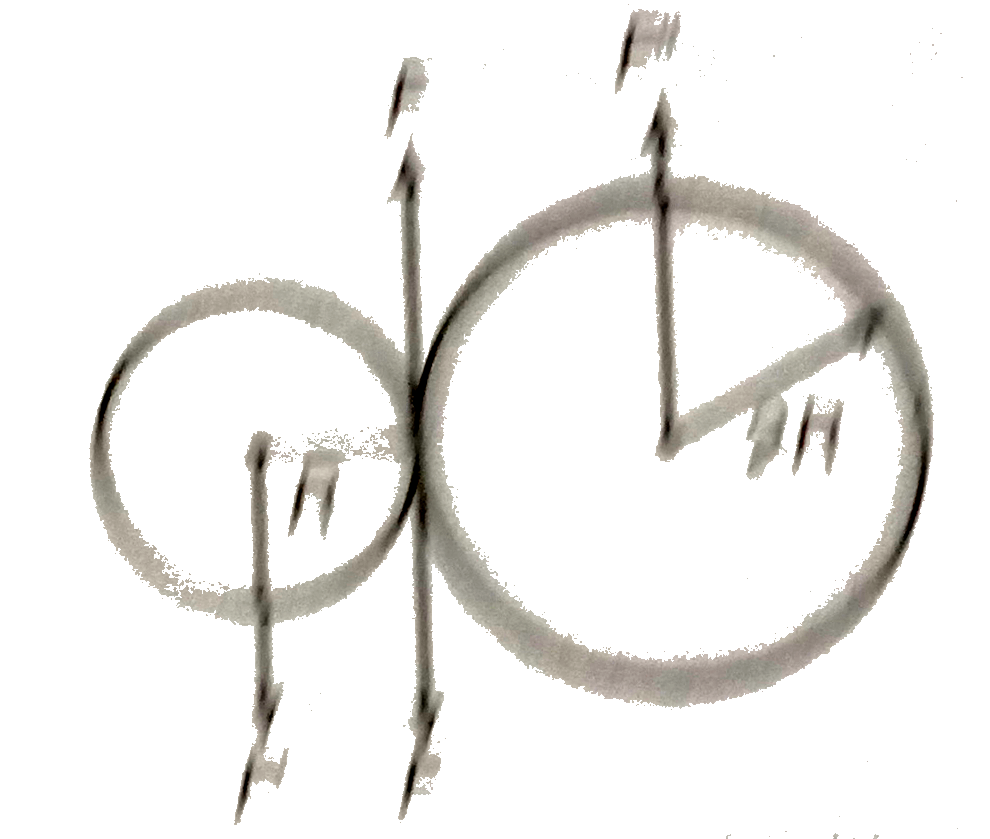
Two cylindrical hollow drums of radii `R and 2R`, and of a commom height h, are rotating with angular velocities `omega` (anti-clockwise) and `omega` (clockwise), respectively. Their axes, fixed are parallel and in a horizontal plane separated by `(3R + delta)`. They are now brought in contact `(delta rarr 0)`.
(a) Show the frictional forces just after contact.
(b) Identify forces and torque external to the system just after contact.
(c ) What would be the ratio of final angular velocities when friction ceases ?

Text Solution

Verified by Experts
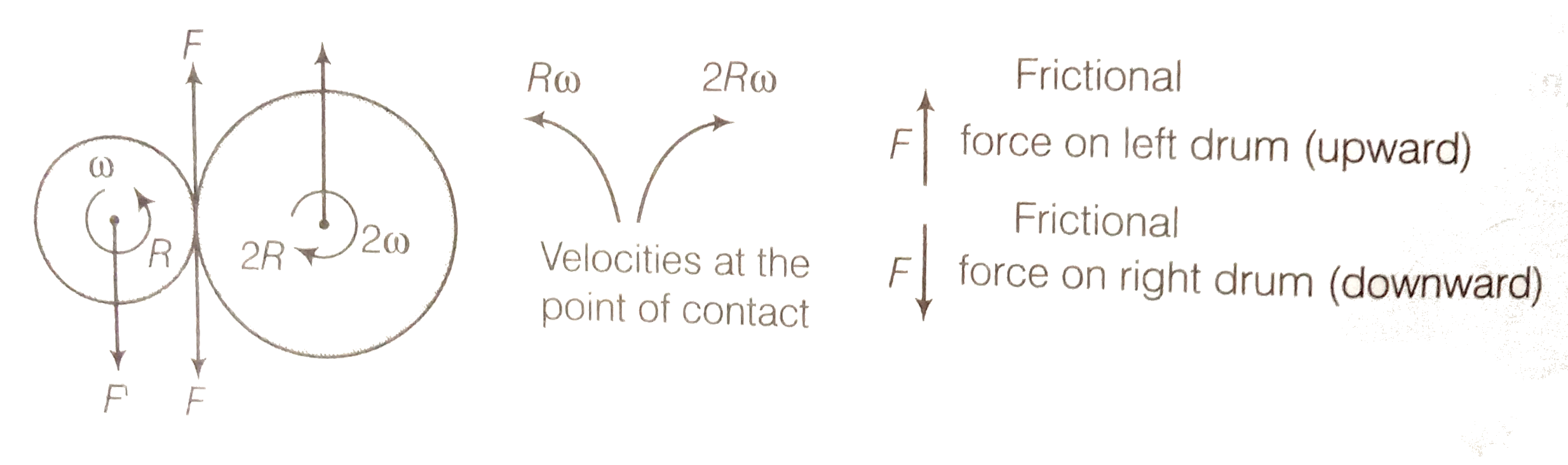
Consider the situation shown below we have shown the frictional forces .

(b) `F'= F=F` where F and F are external forces through support
`implies F_("net")=0 ("one each cylinder")`
External torque `=Fxx3R` (anti- clockwise )

( c) Let `omega _(1)` and `omega_(2)` be final angular velocites of samaller and bigger drum respectively (anti - clokwise and clockwise Respectivelty)
Hence , `Romega_(2)implies(omega_(1))/(omega_(2))=2`
Note :- We should be very careful while indicating direction of frictional forces.
Promotional Banner

Topper's Solved these Questions

  • SYSTEM OF PARTICLES AND ROTATIONAL MOTION

    NCERT EXEMPLAR ENGLISH|Exercise very short answer type questions|18 Videos
  • OSCILLATIONS

    NCERT EXEMPLAR ENGLISH|Exercise All Questions|36 Videos
  • THERMAL PROPERTIES OF MATTER

    NCERT EXEMPLAR ENGLISH|Exercise Very short Answer type Questions|15 Videos

Similar Questions

Explore conceptually related problems

two cylindrical hollow drums of radii R and 2 R, and of a common height h , are rotating with angular velocities omega (anti- clockwise ) and omega (clockwise ) , respectively , their axes , fixed are parallel and in a horizontal plane separated by by 3R + delta , they are now brought in contact (delta to0) (A) show frictional forces just after contact . (B) identify forces and torque external to the system just after contact , (c) what would be the ratio of final of final angular velocities when friction ceases ?

Two discs A and B are in contact and rotating with angular velocity with angular velocities omega_(1) and omega_(2) respectively as shown. If there is no slipping between the discs, then

A body rotating with angular velocity omega stops after rotating for 2 sec. The torque necessary for this is?

A torque T acts on a body of moment of inertia l rotating with angular speed omega . It will be stopped just after time

Find velocity of piston A in the given situation if angular velocity of wheel of radius R is omega (constant) in the clockwise sense (O is fixed point)

A conducting ring of radius r having charge q is rotating with angular velocity omega about its axes. Find the magnetic field at the centre of the ring.

A conducting ring of radius r having charge q is rotating with angular velocity omega about its axes. Find the magnetic field at the centre of the ring.

A disc is rotating with angular velocity omega . A force F acts at a point whose position vector with respect to the axis of rotation is r. The power associated with torque due to the force is given by

A disc is rotating with angular velocity omega . A force F acts at a point whose position vector with respect to the axis of rotation is r. The power associated with torque due to the force is given by

Two discs of moments of inertia I_1 and I_2 about their respective axes , rotating with angular frequencies omega_1 and omega_2 respectively, are brought into contact face to face with their axes of rotation coincident. The angular frequency of the composite disc will be