Home
Class 11
CHEMISTRY
Match the activity given in Column I wit...

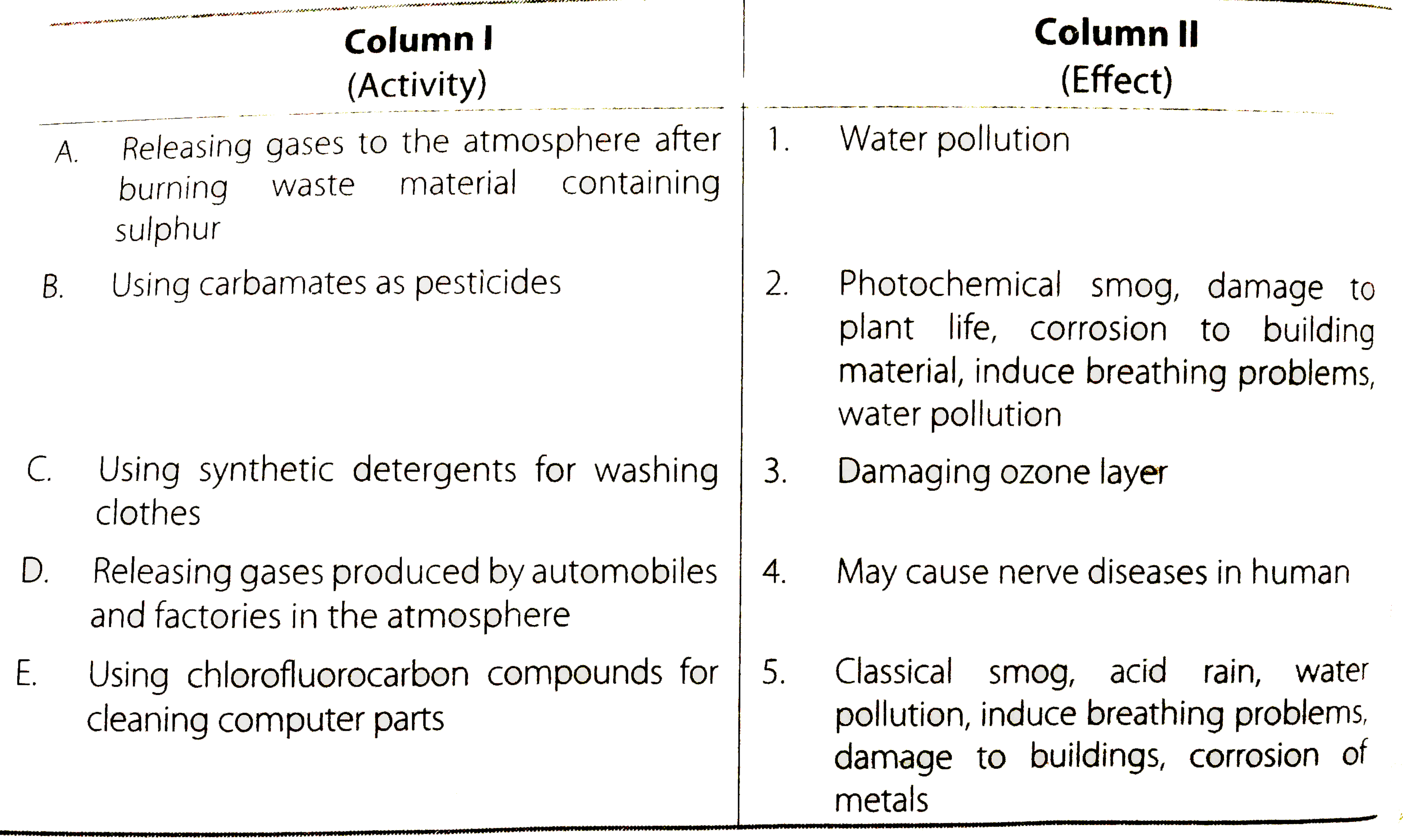
Match the activity given in Column I with the type of pollution created by it given in Column II.

Text Solution

Verified by Experts

The correct Answer is:

A. `rarr (5)` , B. `rarr(4)`, C. `rarr (1)` , (D) `rarr (2)` , (E ) `rarr (3)`

A. Classical smog, acid rain, water pollution, induce breathing problems, damage to buildings, corrosion of metals.
B. May cause nerve disease in human.
C. Water pollution.
D. Photochemical smog, damage to plant life. Corrosion to building material, induce breathing problems, water pollusion.
E. Damaging ozone layer.
Promotional Banner

Topper's Solved these Questions

  • ENVIRONMENTAL CHEMISTRY

    NCERT EXEMPLAR ENGLISH|Exercise Assertion And Reason|7 Videos
  • ENVIRONMENTAL CHEMISTRY

    NCERT EXEMPLAR ENGLISH|Exercise Long Answer Type|5 Videos
  • ENVIRONMENTAL CHEMISTRY

    NCERT EXEMPLAR ENGLISH|Exercise Short Answer Type|18 Videos
  • CLASSIFICATION OF ELEMENTS AND PERIODICITY IN PROPERTIES.

    NCERT EXEMPLAR ENGLISH|Exercise Long answer types question|7 Videos
  • HYDROCARBONS

    NCERT EXEMPLAR ENGLISH|Exercise Long Answer Type Questions|4 Videos

Similar Questions

Explore conceptually related problems

Match the polymers given in column I with the type of linkage present in them given in column II

Match structures given in Column I with the type of detergents given in Column II.

Match the reactions given in Column I with the type of reactions given in Column II

Match the formulas of oxides given in Column I with the type of oxide given in Column II and mark the correct option.

Method of formation of solution is given in Column I. Match it with the type of solution given in Column II.

Match the reactions given in column I with the type of reaction mentioned in column II and mark the appropriate choice

Match the structures given in Column I with the names in Column II

Match the soaps given in Column I with items given in column II.

Match the reactions given in Column I with the reaction types in Column II.

Match the salts given in Column I with their . method of preparation given in Column II :
