Home
Class 12
CHEMISTRY
Electrode potential for Mg electrode var...

Electrode potential for `Mg` electrode varies according to the equation
`E_(Mg^(2+)|Mg)=E_(Mg^(2+)|Mg)^(ϴ) -(0.059)/2 "log" 1/([Mg^(2+)])`
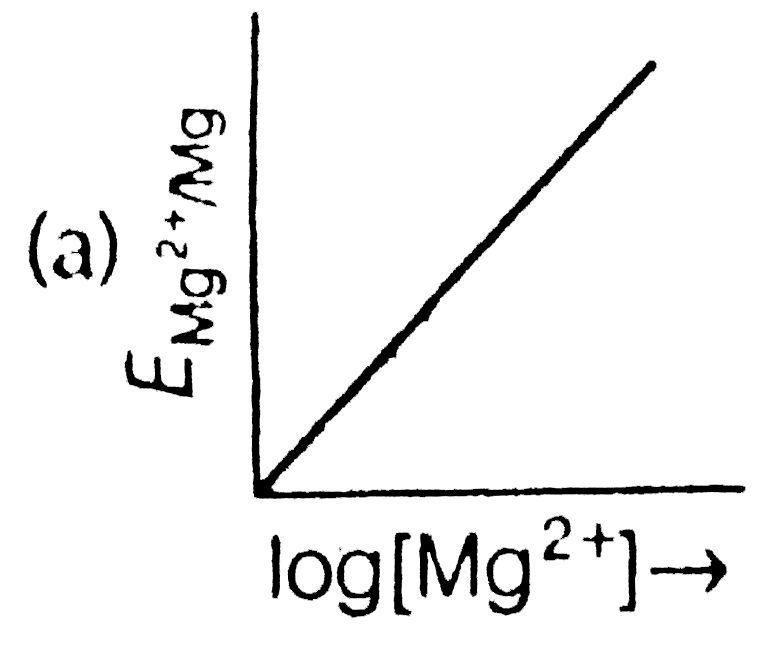
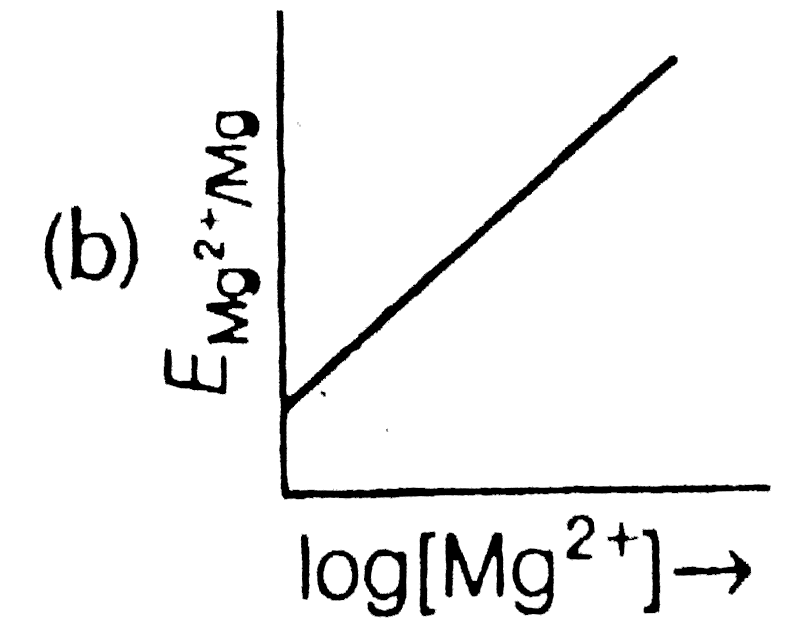
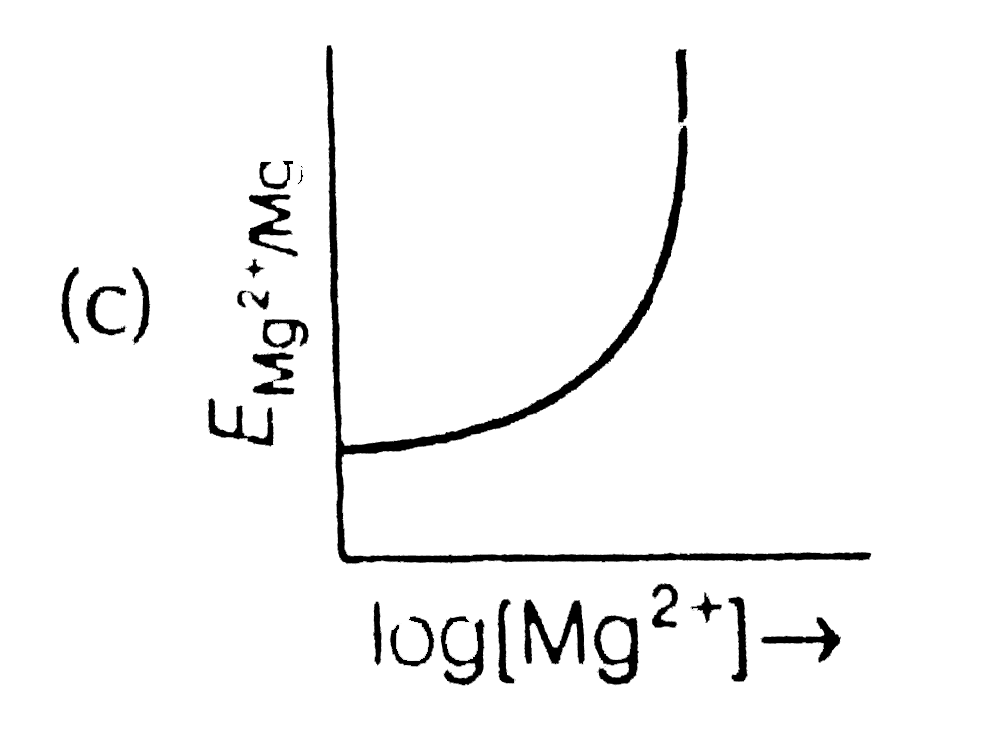
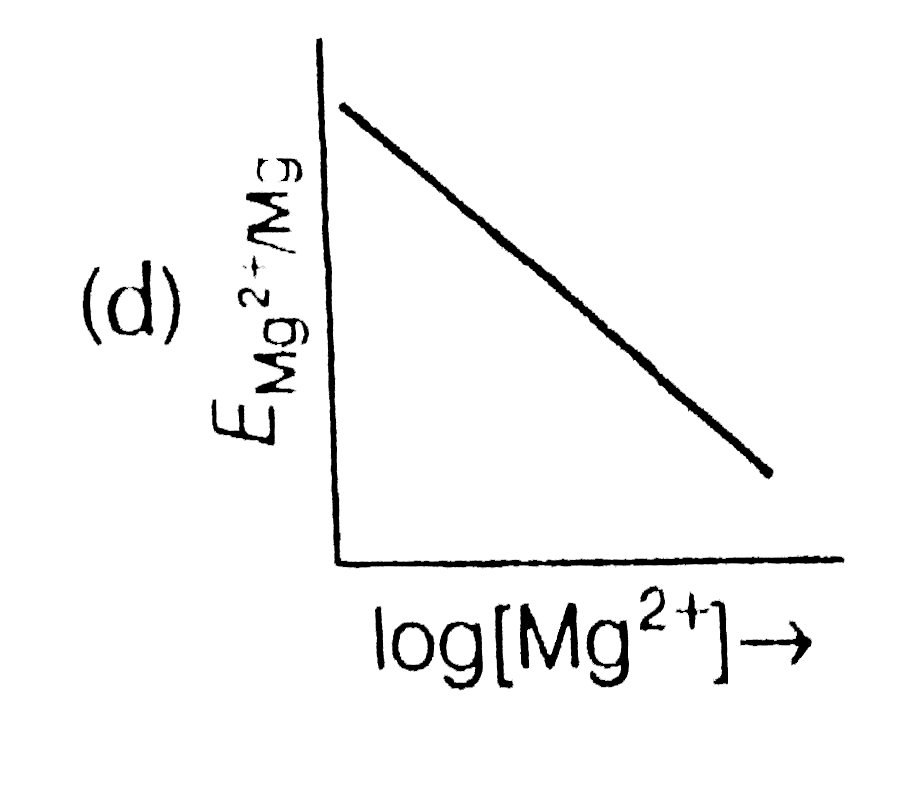
The graph of `E_(Mg^(2+)|Mg) vs log [Mg^(2+)]` is
(a)
(b)
(c)
(d)

A

B

C

D

Text Solution

Verified by Experts
Electrode potential for Mg electrode varies according to the equation
`E_(Mg^(2+)//Mg)=E_(Mg^(2+)//Mg)^(@)-(0.059)/(2)"log"(1)/([ Mg^(2+)])`
`E_(Mg^(2+)//Mg=E_(Mg^(2+)//Mg)^(@))+(0.059)/(2)"log"[Mg^(2+)]`
`E_(Mg^(2+)//Mg)=(0.059)/(2)"log"[Mg^(2+)]+E_(Mg^(2+)//Mg)^(@)`
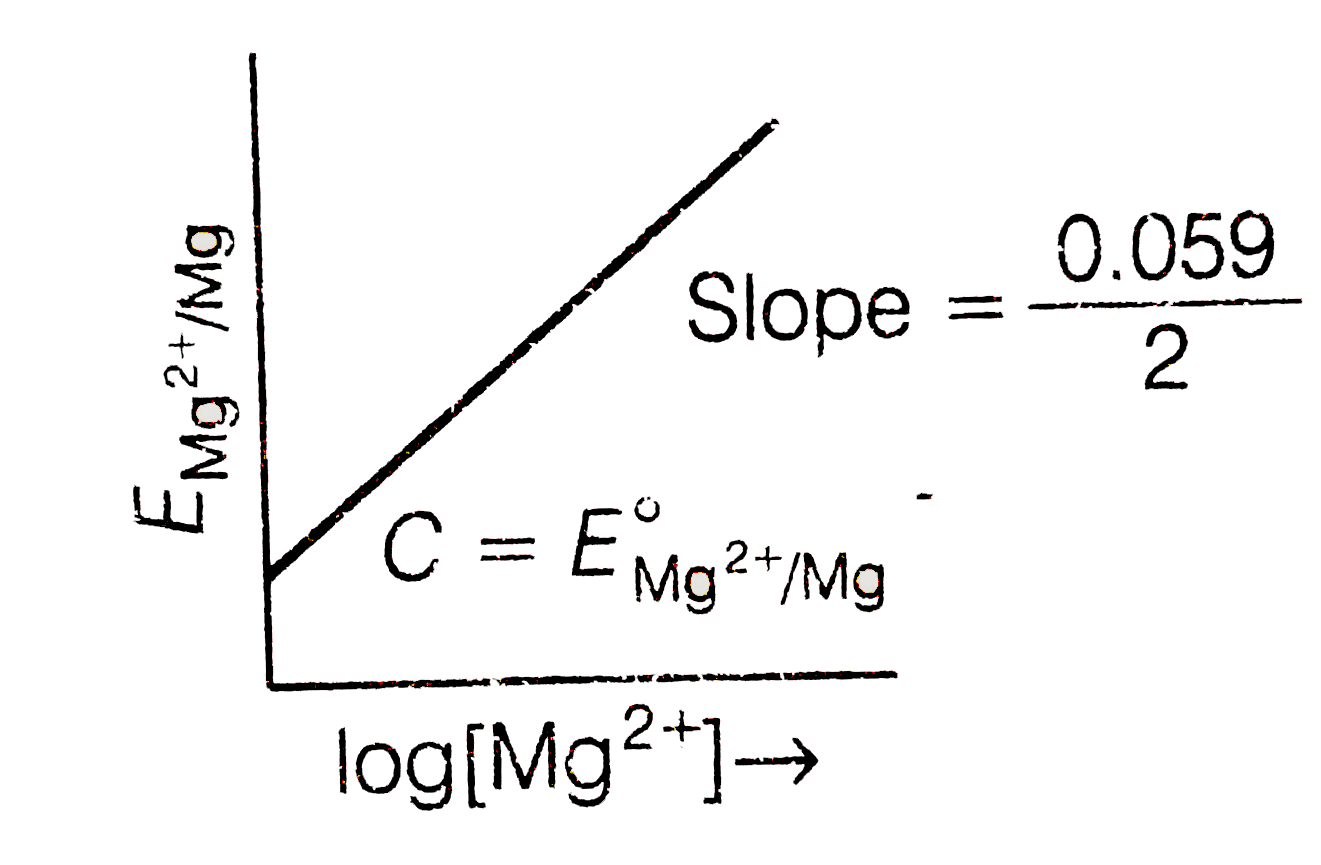
This equation represents equation of straight line. it can be corelated as
`E_(Mg^(2+)//Mg)=((0.059)/(2))"log"[Mg^(2+)]+E_(Mg^(2+)//Mg)^(@)`
`uparrow uparrow uparrow uparrow`
Y M X `+C`
So intercept `(C)=E_(Mg^(2+)//Mg)^(@)`
Thus, equation can be diagramatically represented as
Promotional Banner

Topper's Solved these Questions

  • D AND F-BLOCK ELEMENTS

    NCERT EXEMPLAR ENGLISH|Exercise Short Answer Type Question|20 Videos
  • GENERAL PRINCIPLE AND PROCESSES OF ISOLATION OF ELEMENTS

    NCERT EXEMPLAR ENGLISH|Exercise Long Answer Type Questions|1 Videos

Similar Questions

Explore conceptually related problems

Electrode potential for Mg electrode varies according to the equation E_(Mg^(2+)//Mg)=E_(Mg^(2+)//Mg)^(Theta) -(0.059)/(2)"log"(1) /([Mg^(2+)]) The graph of E_(Mg^(2+)//Mg) vs log[Mg^(2+)] is

Balance the equation: Mg+O_2 to MgO

Why does magnesium form Mg^(2+) and not Mg^(+) ?

Why does magnesium from Mg^(2+) and not Mg^(+) ?

Ca^(2+)" and "Mg^(2+)

Mg liberates H_(2) on reaction with

Mg liberates H_(2) on reaction with

Select the basic and acidic radicals in the Mg(OH)_2 .

Balance the equation Mg+ HNO_(3) to Mg(NO_(3))_(2) + N_(2)O + H_(2)O

How would you determine the standard reduction potential of the system Mg^(2+)|Mg ?

NCERT EXEMPLAR ENGLISH-ELECTROCHEMISTRY-All Questions
  1. Which cell will measure standard electrode potential of copper electro...

    Text Solution

    |

  2. Electrode potential for Mg electrode varies according to the equation ...

    Text Solution

    |

  3. Which of the following statement is correct?

    Text Solution

    |

  4. The difference between the electrode potentials of two electrodes when...

    Text Solution

    |

  5. Which of the following statement is not correct about an inert electro...

    Text Solution

    |

  6. An electrochemical cell an behave like an electrolytic cell when

    Text Solution

    |

  7. Which of the statements about solution of electrolytes is not correct?

    Text Solution

    |

  8. Using the data given below: E(Cr(2)O(7)^(2-)|Cr^(3+))^(@)=1.33V E(Cl...

    Text Solution

    |

  9. Given E("Cr(2)O(7)^(2-)//Cr^(3+))^(@)=1.33V,E(MnO(4)^(-)//Mn^(2+))^(@)...

    Text Solution

    |

  10. Using the data given below: E(Cr(2)O(7)^(2-)|Cr^(3+))^(@)=1.33V E(Cl...

    Text Solution

    |

  11. Use the data given in Q.8 and find out the most stable ion in its redu...

    Text Solution

    |

  12. Using the data given below: E(Cr(2)O(7)^(2-)|Cr^(3+))^(@)=1.33V E(Cl...

    Text Solution

    |

  13. The quantity of charge required to obtain one mole of aluminium from A...

    Text Solution

    |

  14. The cell constant of a conductivity cell

    Text Solution

    |

  15. While charging the lead storage battery: (a)PbSO(4) anode is reduced...

    Text Solution

    |

  16. ^^(m((NH(4)OH)))^(o) is equal to (a)Lambda(m)^(@)(NH(4)OH)+Lambda(m...

    Text Solution

    |

  17. In the electrolysis of aqueous sodium chloride solution which of the h...

    Text Solution

    |

  18. The positive value of the standard electrode potential of Cu^(2+)//Cu ...

    Text Solution

    |

  19. Potential for some half cell reactions are given below. On the basis o...

    Text Solution

    |

  20. E("cell")^(@)=1.1V for Daniel cell. Which of the following expressions...

    Text Solution

    |

