Home
Class 12
CHEMISTRY
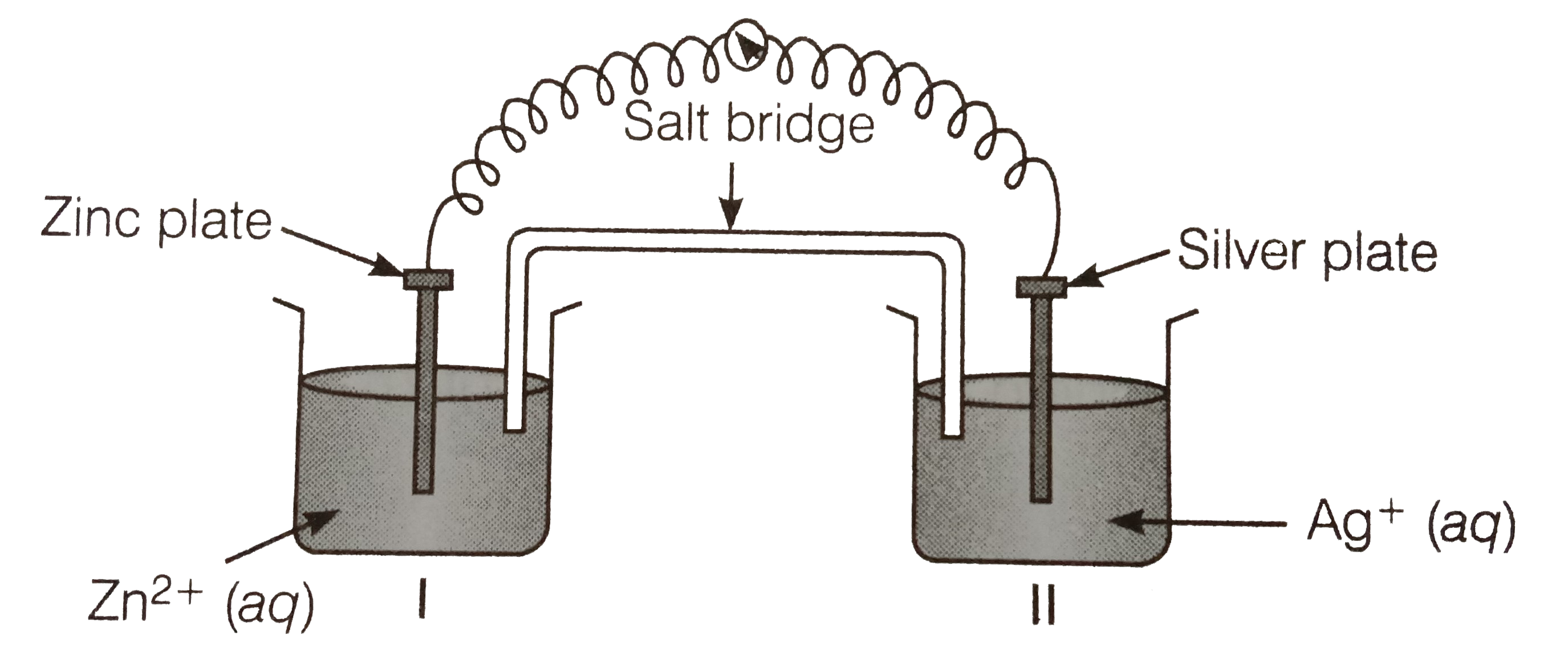
Consider figure from the above question ...

Consider figure from the above question and answer the questions (i) to (vi) given below.

(i) Redraw the diagram to show the direction of electron flow.
(ii) Is silver plate the anode or cathode?
(iii) what will happen it salt bridge is removed?
(iv) When will the cell stop functining?
( v) How will concentration of `Zn^(2+)` ions and `Ag^(+)` ions be affected when the cell function?
(vi) How will the concentration of `Zn^(2+)` ions and `Ag^(+)` ions be affected after the cell becomes dead?

Text Solution

Verified by Experts
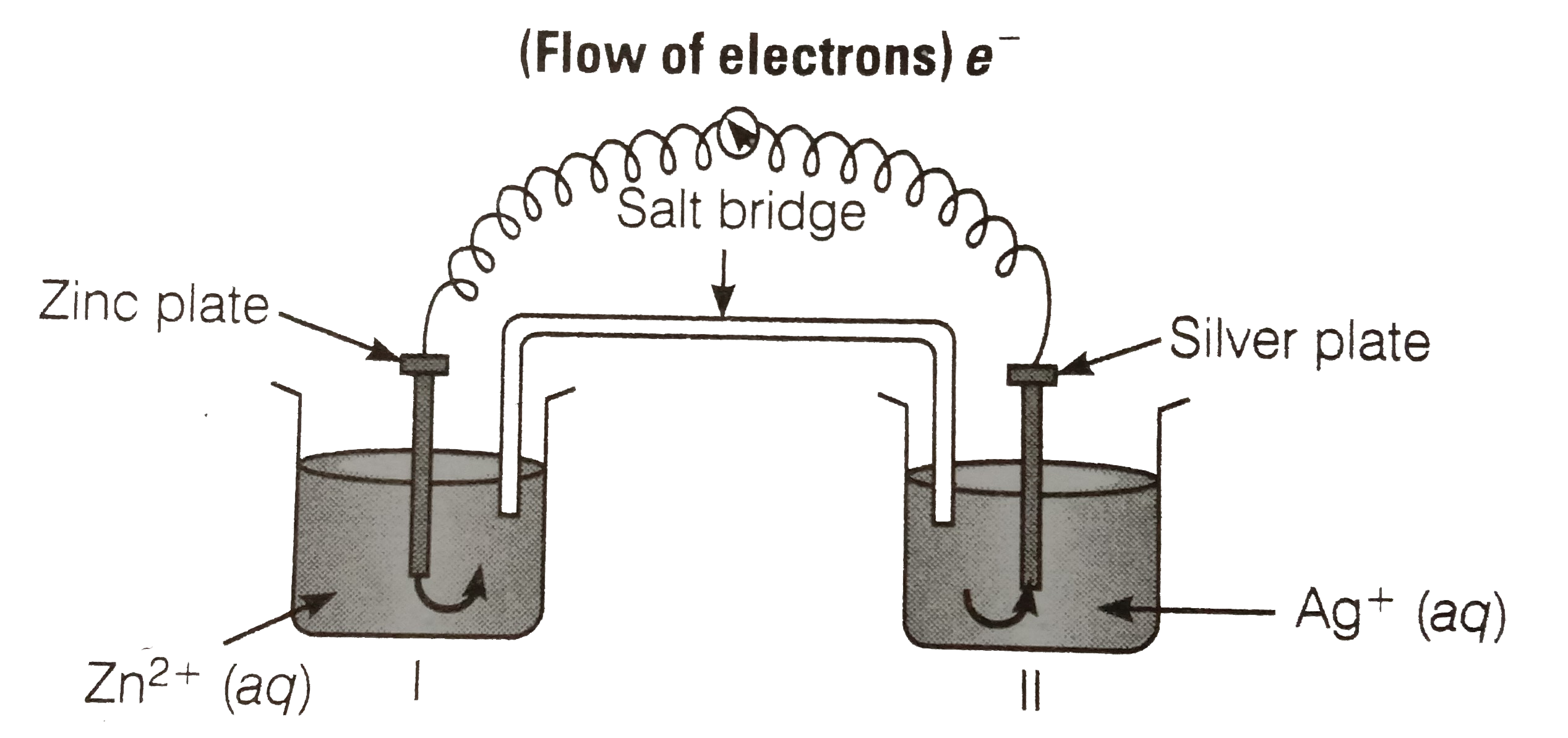
(i) Electrons move from Zn to Ag as `E^(@)` is more negative for Zn so Zn undergoes oxidation and ` Ag^(+)` undergoes reduction.

(ii) Ag is the cathode as it is the site of reduction where `Ag^(+)` takes electrons from medium and deposit at cathode.
(iii) Cell will stop functioning because cell potential drops to zero. AT E=0 reaction reaches equilibrium.
(iv) When `E_("cell")`=0 because at this condition reaction reaches to equilibrium.
(v) concentration of `Zn^(2+)` ions will increase and concentartion of `Ag^(+)` ions will decreases because Zn is converted into `Zn^(2+)` and `Ag^(+)` is converted into Ag.
(vi) when `E_("cell")=0` equilibrium is reached and concentration of `Zn^(2+)` ions and `Ag^(+)` will not change.
Promotional Banner

Topper's Solved these Questions

  • D AND F-BLOCK ELEMENTS

    NCERT EXEMPLAR ENGLISH|Exercise Short Answer Type Question|20 Videos
  • GENERAL PRINCIPLE AND PROCESSES OF ISOLATION OF ELEMENTS

    NCERT EXEMPLAR ENGLISH|Exercise Long Answer Type Questions|1 Videos

Similar Questions

Explore conceptually related problems

(a) When a bright silver object is placed in the solution of gold chloride, it acquires a golden tings but nothing happens when it is placed in solution of copper chloride. Explain this behaviour of silver. [Given : E_(Cu^(2+//)Cu)^(@)=+0.34 V, E_(Ag^(+//)Ag)^(@) =+0.80 V, E_(Au^(3+//)Au)^(@) =+1.40V ] (b) Consider the figure given above and answer the following questions : (i) What is the direction of flow of electrons? (ii) Which is anode and which is cathode? (iii) What will happen if the salt bridge is removed ? (iv) How will concentration of Zn^(2+) and Ag^(+) ions be affected when the cell functions ? (v) How will concentration of these ions be affected when the cell becomes dead ?

Consider the cell Zn|Zn^(2+) || Cu^(2+)|Cu. If the concentration of Zn and Cu ions are doubled, the emf of the cell.

Observe the figure given below, and answer the question. How are i and r related?

Study the given figure and answer the question that follow: Name the ions which will migrate to anode.

Study the given figure and answer the question that follow: Name the ions which will migrate to cathode.

Study the diagram given below and answer the questions that follow : What is emulsification?

Study the diagram given below and then answer the question that follow : Identify the cell.

Write the Nernst equation for the cell reaction in the Daniel cell. How will the E_("cell") be affected when concentration of Zn^(+) ions is increased?

Study the figure given below and answer the questions: (i) How does the repressor molecule get inactivated? (ii) When does the transcription of lac mRNA stop? (iii) Name the enzyme transcribed by the gene Z'.

NCERT EXEMPLAR ENGLISH-ELECTROCHEMISTRY-All Questions
  1. Write the cell reaction of a lead storage battery when it is discharge...

    Text Solution

    |

  2. Why on dilution the Lambda(m) of CH(3)COOH increases drastically, whil...

    Text Solution

    |

  3. Match the terms given in column I with the units given in column II.

    Text Solution

    |

  4. Match the terms given in Column I with the items given in Column II. (...

    Text Solution

    |

  5. Match the items of Column I and Column II.

    Text Solution

    |

  6. Match the items of Column I and Column II.

    Text Solution

    |

  7. Match the items of Column I and Column II.

    Text Solution

    |

  8. Match the items of Column I and Column II on the basis of data given b...

    Text Solution

    |

  9. Assertion(A) Cu is less reactive than hydrogen. Reason(R) E(Cu^(2+)/...

    Text Solution

    |

  10. Assertion (A) E("cell") should have a positive value for the cell to f...

    Text Solution

    |

  11. Assertion (A) Conductivity of all electrolytes decreases on dilution. ...

    Text Solution

    |

  12. Assertion(A) Lambda(m) for weak electrolytes shows a sharp increase wh...

    Text Solution

    |

  13. Assertion(A) Mercury cell does not give steady potential Reason (R) ...

    Text Solution

    |

  14. Assertion(A) Electrolysis of NaCl solution gives chlorine at anode ins...

    Text Solution

    |

  15. Assertion(A) For measuring resistance of an ionic solution an AC sourc...

    Text Solution

    |

  16. Assertion(A) Current stops flowing when E("cell")=0 . Reason(R) Equi...

    Text Solution

    |

  17. Assertion(A) E(Ag^(+)//Ag^(@) increase with increase in concentration ...

    Text Solution

    |

  18. Assertion (A) Copper sulphate can be stored in zinc vessel. Reason(R...

    Text Solution

    |

  19. Consider the figure and answer the following question. (i) Cell '...

    Text Solution

    |

  20. Consider figure from the above question and answer the questions (i) t...

    Text Solution

    |

