Home
Class 11
PHYSICS
Shown are several cuves (fig. (a), (b), ...

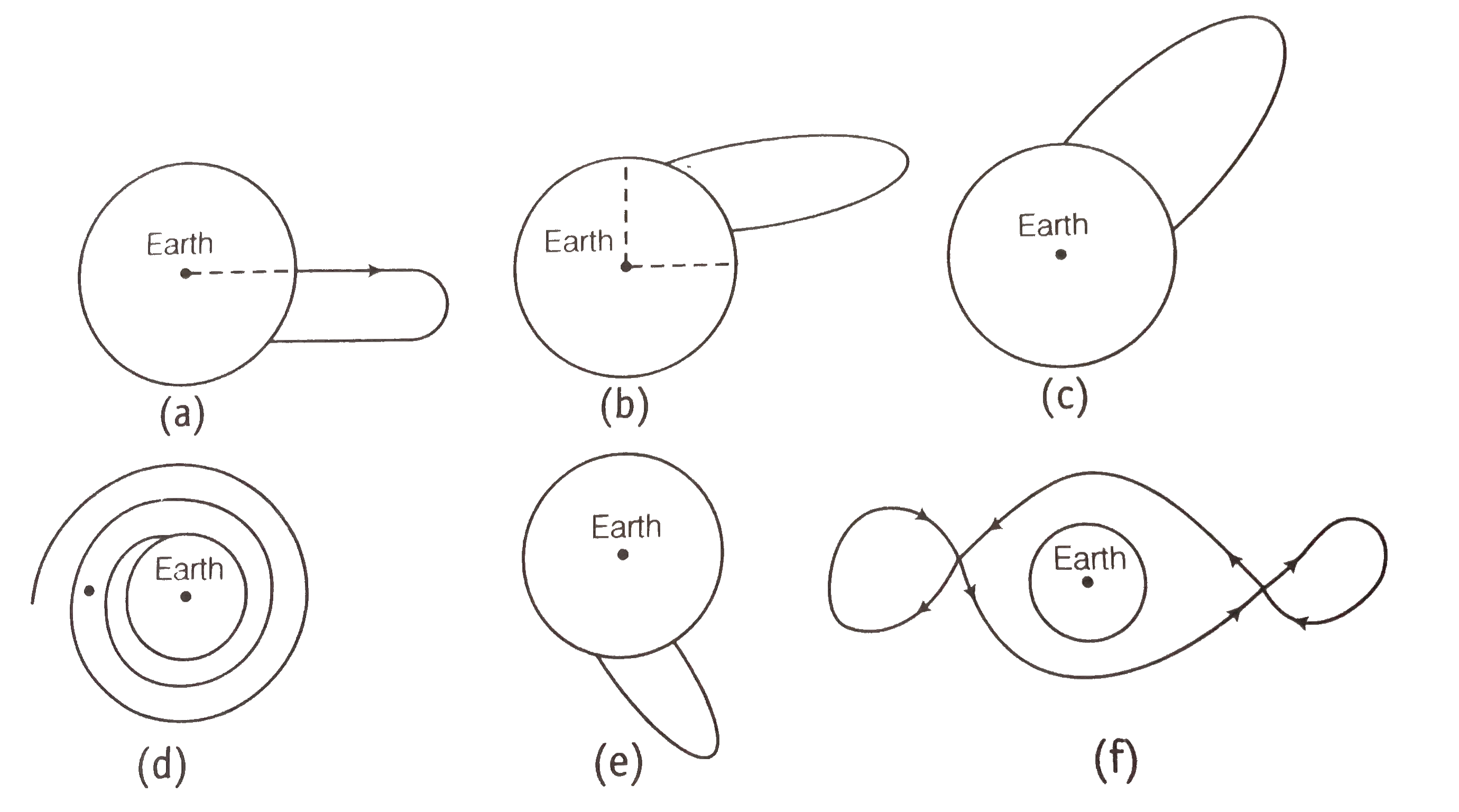
Shown are several cuves (fig. (a), (b), (c), (d), (e), (f)]. Explain with reason, which ones amongst them can be possible trajectories traced by a projectile (neglect air friction).

Text Solution

Verified by Experts

The trajectory of a particle under gravitational force of the earth will be a conic section (for motion outside the earth) with the centre of the earth as a focus. Only (c) meets this requirement
Note. The trajectory of the particle depends upon the velocity of projection. Depending upon the magnitude and direction of velocity it may be parabolic or elliptical
Promotional Banner

Topper's Solved these Questions

  • GRAVITATION

    NCERT EXEMPLAR ENGLISH|Exercise Long Answer type question|5 Videos
  • GRAVITATION

    NCERT EXEMPLAR ENGLISH|Exercise Very short Answer type question|11 Videos
  • KINETIC THEORY

    NCERT EXEMPLAR ENGLISH|Exercise Multiple Choice Questions (MCQs)|31 Videos

Similar Questions

Explore conceptually related problems

If a, b, c, d, e, f are in AP, then (e-c) is equal to which one of the following?

Assertion In projectile motion, the angle between instanteneous velocity vector and acceleration vector can be anything between o to pi (excluding the limiting case) Reason In projectile motion, acceleration vector is always pointing vertically downwards. (Neglect air friction.)

Explain giving reasons : Which of the following is likely to cause more severe burns? (a) water at 100^@C (b) steam at 100^@C .

Statement I: A disc is allowed to roll purely on an inclined plane as shown in Fig. A force F parallel to the incline and passing through the centre of the disc acts which remains constant during the motion. It is possible that for certain values of F , the friction on the disc is acting along downward direction and for certain other values of F , the friction on the disc be acting along upward direction and there is no other possibility. Statement II: The friction (if acting) will be static and not kinetic in nature.

Which one employs 'sexual deceit' to get pollinated by a species of bee? (a) Yucca (b) Ophrys (c) Fig (d) Lichen

A body of mass m was slowly hauled up the hill as shown in the fig. by a force F which at each point was directed along a tangent to the trajectory. Find the work performed by this force, if the height of the hill is h, the length of its base is I and the coefficient ot friction is mu . .

Three projectile A, B and C are thrwon from the same point in the same plane. Their trajectories are shown in the figure. Then which of the following statement is true:-

The graph of (y-x) against (y+x) is shown. fig which one of the following shows the graph of y against x ? fig (b) fig (c) fig (d) fig

Given a,b,c are in A.P. b,c,d are in G.P. and c,d,e are in H.P. if a =2 and e =18, then the possible value of 'c' can be :

The electronic configurations of the four elements A, B, C and D are given below: A - 2, 1 " " B - 2, 2 " " C - 2, 8, 2 " " D - 2 (a) Which amongst these elements belong to same group? Write chemical name of any one of these. (b) Which amongst these elements belong to same period? Write chemical name of any one of these. (c) Which amongst these is not a metal? Write its chemical name.
