Home
Class 9
PHYSICS
The velocity-time graph shows the motion...

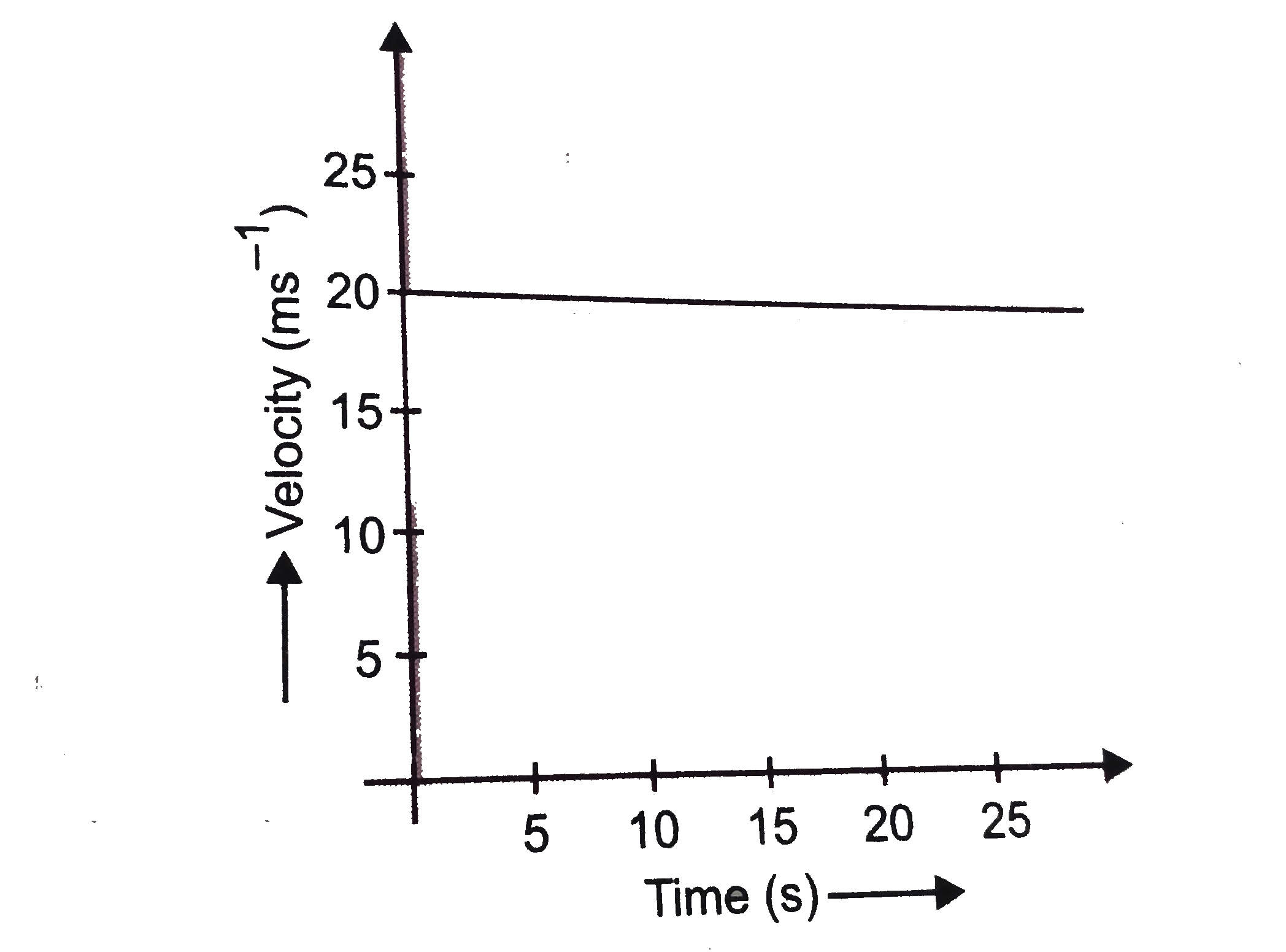
The velocity-time graph shows the motion of a cyclist. Find (i) its acceleration (ii) its velocity and (iii) the distance covered by the cyclist in `15` seconds.

Text Solution

Verified by Experts

(i) From the graph , it is clear that velocity is not changing with time i.e., acceleration is zero. (as a = `(dv)/(dt)+dv= 0`)
(ii) Again from the graph , we can see that there is no change in the velocity with time so, velocity after 15 s will remain same as `20ms^(-1)`
(iii) Distance covered in 15s = `"Velocity" xx "Time"= 20xx15 = 300m [because "Time"=("Distance")/("Speed")]`
Promotional Banner

Topper's Solved these Questions

  • MOTION

    NCERT EXEMPLAR ENGLISH|Exercise Long Answer Type Questions|6 Videos
  • MOTION

    NCERT EXEMPLAR ENGLISH|Exercise Long Answer Type Questions|6 Videos
  • GRAVITATION

    NCERT EXEMPLAR ENGLISH|Exercise LONG ANSWER TYPE QUESTIONS|4 Videos
  • SOUND

    NCERT EXEMPLAR ENGLISH|Exercise Long Answer Type Questions|3 Videos

Similar Questions

Explore conceptually related problems

The slope of velocity-time graph for uniform motion of an object is

A car acquires a velocity of 72 km h^(-1) In 10 s starting from rest. Calculate : (i) the acceleration, (ii) the average velocity, and (iii) the distance travelled in this time.

State how the velocity-time graph can be used to find (i) the acceleration of a body, (ii) the distance travelled by the body in a given time, and (iii) the displacement of the body in a given time.

The initial velocity of a body moving along a straight lines is 7m//s . It has a uniform acceleration of 4 m//s^(2) the distance covered by the body in the 5^(th) second of its motion is-

Draw a velocity-time graph for a body moving with an initial velocity u and uniform acceleration a. Use this graph to find the distance travelled by the body in time t.

A car accelerates uniformly from 18 km//h to 36 km//h in 5 second. Calculate (i) the acceleration and (ii) the distance covered by the car in that time .

The velocity-time graph of an object is shown below. The part of the graph showing zero acceleration is

A car of mass 1000kg accelerates uniformly from rest to a velocity of 54km//h in 5 seconds. Calculate (i) its acceleration (ii) its gain in KE (iii) average power of the engine during this period.

The velocity-time graph of a moving body is given below in Fig. 2.43.(i) the acceleration in parts AB, BC and CD. Find : (ii) displacement in each part AB, BC, CD, and (iii) total displacement.

A particle moves on straight line according to the velocity-time graph shown in fig. Calculate - (i) Total distance covered (ii) Average speed (iii) In which part of the graph the acceleration is maximum and also find its value. (iv) Retardation
