Home
Class 10
BIOLOGY
Would a Planaria cut vertically into two...

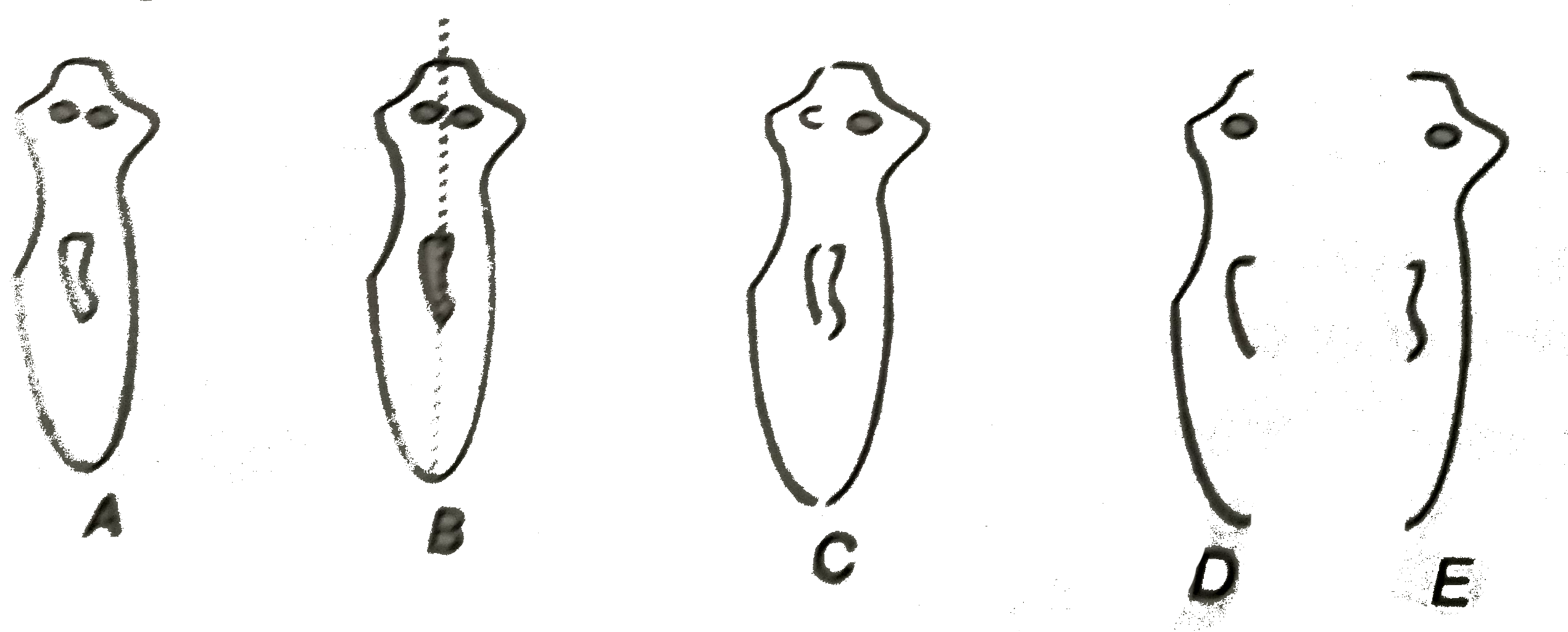
Would a Planaria cut vertically into two halves regenerate into two individuals? Complete the given figure D and E by indicating the regenerated regions.

Text Solution

Verified by Experts
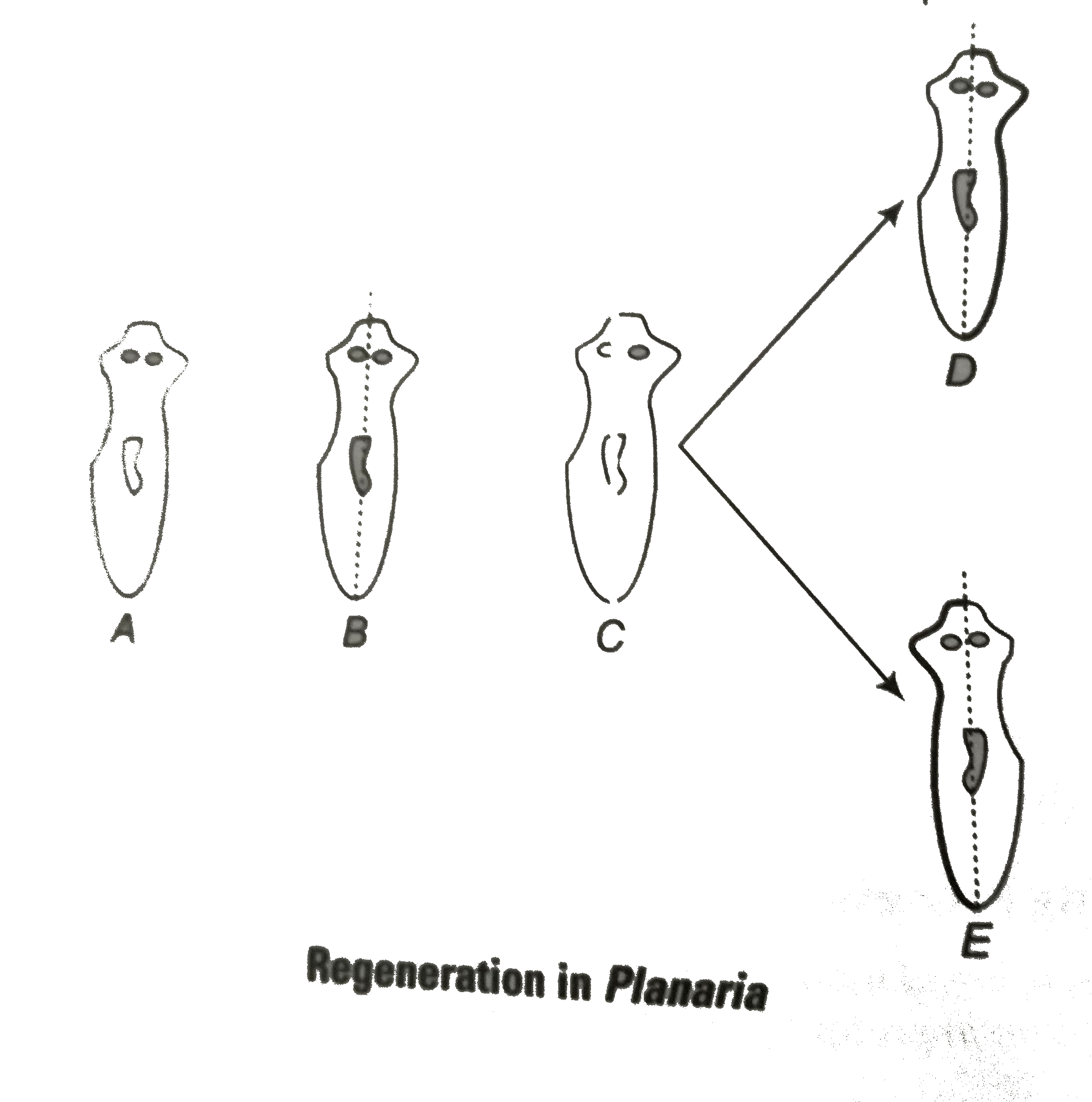
Planaria possesses great power of regeneration. Thus if the body is cut into two vertical halves, each piece of the body of Planaria grows into a complete individual.
Promotional Banner

Topper's Solved these Questions

  • HOW DO ORGANISMS REPRODUCE

    NCERT EXEMPLAR ENGLISH|Exercise Long Answer Type Questions|10 Videos
  • HOW DO ORGANISMS REPRODUCE

    NCERT EXEMPLAR ENGLISH|Exercise Long Answer Type Questions|10 Videos
  • HEREDITY AND EVOLUTION

    NCERT EXEMPLAR ENGLISH|Exercise LONG ANSWER TYPE QUESTIONS|11 Videos
  • LIFE PROCESSES

    NCERT EXEMPLAR ENGLISH|Exercise Long Answer Type Questions|11 Videos

Similar Questions

Explore conceptually related problems

An equi-convex lens of focal length F in air is is cut into two halves along the plane perpendicular to the optic axis. One of the halves is placed between a fixed object and a screen separated by distance of 90 cm . Two images are formed on the screen for two different positions of the lens with magnification 2 and 1/2 respectively. Find the value of F . what would be the value of the focal length of the equiconvex lens if the lens is immersed in water ? Refractive index of the material of the lens is 1.5 and that of water is mu_w=4//3 .

A seed cut into two halves and immersed in 0.1 % triphenyl tetrazolium chloride solution . Its viability is indicated by development of colouration

What will happen if Hydra is cut transversely into two halves (a) Build up the lost part (b) Tend to reunite (c) Cut ends heal up (d) Both halves die

The system shown in the figure is initially in equilibrium. A is of mass 2 m and B,C D and E are of mass m Certain actions are performed on the system. Every action has been taken individually when the system is intact. Find the direction and magnitude of acceleration of the blocks after each action of the following actions has been taken {:((i)"Spting 1 is cut",(ii)"Spring 2 is cut"),((iii)"String between C and D is cut.",(iv)"String between B and C is cut."):}

A point object is placed at a distance of 0.3 m from a convex lens (focal length 0.2 m) cut into two halves each of which is displaced by 0.0005 m as shown in the figure. Find the position of the image . If more than one image is formed find their number and the distance between them.

A point object is placed at a distance of 0.3 m from a convex lens (focal length 0.2 m) cut into two halves each of which is displaced by 0.0005 m as shown in the figure. Find the position of the image . If more than one image is formed find their number and the distance between them.

A point object is placed at a distance of 0.3 m from a convex lens (focal length 0.2 m) cut into two halves each of which is displaced by 0.0005 m as shown in the figure. Find the position of the image . If more than one image is formed find their number and the distance between them.

An object suspended from a spring exhibits oscillations of period T. Now the spring is cut in two halves and the same object is suspended with two halves as shown in figure. The new time period of oscillation will become

Two triangles are congruent if two sides and the included angle of one are equal to the corresponding sides and the included angle of the other triangle. GIVEN : Two triangles A B C and D E F such that A B=D E ,A C=D F and /_A=/_D PROVE : A B C~= D E F Figure

An object suspended from a spring exhibits oscillations of period T . Now ,the spring is cut in half and the two halves are used to support the same object, as shown in figure. The new period of oscillation is . .

NCERT EXEMPLAR ENGLISH-HOW DO ORGANISMS REPRODUCE-Short Answer Type Questions
  1. Can you consider cell division as a type of reproduction in unicellula...

    Text Solution

    |

  2. What is a clone? Why do offsprings formed by asexual reproduction exhi...

    Text Solution

    |

  3. Explain how, offspring and parents of organisms reproducing sexually h...

    Text Solution

    |

  4. Colonies of yeast fail to multiply in water, but multiply in sugar sol...

    Text Solution

    |

  5. Why does bread mould grow profusely on a moist slice of bread rather t...

    Text Solution

    |

  6. Give two reasons for the appearance of variations among the progeny fo...

    Text Solution

    |

  7. Would a Planaria cut vertically into two halves regenerate into two in...

    Text Solution

    |

  8. From the internet, gather information about the chromosome numbers of ...

    Text Solution

    |

  9. In tobacco plant, the male gametes have twenty four chromosomes. What ...

    Text Solution

    |

  10. Why cannot fertilisation take place in flowers if pollination does not...

    Text Solution

    |

  11. Is the chromosome number of zygote, embryonal cells and adult of a par...

    Text Solution

    |

  12. Where is the zygote located in the flower after fertilisation?

    Text Solution

    |

  13. Reproduction is linked to stability of population of a species. Justif...

    Text Solution

    |

  14. How are general growth and sexual maturation different from each other...

    Text Solution

    |

  15. Trace the path of sperm during ejaculation and mention the gland and t...

    Text Solution

    |

  16. What changes are observed in the uterus if fertilisation does not occu...

    Text Solution

    |

  17. What changes are observed in the uterus subsequent to implantation of ...

    Text Solution

    |

  18. What are the benefits of using mechanical barriers during sexual act?

    Text Solution

    |

  19. In the given figure label the parts and mention their functions (a)P...

    Text Solution

    |

  20. What would be the ratio of chromosome number between an egg and its zy...

    Text Solution

    |

