Home
Class 10
PHYSICS
A prism ABC (with BC as base) is placed ...

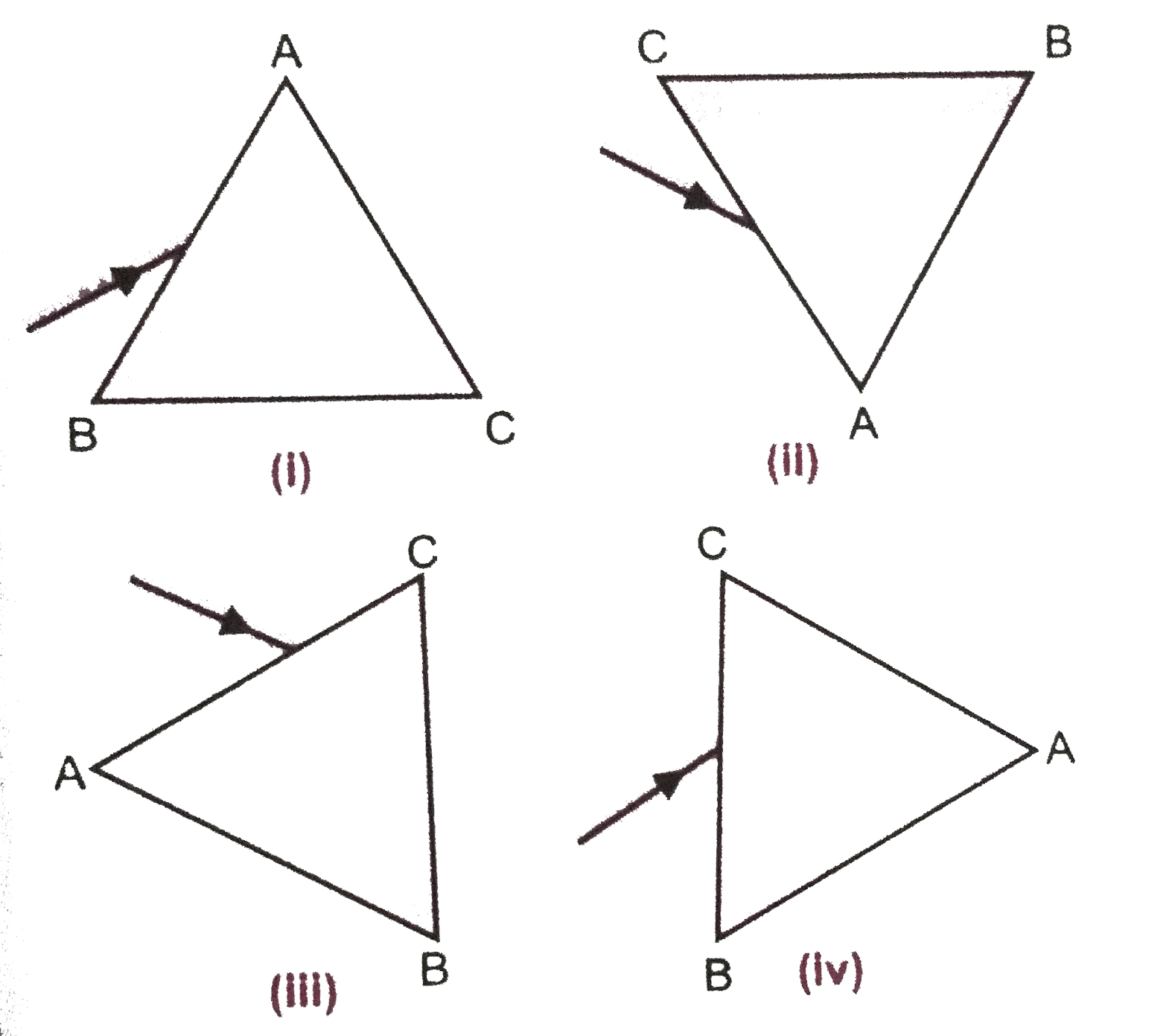
A prism `ABC` (with BC as base) is placed in different orientations. A narrow beam of white light is incident on the prism as shown in (figure 2.21) In which of the following cases, after dispersion, the third colour from the top corresponds to the colour of the sky ?
.

Text Solution

Verified by Experts

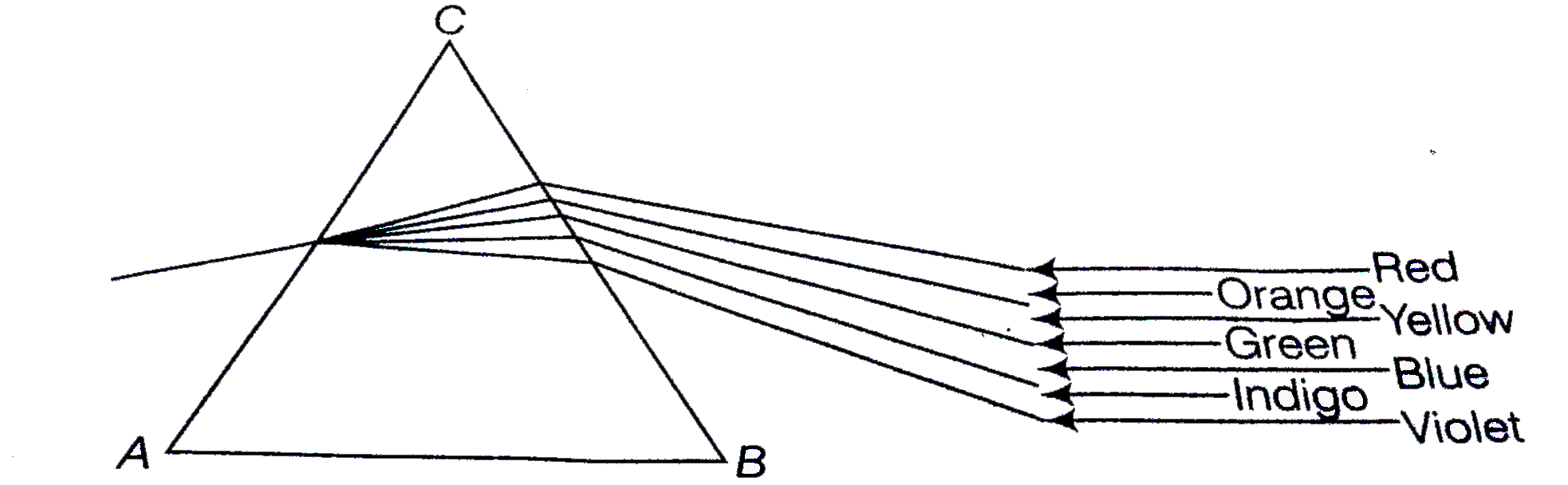
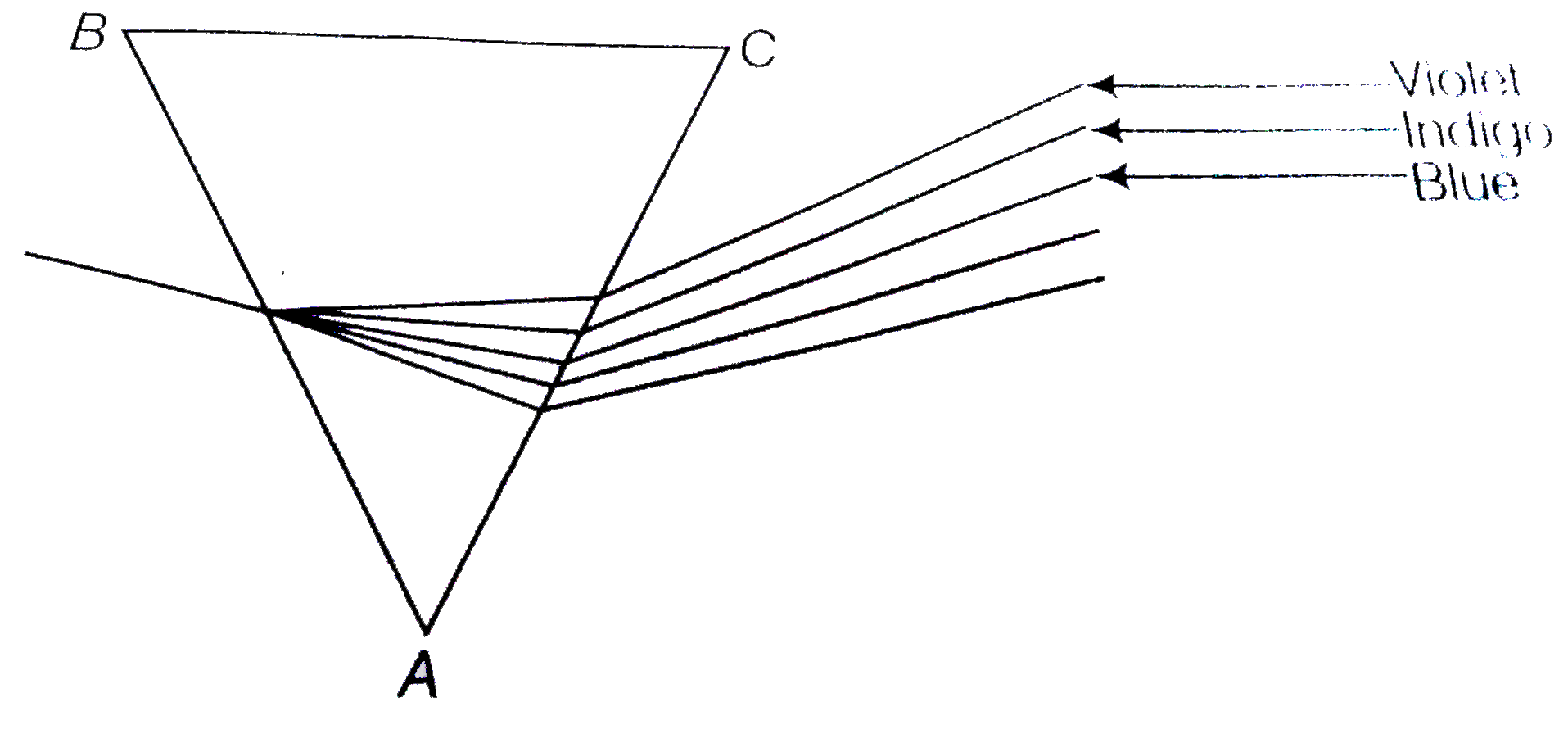
Generally, in case of a prism (II), the formation of spectrum is shown below

In the above figure, from top the third colour is yellow. But we can see that from bottom the third colour is blue which is the colour of sky. So, we can obtain the correct situation by inverting the prism. Thus the required orientations can be bound in case II.
Promotional Banner

Topper's Solved these Questions

  • THE HUMAN EYE AND THE COLOURFUL WORLD

    NCERT EXEMPLAR ENGLISH|Exercise SHORT ANSWER TYPE QUESTIONS|10 Videos
  • THE HUMAN EYE AND THE COLOURFUL WORLD

    NCERT EXEMPLAR ENGLISH|Exercise LONG ANSWER TYPE QUESTIONS|6 Videos
  • SOURCES OF ENERGY

    NCERT EXEMPLAR ENGLISH|Exercise LONG ANSWER TYPE QUESTIONS|7 Videos

Similar Questions

Explore conceptually related problems

Draw a ray diagram showing the dispersion through a prism when a narrow beam of white light is incident on one of its refracting surface. Also indicate the order of the colours of the spectrum obtained.

Which of the following colours of white light deviated most when passes through a prism ?

A parallel beam of light consisting of red and blue colour is incident on a prism as shown in the figure. The refractive indices of the prism for red is 1.40 and for blue is 1.47. The prism will (sin44°=1/1.44)

Two light rays 1 and 2 are incident on two faces AB and AC on an isosceles prism as shown in the figure. The rays emerge from the side BC. Then,

A light ray is incident normally on the face AB of a right-angled prism ABC (mu==1.50) as shown in figure. What is the largest angle phi for which the light ray is totally reflected at the surface AC ?

If two prisms are combined , as shown in figure, find the total angular dispersion and angle of deviation suffered by a white ray of light incident on the combination.

The diagram shown below in Fig. 6.8 shows the path taken by a narrow beam of yellow monochromatic light passing through an equiangular glass prism. If the yellow light is replaced by a narrow beam of white light incident at the same angle, draw another diagram to show the passage of white light through the prism and label it to show the effect of the prism on the white light.

A ray of light is incident on a prism ABC of refractive index sqrt3 as shown in the figure. The angle by which the second identical prism must be rotated so that the final ray suffers net minimum deviation is

White light is incident on a glass prism as shown. Four easily identifiable colors – red, green, yellow and blue get separated as A, B, C and D. Which of the rays (A, B, C and D) correspond to which color?

A ray of light mekes normal incidence on the diagonal face of a right angled prism as shown in figure. If theta=37^@, then the angle of deviation after second step (from AB ) is (sin 37^@=3//5)