Home
Class 11
CHEMISTRY
In the presence of peroxide addition of ...

In the presence of peroxide addition of HBr to propene takes place according to anti Markownikoff's rule but peroxide effect is not seen in the case of HCl and HI. Explain.

Text Solution

Verified by Experts
`underset("propene")(CH_(3)-CH=CH_(2)+HBr)overset("Perioxide")rarrunderset("n-propyl bormide")(CH_(3)-CH_(2)CH_(2)Br)`
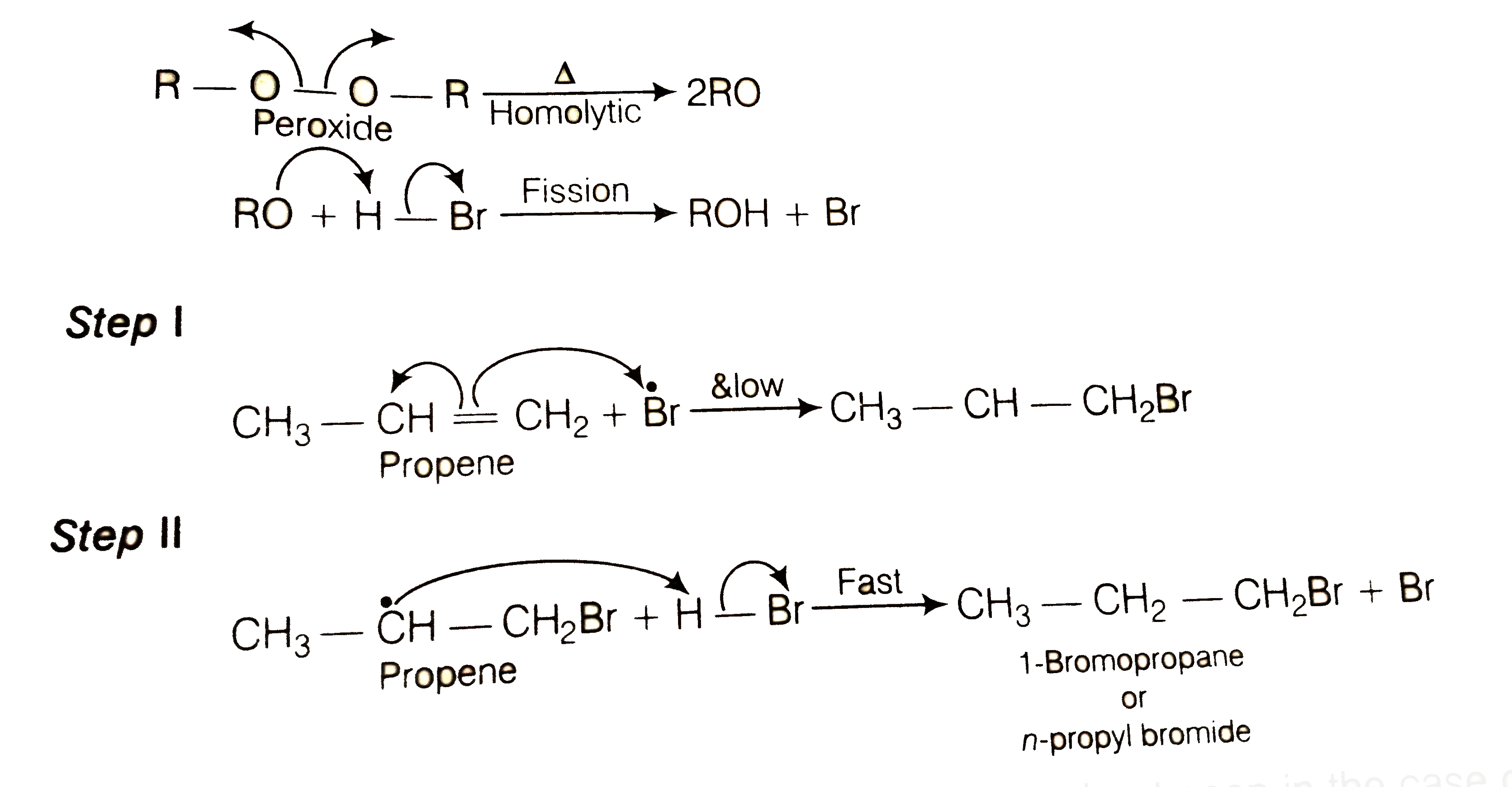
The mechanism of the reaction is

Perioxide effect is effective only in the case of HBr and not seen in the case of HCl and HI. This is due to the following reasons.
(i) H - Cl bond (103 kcal/mol) is stronger than H-Br bond (87 kcal/mol) H-Cl bond is not decomposed by the peroxide free redical whereas the H-I bond is weaker (71 kcal/mol) form iodine free radicals .
(ii) lodine free radical `(I^(@))` formed as H - I bond is weaker bot iodine free radicalts readily combine with each other to form iodine molecules rather attacking the double bond .
Promotional Banner

Topper's Solved these Questions

  • HYDROCARBONS

    NCERT EXEMPLAR ENGLISH|Exercise Assertion and Reason|4 Videos
  • ENVIRONMENTAL CHEMISTRY

    NCERT EXEMPLAR ENGLISH|Exercise Long Answer Type|5 Videos
  • HYDROGEN

    NCERT EXEMPLAR ENGLISH|Exercise LONG ANSWER TYPE QUESTIONS|8 Videos

Similar Questions

Explore conceptually related problems

Why is in the presence of diethyl peroxide, the addition of HBr to propene is against Markownikoff's rule?

Explain Markownikoff's rule with respect to the addition of HCl propene.

Reaction of HBr with propene in the presence of peroxide gives :-

The intermediate during the addition of HCl to propene in the presence of peroxide is :

In the presence of peroxide, hydrogen chloride and hydrogen iodide do not give anti-Markovnikov's addition to alkenes because:

In the adddition of HBr to propene in the absence of peroxides, the first step involves the addition of-s

Assertion: -The addition of HCl to unsymmetrical alkenes in the presence of organic peroxides takes place against Markownikoff's rule. Reason :- 2^@ free radicals are more stable than 1^@ free radicals.

The reaction of HBr with 1-propene in the presence of peroxides will produce primarily

Addition of HBr to propene yields 2-bromopropane, while in the presence of benzoyl peroxide, the same reaction yields 1-bromopropane. Explain and give mechanism.

The reaction intermediates involved in the addition of HBr to propene in the presence of an organic peroxide are (a) free radicals (b)carbocations (c)carbanions (d)carbenes

