Home
Class 12
CHEMISTRY
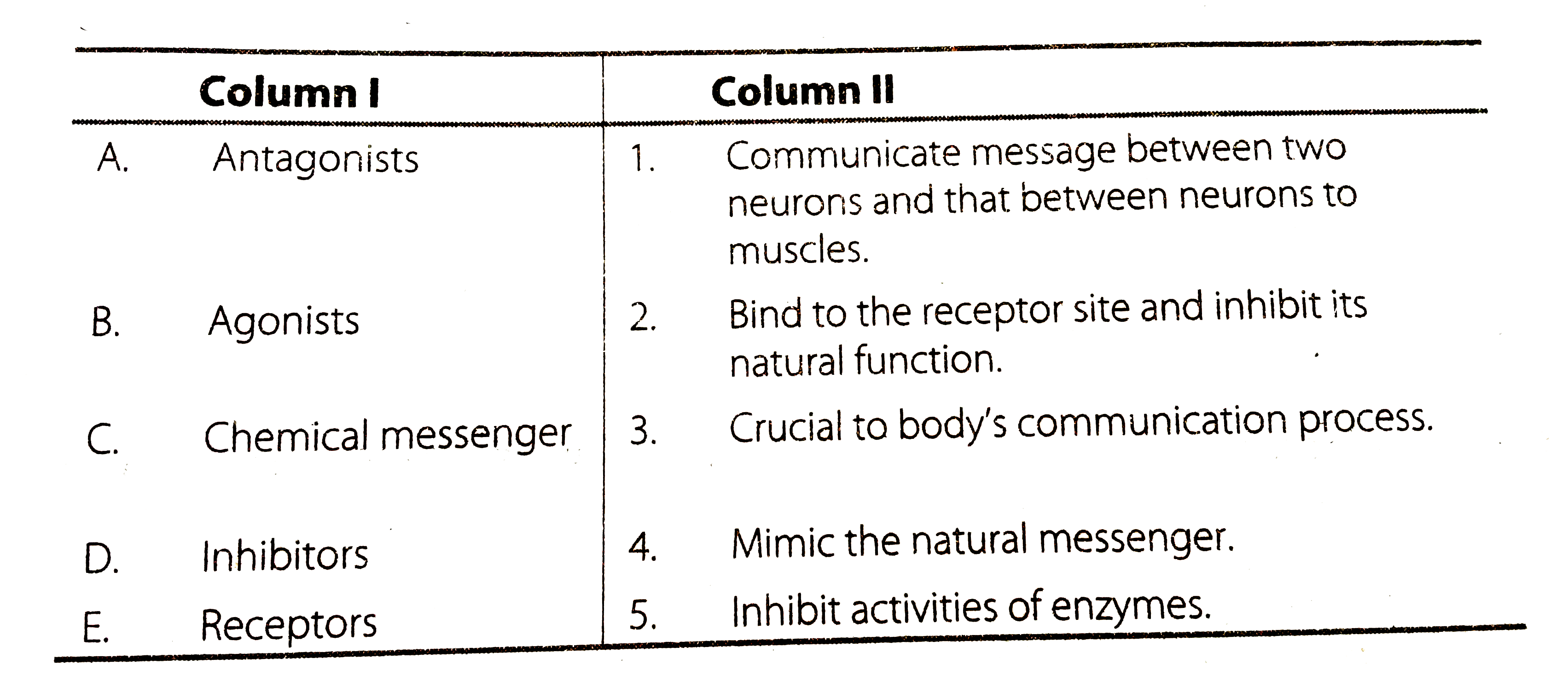
Match the class of compounds given in Co...

Match the class of compounds given in Column I with their functions given in Column II.

Text Solution

Verified by Experts

The correct Answer is:

`Ararr(2) B.rarr(4) C.rarr(1) D.rarr(5) Erarr(3)`

A. Antagonist drugs are used when blocking of message is required e.g., doparmine antagoist is a drug which blocks the dopamine receptors antagonism.
B. Agonist drugs are useful when there is lack of chemical messenger e.g., herion.
C. These chemical messengers are received at the binding sites of receptor. These communicate between two neurons and that between neurons to muscles.
D. Inhibitors block the binding site of the enzyme and prevent the binding of the substrate, or inhibitthe catalytic activity of the enzyme. ltbr E. Receptors are proteins that are crucial to body's communication. They are embedded in the cell membrane in such a way that their small part possessing active site projects out of the surfae of the membrane of and opens on the outside region of the cell membrane.
Promotional Banner

Topper's Solved these Questions

  • CHEMISTRY IN EVERYDAY LIFE

    NCERT EXEMPLAR ENGLISH|Exercise Assertion and Reason|14 Videos
  • CHEMISTRY IN EVERYDAY LIFE

    NCERT EXEMPLAR ENGLISH|Exercise Long Answer Type Qns|4 Videos
  • CHEMISTRY IN EVERYDAY LIFE

    NCERT EXEMPLAR ENGLISH|Exercise Short Answer Type|39 Videos
  • CHEMICAL KINETICS

    NCERT EXEMPLAR ENGLISH|Exercise LONG ANSWER TYPE QUESTIONS|5 Videos
  • COORDINATION COMPOUNDS

    NCERT EXEMPLAR ENGLISH|Exercise Long Answer Type Question|5 Videos

Similar Questions

Explore conceptually related problems

Match the classes of drugs given in Column I with their action given in Column II.

Match the compounds given in column I with the effects given in Column II

Match the phytohormones given in column I with their functions given in column II. Choose the answer with the correct combination of the alphabets of the two-column.

Match the compounds given in Column-I with the items given in Column - II.

Match the pollutants given in Column I with their effects given in Column II.

Match the reactions given in Column I with the type of reactions given in Column II

Match the compounds given in Column I with the hybridisation and shape given in Column II and mark the correct option.

Match the ions given in Coumn I with their nature given in Column II.

Match the formulas of oxides given in Column I with the type of oxide given in Column II and mark the correct option.

Match the reactions given in Column I with the names given in Column II.
