Home
Class 12
CHEMISTRY
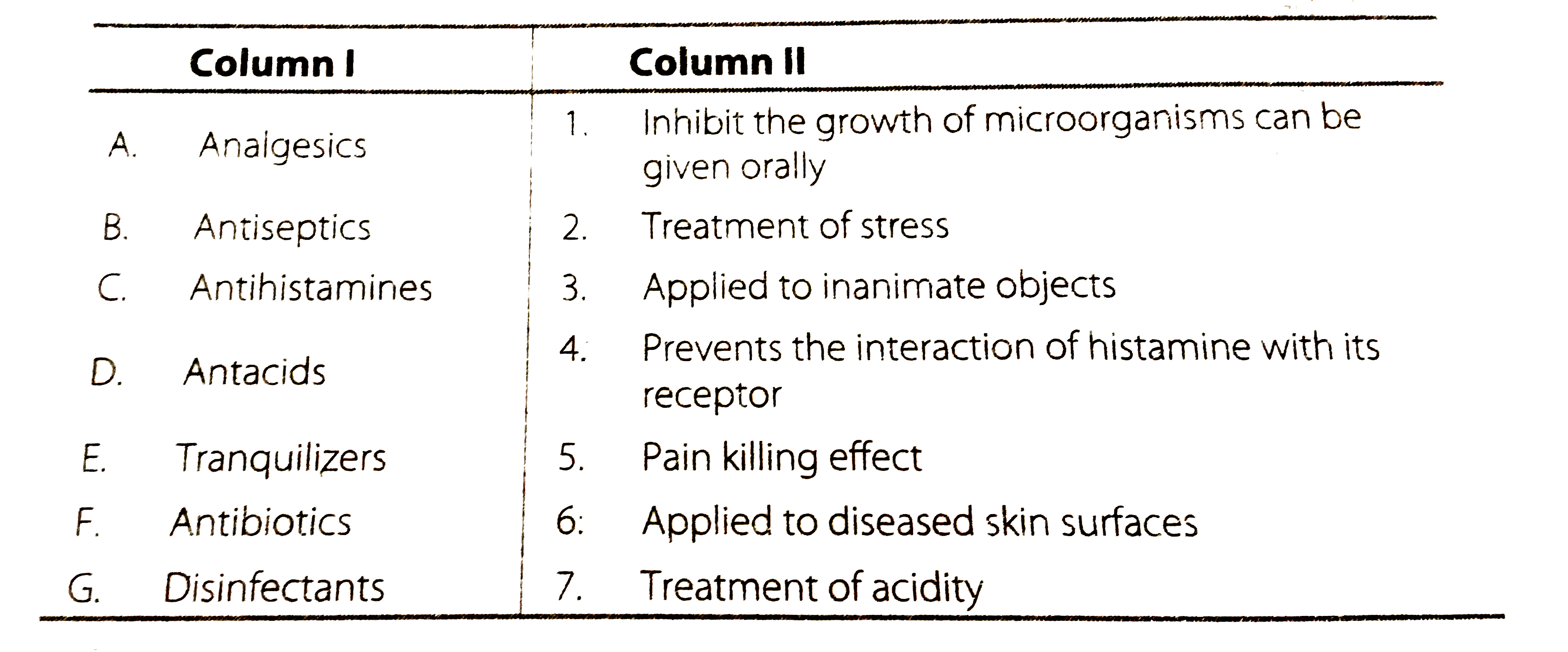
Match the classes of drugs given in Colu...

Match the classes of drugs given in Column I with their action given in Column II.

Text Solution

Verified by Experts

The correct Answer is:

`Ararr(5) B.rarr(6) C.rarr(4) D.rarr(7) Erarr(2) F.rarr(1) G.rarr(3)`

A. Analgesics reduce or abolish pain without causing impariment of consciousness, metal coordinatin or paralysis or some other disturbances of nervous system, e.g., asprin.
B. Antiseptics are are the chemicals which either either kill or prevent the growth of microorganisms. They are applied to living tissues such as wounds cuts etc. e.g., tincture of iodine.
C. Antihistamines are anti-allergic drugs. These drugs interfere with the natural action of histamine by competing with histamine for binding sites of receptor where histamine exerts its effect e.g., seldane.
D. Antacids are used to neutralise excess of acid released in stomach e.g., mixture of `Mg(OH)_(2)` and `Al(OH)_(3)`.
E. Tranquillizers are used for the treatment of stress , and mild or even severe mental diseases e.g., equanil.
F. Antibiotics are antimicrobial drugs. Antibiotics are used as drugs to treat infections because of their toxicity for humans and animals e.g., chloramphenicol.
G. Disinfectants are the chemicals which either kill or prevent the growth of microoganisms but they can be applied on non-living objects e.g., 1 per cent solution of phenol.
Promotional Banner

Topper's Solved these Questions

  • CHEMISTRY IN EVERYDAY LIFE

    NCERT EXEMPLAR ENGLISH|Exercise Assertion and Reason|14 Videos
  • CHEMISTRY IN EVERYDAY LIFE

    NCERT EXEMPLAR ENGLISH|Exercise Long Answer Type Qns|4 Videos
  • CHEMISTRY IN EVERYDAY LIFE

    NCERT EXEMPLAR ENGLISH|Exercise Short Answer Type|39 Videos
  • CHEMICAL KINETICS

    NCERT EXEMPLAR ENGLISH|Exercise LONG ANSWER TYPE QUESTIONS|5 Videos
  • COORDINATION COMPOUNDS

    NCERT EXEMPLAR ENGLISH|Exercise Long Answer Type Question|5 Videos

Similar Questions

Explore conceptually related problems

Match the class of compounds given in Column I with their functions given in Column II.

Match the polymers given in column I with their main applications given in column II

Match the polymer given in Column I with their chemical names given in Column II

Match the reactions given in Column I with the type of reactions given in Column II

Match the ions given in Coumn I with their nature given in Column II.

Match the polymers given in column I with their repeating units given in column II

match the types of defect given in column I with the statement given in column II.

Match the statements given in Column I with the oxidation states given in Column II.

match the types of defect given in column I with the statement given in column II.

Match the terms given in Column I with the compound given in Column II.
