Home
Class 12
CHEMISTRY
Identify A to E and also explain the rea...

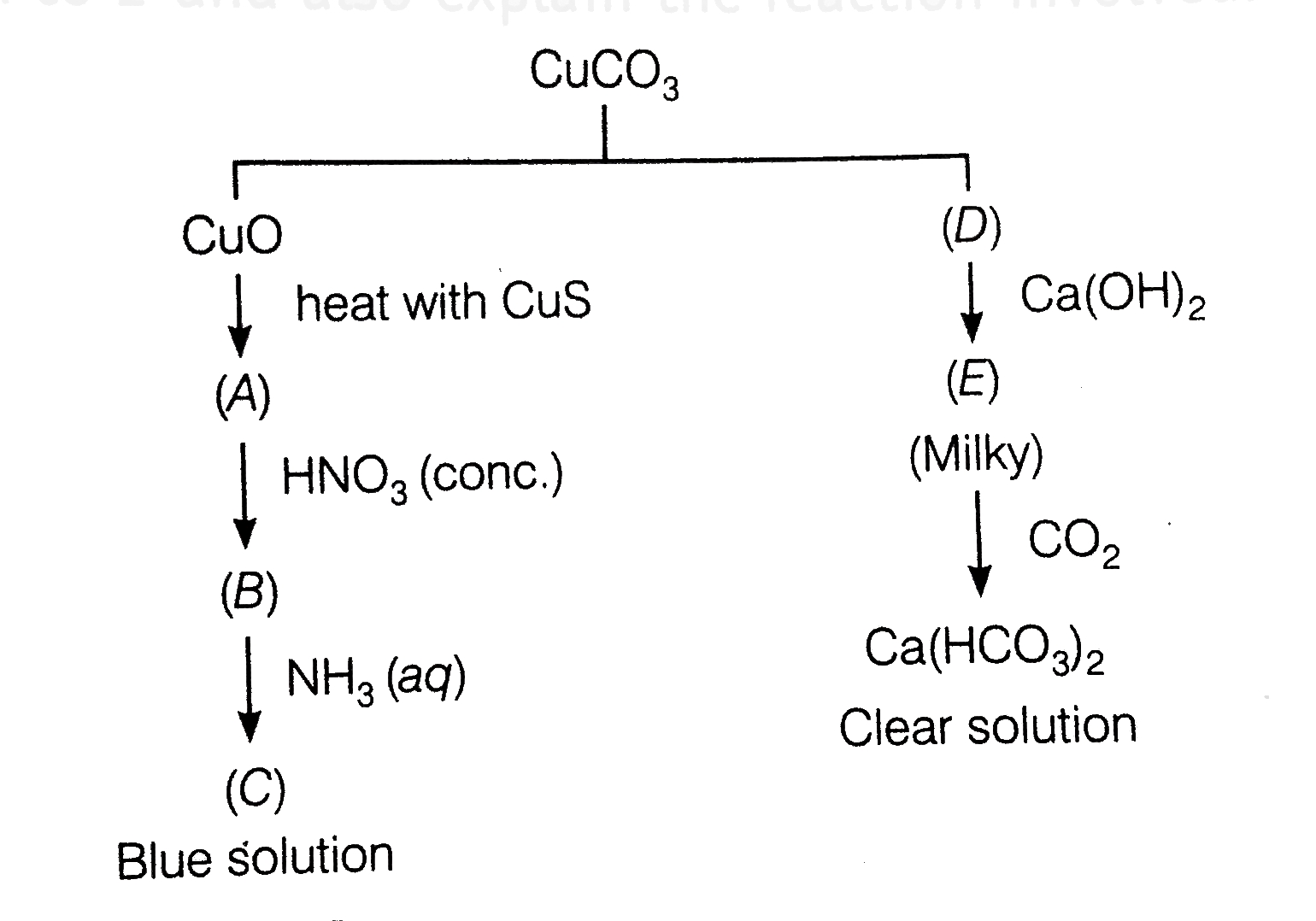
Identify A to E and also explain the reaction involved.

Text Solution

Verified by Experts

The substances from A to E are
A = Cu, B = Cu`(NO_(3))_(2)`, C = `[Cu(NH_(3))_(4)]^(2+)`, D = `CO_(2)`, E = `CaCO_(3)`
Reactions:
(i) `CuCO_(3)overset(Delta)rarr CuO+CO_(2) xx2`
(ii) `2CuO + CuS rarr underset([A])(3Cu) + SO_(2)`
(iii) `underset ([A])(Cu) + 4HNO_(3) ("Conc.")rarr Cu underset([B])((NO_(3))_2)+2NO+2H_(2)O`
(iv) `C underset([B])(u^(2+))+NH_(3) rarr undersetunderset(("Blue solution"))([C])([Cu(NH_(3))_(4)])`
(v) `Ca(OH)_(2) + underset([D])(CO_(2)) rarr undersetunderset(("Milky"))([E]) (CaCO_(3)) + H_(2)O`
(vi) `CaCO_(3) + H_(2)O + CO_(2) rarr Ca(HCO_(3))_(2)`
Promotional Banner

Topper's Solved these Questions

  • D AND F-BLOCK ELEMENTS

    NCERT EXEMPLAR ENGLISH|Exercise Short Answer Type Question|20 Videos
  • COORDINATION COMPOUNDS

    NCERT EXEMPLAR ENGLISH|Exercise Long Answer Type Question|5 Videos
  • ELECTROCHEMISTRY

    NCERT EXEMPLAR ENGLISH|Exercise All Questions|67 Videos

Similar Questions

Explore conceptually related problems

When an oxide of manganese (A) is fused with KOH in the presence of an oxidising agent and dissolved in water, it gives a dark green solution of compound (B). Compound (B) disproportionates in neutral or acidic (C ) oxidises potassium iodide solution to a compound (D) and compound (A) is also formed. Identify compounds A to D and also explain the reactions involved.

What is the reaction involved in B?

A substance X, which is an oxide of a group 2 element, is used intensively in the cement industry. This element is present in bones also. On treatment with water it forms a solution which turns red litmus blue. Identify X and also write the chemical reactions involved.

Identify ( E) .

Metabolic reaction involves

Name the reaction which is commonly used in the conversion of vegetable oil to fats. Explain the reaction involved in detail.

Explain the principle involved in ELISA.

NCERT EXEMPLAR ENGLISH-D AND F-BLOCK ELEMENTS-Short Answer Type Question
  1. Identify A to E and also explain the reaction involved.

    Text Solution

    |

  2. Why does copper not replace hydrogen from acids?

    Text Solution

    |

  3. Why E^(-) values for Mn, Ni and Zn are more negative than expected?

    Text Solution

    |

  4. Why first ionisation enthalpy of Cr is lower than that of Zn?

    Text Solution

    |

  5. Transition elements show high melting points. Why?

    Text Solution

    |

  6. When Cu^(2+) ion is treated with KI, a white precipitate is formed. Ex...

    Text Solution

    |

  7. Out of Cu(2)Cl(2) and CuCl(2), which is more stable and why?

    Text Solution

    |

  8. When a brown compound of manganese (A) is treated with HCl it gives a ...

    Text Solution

    |

  9. Although fluorine is more electronegative than oxygen, but the ability...

    Text Solution

    |

  10. Although Cr^(3+) and Co^(2+) ions have same number of unpaired electro...

    Text Solution

    |

  11. Ionisation enthalpies of Ce, Pr and Nd are higher than Th, Pa and U. W...

    Text Solution

    |

  12. Although Zr belongs to 4d and Hf belongs to 5d transition series but i...

    Text Solution

    |

  13. Cerium shows oxidation state of +4 because

    Text Solution

    |

  14. Explain why does colour of KMnO(4) disappear when oxalic acid is added...

    Text Solution

    |

  15. When orange solution containing Cr(2)O(7)^(2-) ion is treated with an ...

    Text Solution

    |

  16. A solution of KMnO(4) on reduction yields either a colourless solution...

    Text Solution

    |

  17. The second and third rows of transition elements resemble each other m...

    Text Solution

    |

  18. E^(Theta) of Cu is +0.34V while that of Zn is -0.76 V. Explain.

    Text Solution

    |

  19. The halides of transition elements become more covalent with increasin...

    Text Solution

    |

  20. While filling up of electrons in the atomic orbitals, the 4s orbital i...

    Text Solution

    |

  21. Reactivity of transition elements decreases almost regularly from Sc t...

    Text Solution

    |
