Home
Class 11
PHYSICS
Find the time period of mass M when disp...

Find the time period of mass M when displaced from its equilibrium position and then released for the system shown in figure.

Text Solution

Verified by Experts
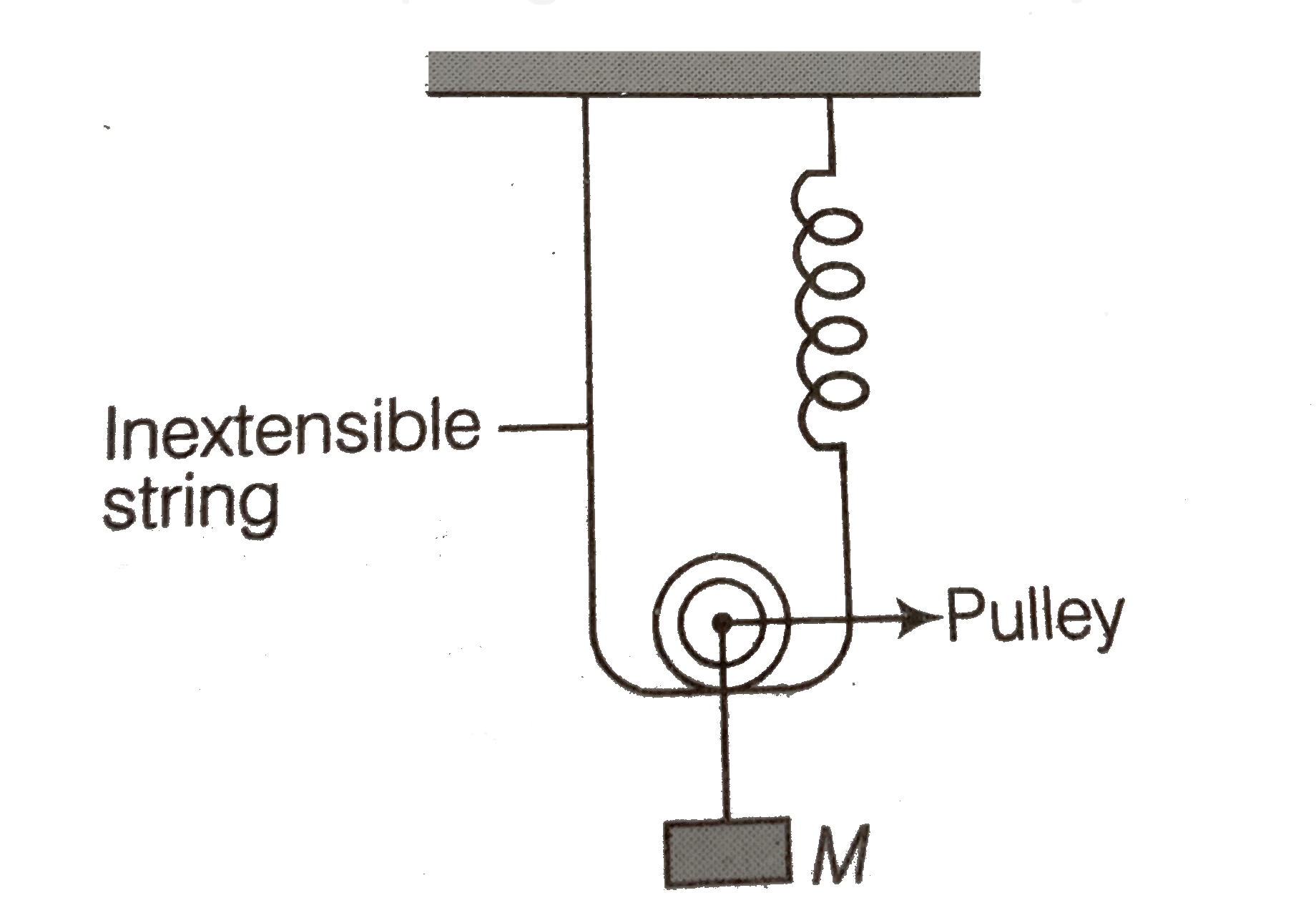
For the calculation purpse, in this situation we will neglect gravity because it is constant throughout and will not effect the net restoring force.
Let in the equilibrium position, the spring has extended by an amount `x_(0)`

Now, if the mass is given a further displacement downwards by an amount x. The string and spring both should increase in length by x.
But, string is inextensible, hence the spring alone will contribute the total extension `x+x=2x`, to lower the mass down by x from initial equilibrium mean position `x_(0)`. So, net extension in the spring `(=2x+x_(0))`.
Now force on the mass before bulling (in the `x_(o)`extension caes)

`F=2T`
But `T=kx_(0)` [where k is spring constant]
`:.F=2kx_(0)" " ....(i)`
When the mass is lowered down further by x,
`F'=2T['`
But new spring length `=(2x+x_(0))`
`:.F'=2k(2x+x_(0))" ".....(ii)`
Restoring force on the system.
`F_("restoring")=-[F'-F]`

Using Eqs. (i) and (ii), we get
`F_("restoring")=-[2k(2x+x_(0))-2kx_(0)]`
`=-[2xx2kx+2kx_(0)-2kx_(0)]`
`=-4kx`
or `Ma=-4kx`
where, a= acceleration " " (As, F =ma)
`rArra=-((4k)/(M))x`
`k_(1)` M being constant.
`:.aprop-x`
Hence, motion is SHM.
Comparing the above accleration expression with standard SHM equation `a=-omega^(2)x,` we get
`omega^(2)=(4k)/(M)rArromega=sqrt((4k)/(M)`
:. Time period `T=(2pi)/(omega)=(2pi)/(sqrt((4k)/(M)))=2pisqrt((M)/(4k))`
Promotional Banner

Topper's Solved these Questions

  • MOTION IN A STRAIGHT LINE

    NCERT EXEMPLAR ENGLISH|Exercise Very Short Answer Type Qns|14 Videos
  • SYSTEM OF PARTICLES AND ROTATIONAL MOTION

    NCERT EXEMPLAR ENGLISH|Exercise Long answer type questions|12 Videos

Similar Questions

Explore conceptually related problems

Find the period of oscillation of the system shown in figure.

A small ball B of mass m is suspended with light inelastic string of length L from a block A of same mass in which can move on smooth horizontal surface as shown in the figure. The ball is displaced by angle theta from equilibrium position and then released. The displacement of centre of mass of A + B system till the string becomes vertical is

A small ball B of mass m is suspended with light inelastic string of length L from a block A of same mass in which can move on smooth horizontal surface as shown in the figure. The ball is displaced by angle theta from equilibrium position and then released. Tension in string when it is vertical, is

A mass of 1.5 kg is connected to two identical springs each of force constant 300 Nm^(-1) as shown in the figure. If the mass is displaced from its equilibrium position by 10 cm, then maximum speed of the trolley is

Figure shows a system consisting of a massless pulley, a spring of force constant k and a block of mass m. If the block is slightly displaced vertically down from is equilibrium position and then released, the period of its vertical oscillation is

A small ball B of mass m is suspended with light inelastic string of length L from a block A of same mass in which can move on smooth horizontal surface as shown in the figure. The ball is displaced by angle theta from equilibrium position and then released. The displacement of block when equilibrium position is

Figure-1 to Figure -4 shows four different spring arrangements . Mass m in each arrangement is displacement from its equilibrium position and released Neglec mass of the springs. Choose the correct statement (s)

Two identical springs of spring constant k are attached to a block of mass m and to fixed supports as shown in figure . Show that when the mass is displaced from its equilibrium position on either side, it executes a simple harmonic motion. Find the period of oscillation.

A mass of 1.5 kg is connected to two identical springs each of force constant 300 Nm^(-1) as shown in the figure. If the mass is displaced from its equilibrium position by 10cm, then the period of oscillation is

A mass of 0.5 kg is hung from a spring. A gradually increasing 0.5 N force is required to pull the mass downward a distance of 0.25 m from its equilibrium position,if the mass is then released from this position, find (a) The total energy of the system . (b) The frequency of the oscillation (c ) The speed and acceleration of the mass as it passes the equilibrium position. (d) The speed and acceleration of the mass when the diplacement from equilibrium is 0.25 m (e) For the initial condition stated, write down the diplacement equation of motion for this mass.

NCERT EXEMPLAR ENGLISH-OSCILLATIONS-All Questions
  1. A body is performing SHM, then its

    Text Solution

    |

  2. Displacement versus time curve for a particle executing SHM is shown i...

    Text Solution

    |

  3. Tow identical springs of spring constant k are attached to a block of ...

    Text Solution

    |

  4. What are the two basic characteristics of a simple harmonic motion?

    Text Solution

    |

  5. When will the motion of a simple pendulum be simple harmonic?

    Text Solution

    |

  6. What is the ratio of maximum acceleration to the maximum velocity of a...

    Text Solution

    |

  7. What is the ratio between the distance travelled by the oscillator in ...

    Text Solution

    |

  8. In figure, what be the sign of the velocity of the point P', which is ...

    Text Solution

    |

  9. Show that for a particle executing SHM, velocity and dispacement have ...

    Text Solution

    |

  10. Draw a graph to show the variation of PE, KE and total energy of a sim...

    Text Solution

    |

  11. The length of a second's pendulum on the surface of earth is 1 m. What...

    Text Solution

    |

  12. Find the time period of mass M when displaced from its equilibrium pos...

    Text Solution

    |

  13. Show that the motion of a particle represented by y=sinomegat-cosomega...

    Text Solution

    |

  14. Find the displacement of a simple harmonic oscillator at which its PE ...

    Text Solution

    |

  15. A body of mass m is situated in potential field U(x)=U(o)(1-cospropx) ...

    Text Solution

    |

  16. A mass of 2kg is attached to the spring of spring constant 50Nm^(-1). ...

    Text Solution

    |

  17. Consider a pair of identical pendulums, which oscillate with equal amp...

    Text Solution

    |

  18. A person normally weighing 50 kg stands on a massless platform which o...

    Text Solution

    |

  19. A body of mass m is attached ot one end of a massless spring which is ...

    Text Solution

    |

  20. A cylindrical log of wood of height h and area of cross-section A floa...

    Text Solution

    |