Home
Class 11
PHYSICS
ABCDEFGH is a hollow cube made of an in...

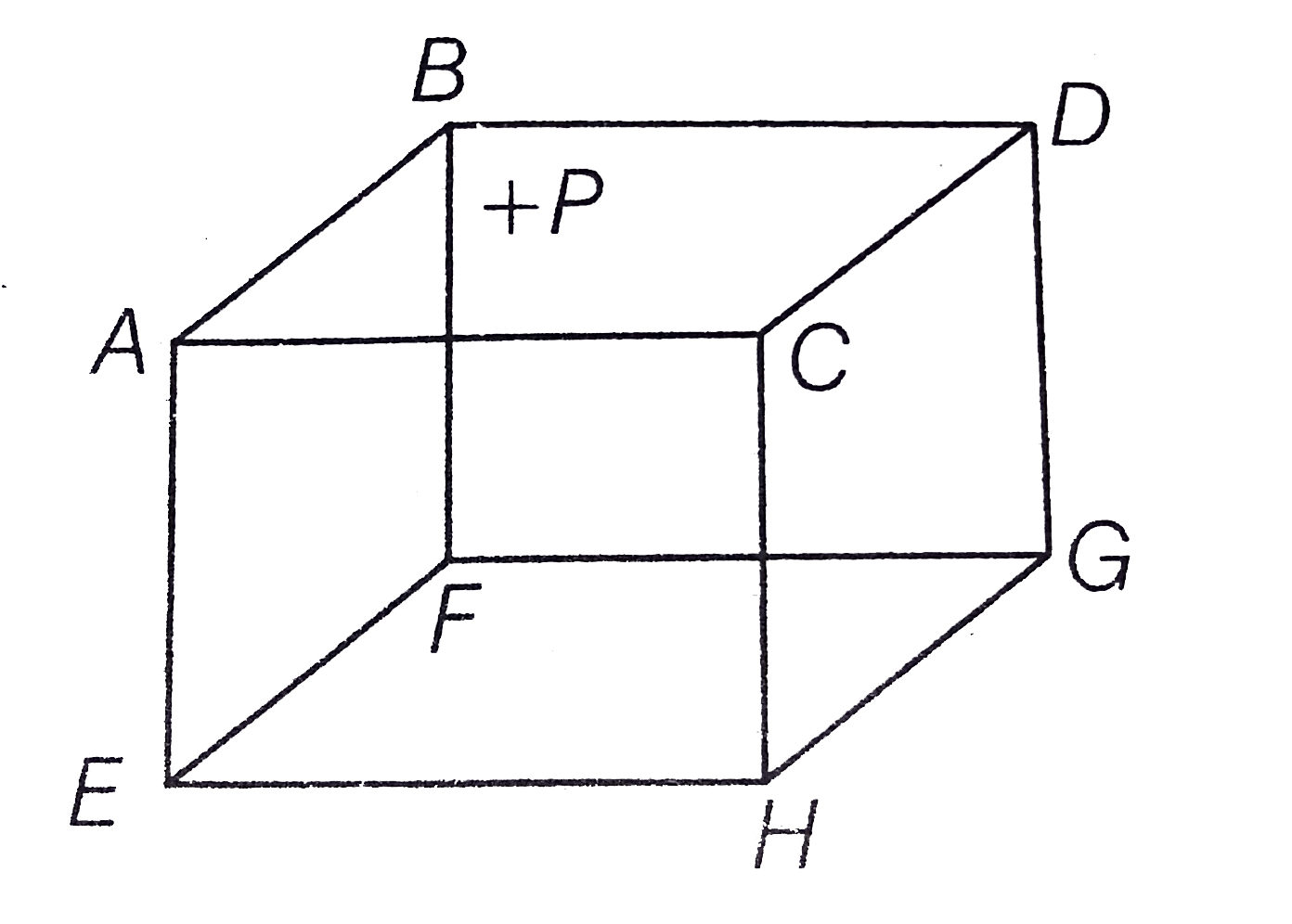
ABCDEFGH is a hollow cube made of an insulator (figure) face ABCD has positive charge on it. Inside the cube, we have ionised hydrogen.

A

will be valid

B

will not be valid, since the ions would experience forece other than due to collisions with the walls.

C

will not be valid since collisions with would not be elastic

D

will not be valid because isotropy is lost

Text Solution

Verified by Experts

The correct Answer is:

2 and 4

Due to presence of external positive charge on the face ABCD. The usual expression for pressure on the basis of kinetic theory will not be valid as ions would also experience electrostatic forces other than the forces due to collisions with the walls of the container. Due to pressence of positive charge the isotropy is also lost.
Promotional Banner

Topper's Solved these Questions

  • GRAVITATION

    NCERT EXEMPLAR ENGLISH|Exercise Long Answer type question|5 Videos
  • LAWS OF MOTION

    NCERT EXEMPLAR ENGLISH|Exercise Long answer Type Questions|9 Videos

Similar Questions

Explore conceptually related problems

Consider a solid cube made up of insulating material having a uniform volume charge density. Assuming the electrostatic potential to be zero at infinity, the ratio of the potential at a corner of the cube to that at the centre will be

A square frame ABCD is made of insulated wires and there is a short dipole, with dipole moment p, fixed in the plane of he figure. The dipole is lying at the centre of the square, making an angle theta , as shown in the figure. If four point charges are placed at the four point charges are placed at the four corners of the square, then the magnitude of force exerted by the dipole on the system of charges is

We have a fixed conductor having a cavity inside. There is a point charge q_(1) kept inside the cavity charge appearing at the inner surface of the cavity is q_(2) . Charge appearing at outer surface of conductor is q_(3) and there lies another point charge q_(4) out side the conductor. Whole situation is shown in figure. q_(4) . is held stationary by applying an external force vecF_(0) on it. Three points A, B and C are shown. Answer the following two questions. Q. If keeping the magnitude and nature of q_(1) fixed position of q_(1) is changed inside the cavity. Then choose the correct option(s)

A positive charge q of mass m is projected , a very large distance , toward a fixed non-conducting sphere having Q charge uniformly distributed inside it, as shown in figure. If the charge q just grazes the sphere , then the speed of projection u is kappa=(1/4piepsilon_0).

We have a fixed conductor having a cavity inside. There is a point charge q_(1) kept inside the cavity charge appearing at the inner surface of the cavity is q_(2) . Charge appearing at outer surface of conductor is q_(3) and there lies another point charge q_(4) out side the conductor. Whole situation is shown in figure. q_(4) . is held stationary by applying an external force vecF_(0) on it. Three points A, B and C are shown. Answer the following two questions. Q. If keeping the nature and position of q_(1) fixed, magnitude of q_(1) is changed, then choose the INCORRECT options(s)

A hollow non conducting sphere of radius R has a positive charge q uniformly distributed on its surface. The sphere starts rotating with a constant angular velocity 'omega' about an axis passing through center of sphere, as shown in the figure. Then the net magnetic field at center of the sphere is

Three conducting spherical shells have radii (a, b, and c) such that a lt b lt c (Fig. 3.113). Initially, the inner shell is uncharged, the middle shell has a positive charge Q, and the outer shell has a negative charge -Q . . a. Find the electric potential of the three shells. b. If the inner and outer shells are now connected by a wire that is insulated as it passes through the middle shell, what is the electric potential of each of the three shells ? Also, what is the final charge on each shell ?

Each of the lettered points at the corners of the cube as shown in Fig. 1.60 represents a positive charge q moving with a velocity of magnitude v in the direction indicated. The region in the figure is in a uniform magnetic field vec B , parallel to the x-axis and directed toward right. Copy the figure, find the magnitude and direction of the force on each charge and show the force in your diagram.

A short electric dipole (which consists of two point charges, + q and -9) is placed at the centre o and inside a large cube (ABCDEFGH) of length L, as shown in figure below. The electric flux, emanating through the cube is :

Eight point charges of magnitude Q are arranged to form the corners of a cube of side L. The arrangement is made in manner such that the nearest neighbour of any charge has the opposite sign. Initially, the charges are held at rest. If the system is let free to move, what happens to the arrangement? Does the cube-shape shrink or expand? Calculate the velocity ct each charge when the side-length of the cube formation changes from L to nL. Assume that the mass of each point charge is m.

NCERT EXEMPLAR ENGLISH-KINETIC THEORY-Multiple Choice Questions (MCQs)
  1. A vessel of volume V contains a mixture of 1 mole of hydrogen and 1 mo...

    Text Solution

    |

  2. An inflated rubber ballon contains one mole of an ideal gas , has a p...

    Text Solution

    |

  3. ABCDEFGH is a hollow cube made of an insulator (figure) face ABCD has...

    Text Solution

    |

  4. Diatomic molecules like hydrogen have energies due to both translation...

    Text Solution

    |

  5. In a diatiomic molecule, the rotational energy at a given temperature

    Text Solution

    |

  6. Which of the following diagrams (figure) depicts ideal gas behaviour?

    Text Solution

    |

  7. When an ideal gas is compressed adiabatically , its temperature rises ...

    Text Solution

    |

  8. Caculate the number of atoms in 39.4 g gold. Molar mass of gold is 197...

    Text Solution

    |

  9. The volume of a given mass of a gas at 27^(@)C, 1 atm is 100cc. What w...

    Text Solution

    |

  10. The molecules of a given mass of a gas have root mean square speeds of...

    Text Solution

    |

  11. Two molecules of a gas have speeds of 9xx10^(6) ms^(-1) and 1xx10^(6) ...

    Text Solution

    |

  12. A gas mixture consists of 2.0 moles of oxygen and 4.0 moles of neon a...

    Text Solution

    |

  13. Calculate the ratio of the mean free paths of the molecules of two gas...

    Text Solution

    |

  14. The container shown in figure has two chambers separated by a partitio...

    Text Solution

    |

  15. A gas mixture consists of molecules of A,B and C with masses m(A) g...

    Text Solution

    |

  16. We have 0.5 g of hydrogen gas in a cubic chamber of size 3 cm kept at ...

    Text Solution

    |

  17. When air is pumped into a cycle tyre the volume and pressure of the a...

    Text Solution

    |

  18. A balloon has 5.0 mole of helium at 7^(@)C. Calculate (a) the numbe...

    Text Solution

    |

  19. Calculate the number of degrees of freedom of molecules of hydrogen in...

    Text Solution

    |

  20. An insulated container containing monoatomic gas of molar mass m is m...

    Text Solution

    |
