Home
Class 11
PHYSICS
An ideal gas undergoes for different pro...

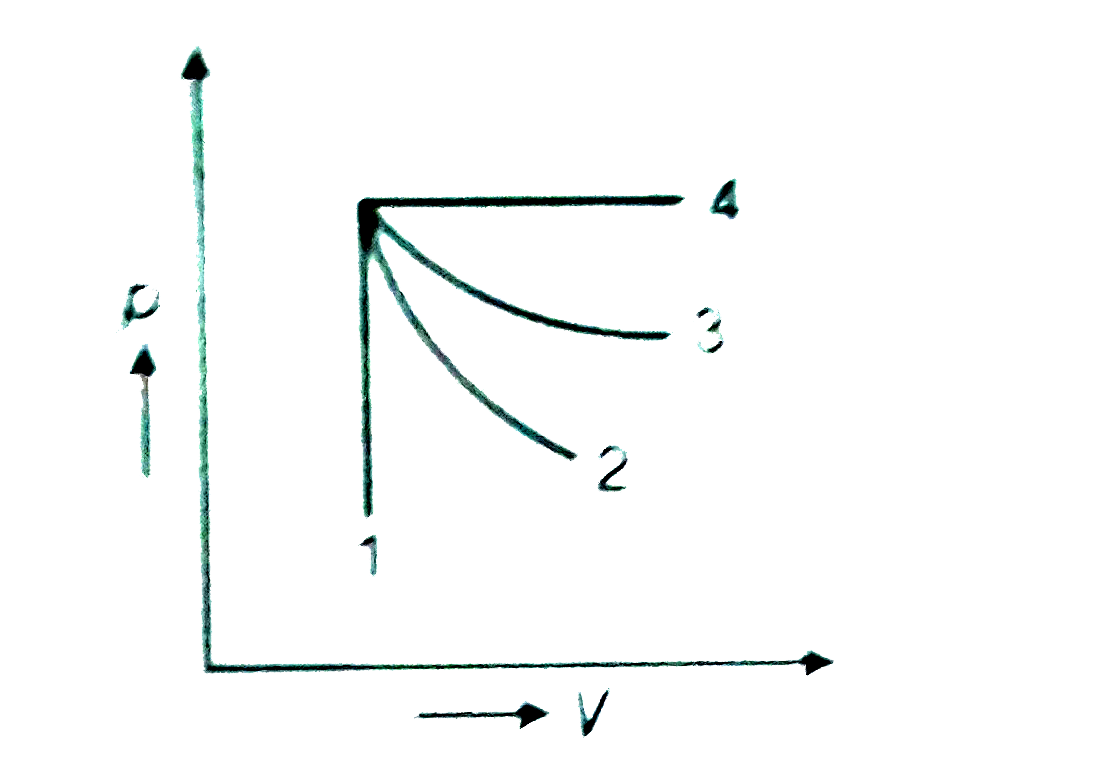
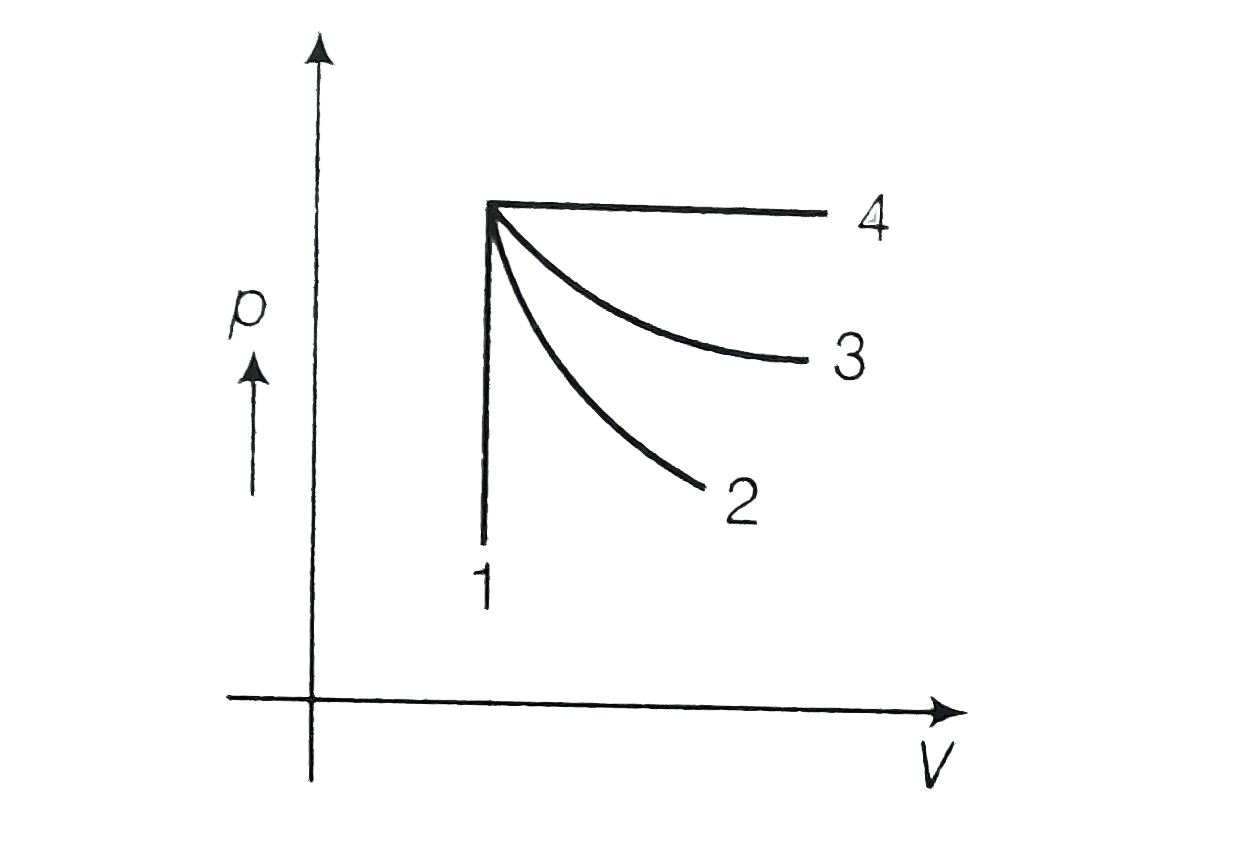
An ideal gas undergoes for different processes from the same initial state (figure). Four processes are adiabatic, isothermal, isobaric and isochoric. Out of 1, 2, 3 and 4 which one is adiabatic ?

A

4

B

3

C

2

D

1

Text Solution

Verified by Experts

The correct Answer is:
C

For the curve 4 pressure is constant, so this is an isobaric process. ltBrgt
For the curve 1, volume is constant, so it is isochoric process. Between cuves 3 and 2, curve 2 is steeper, so it is adiabatic and 3 is isothermal.
Note We should be careful while deciding between isothermal and adiabatic curves because these curves look similar.
Promotional Banner

Topper's Solved these Questions

  • THERMODYNAMICS

    NCERT EXEMPLAR ENGLISH|Exercise MULTIPLE CHOICE QUESTIONS (MORE THAN ONE OPTIONS)|5 Videos
  • THERMODYNAMICS

    NCERT EXEMPLAR ENGLISH|Exercise VERY SHORT ANSWER TYPE QUESTIONS|5 Videos
  • THERMAL PROPERTIES OF MATTER

    NCERT EXEMPLAR ENGLISH|Exercise Very short Answer type Questions|15 Videos
  • UNITS AND MEASUREMENTS

    NCERT EXEMPLAR ENGLISH|Exercise Long Answer Type Questions|9 Videos

Similar Questions

Explore conceptually related problems

An ideal gas undergoes isothermal process from some initial state i to final state f . Choose the correct alternatives.

One mole of a monatomic ideal gas undergoes four thermodynamic processes as shown schematically in the -diagram below. Among these four processes, one is isobaric, one is isochoric, one is isothermal and one is adiabatic. Match the processes mentioned

Can a process on an ideal gas be both adiabatic and isothermal. ?

A gas is expanded form volume V_(0) to 2V_(0) under three different processes as shown in the figure . Process 1 is isobaric process process 2 is isothermal and and process 3 is adiabatic . Let DeltaU_(1),DeltaU_(2) and DeltaU_(3) be the change in internal energy of the gas in these three processes then

An ideal gas undergoes a cyclic process as shown in the given P-T diagram, where AC is adiabatic. The process is also represented by:

If a certain mass of gas is made to undergo separately adiabatic and isothermal expansions to the same pressure, starting form the same initial conditions of temperature and pressure, then, as compared to that of isothermal expansion, in the case of adiabatic expansion, the final

Given here is a cyclic process on P -V diagram. Process 1-2 is isothermal, 2-3 is isobaric and 3-1 is an isochoric process. Plot this T - P diagram.

One mole of mono-atomic ideal gas is taken along two cyclic processes and as shown in the PV diagram. The processes involved are purely isobaric, isothermal or adiabatic. Match the paths in Column I with the magnitudes of the work done in column II and select the correct answer using the codes given below the lists.

An ideal gas undergoes a cyclic process as shown. Part of the process ab is isothermal expansion and work done by the gas in this expansion is 700 J. in adiabatic expansion be it again does 400 J work. If it rejects 100 J heat when it returns to a from c via b then find efficiency of the cycle.

An ideal gas undergoes a cyclic process, in which one process is isochoric, one process is isothermal and one process is adiabatic. During the isothermal process, 40 J heat is released by the gas, and during the isochoric process, 80 J heat is absorbed by the gas. if work done by the gas during adiabatic process is W_(1) and during isothermal process is W_(2) then the magnitude of (W_(1))/(W_(2)) will be equal to:

