Home
Class 11
PHYSICS
A cycle followed by an engine (made of o...

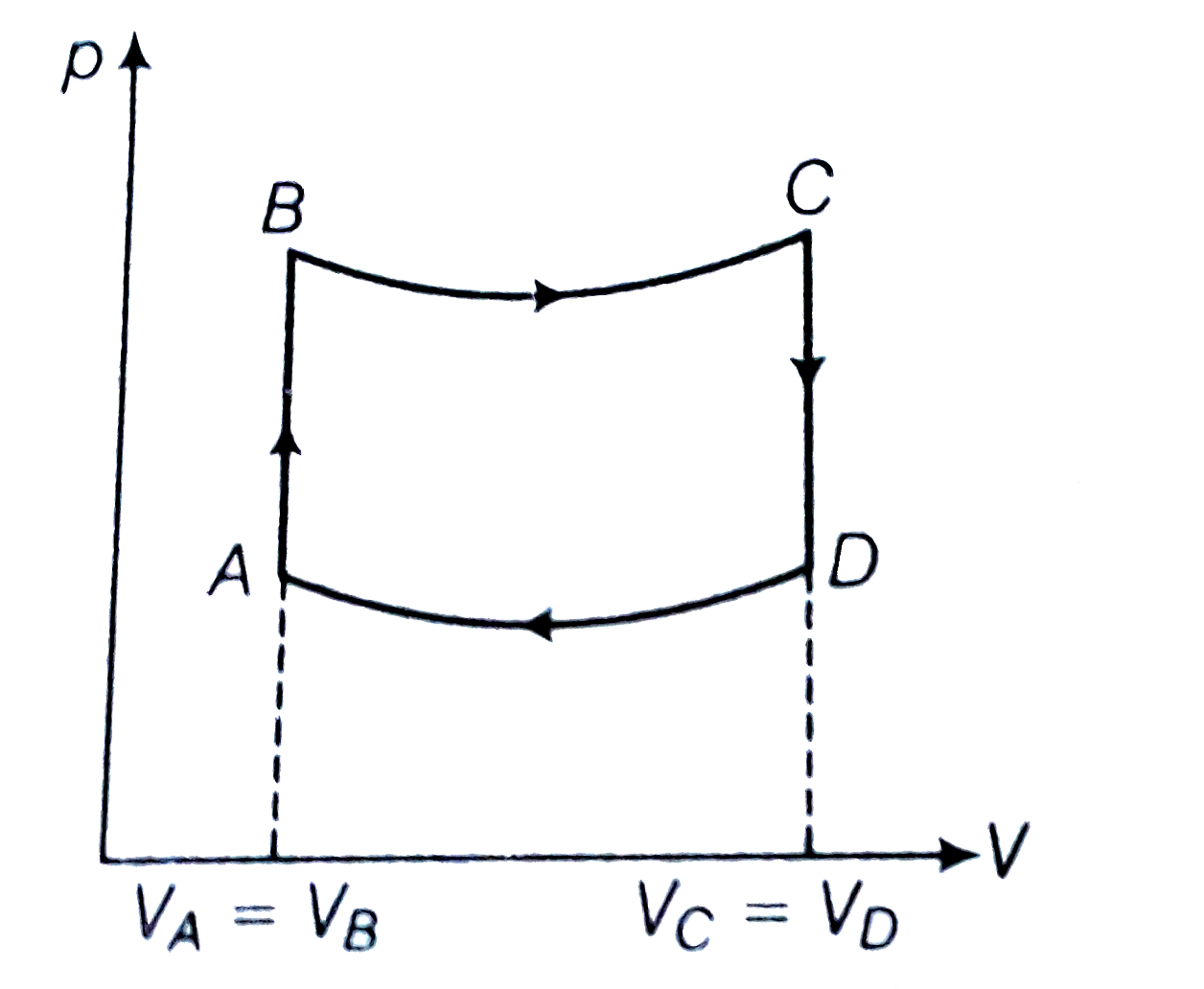
A cycle followed by an engine (made of one mole of perfect gas in a cylinder with a piston) is shown in figure.

A to B volume constant, B to C adiabatic, C to D volume constant and D to A adiabatic
`" "V_(C)=V_(D)=2V_(A) = 2V_(B)`
(a) In which part of the cycle heat is supplied to the engine form outside?
(b) In which part of the cycle heat is being given to the surrounding by the engine ?
(c ) What is the work done by the engine in one cycle ? Write your answer in term of `p_(A),p_(B),V_(A)` ?
(d) What is the efficiency of the engine ?
`" "(gamma=(5)/(3)` for the gas`)`, `(C_(V)= (3)/(2)R` for one mole `)`

Text Solution

Verified by Experts

(a) For the process AB,
`" "dV=0rArrdW=0" "(because "volume is constant")` ltBrgt `" "dQ=dU+dW=dU`
`rArr " "dQ=dU="Change in internal energy.")`
Hence, in this process heat supplied is utilised to increase, internal energy of the system.
Since, `p=((nR)/(V))T`, in isochoric process, `T prop p.` So temperature increases with increases
of pressure in process AB which in turn increases internal energy of the system i.e.,
dU`gt` 0. This imply that dQ`gt`0. So heat is supplied to the system in process AB.
(b) For the process CD, volume is constant but pressure decreases.
Hence, temperature also decreases so heat is given to surroundings.
(c ) To calculate work done by the engine in one cycle, we calculate work done in each part separately.
`" "W_(AB)=int_(A)^(B)pdV=0, W_(CD)=int_(V_(C))^(V_(D))pdV=0" "(becausedV=0)`
`" "W_(BC)=int_(V_(B))^(V_(C))pdV=kint_(V_(B))^(V_(C))(dV)/(V^(gamma))=(k)/(1-gamma)[V^(1-gamma)]_(V_(B))^(V_(C))`
`" "=(1)/(1-gamma)[pV]_(V_(B))^(V_(C))=((p_(C)V_(C)-p_(B)V_(B)))/(1-gamma)`
Similarly, `" "W_(DA)=(p_(A)V_(A)-p_(D)V_(D))/(1-gamma)" "[because BC" is adiabatic process"]`
`because B and C` lies on adiabatic curve BC. ltBrgt `therefore" "p_(B)V_(B)^(gamma)=p_(C)V_(C)^(gamma)`
`" "p_(C)=p_(B)((V_(B))/(V_(C)))^(gamma)=p_(B)((1)/(2))^(gamma)=2^(-gamma)p_(B)`
Similarly, `" "p_(D)=2^(-gamma)p_(A)`
Total work done by the engine in one cycle ABCDA.
`" "W=W_(AB)+W_(BC)+W_(CD)+W_(DA)=W_(BC)+W_(DA)`
`" "=((p_(C)V_(C)-p_(B)V_(B)))/(1-gamma)+((p_(A)V_(A)-p_(D)V_(D)))/(1-gamma)`
`" "W=(1)/(1-gamma)[2^(-gamma)p_(B)(2V_(B))-p_(B)V_(B)+p_(A)V_(A)-2^(-gamma)p_(B)(2V_(B))]`
`" "(1)/(1-gamma)[p_(B)V_(B)(2^(-gamma+1)-1)-p_(A)V_(A)(2^(-gamma+1)-1)`
`" "=(1)/(1-gamma)(2^(1-gamma)-1)(p_(B)-p_(A))V_(A)`
`" "(3)/(2)[1-((1)/(2))^(2//3)](p_(B)-p_(A))V_(A)`
Promotional Banner

Topper's Solved these Questions

  • THERMODYNAMICS

    NCERT EXEMPLAR ENGLISH|Exercise SHORT ANSWER TYPE QUESTIONS|6 Videos
  • THERMAL PROPERTIES OF MATTER

    NCERT EXEMPLAR ENGLISH|Exercise Very short Answer type Questions|15 Videos
  • UNITS AND MEASUREMENTS

    NCERT EXEMPLAR ENGLISH|Exercise Long Answer Type Questions|9 Videos
