Home
Class 11
PHYSICS
Consider one mole of perfect gas on a...

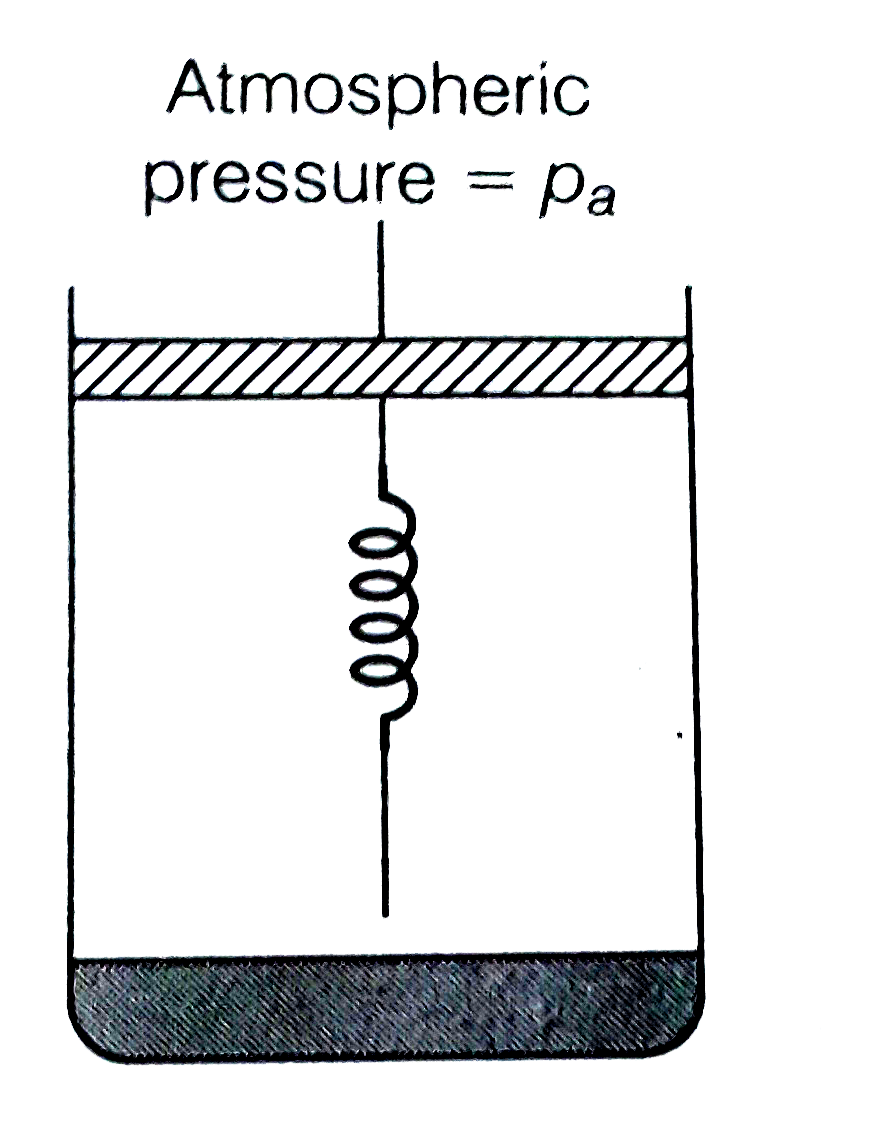
Consider one mole of perfect gas on a cylinder of units cross-section with a piston attached (figure). A spring (spring constant K ) is attached ( unstretched length L ) to the piston and to the bottom of the cylinder . Initially the spring is unstretched and the gas is in equilibrium. A certain amount of heat Q is supplied to the gas causing an increase of value from `V_(0)` to `V_(1)`.
(a) What is the initial pressure of the system ?
(b) What is the final pressure of the system?
(c) Using the first law of thermodynamic, write down a relation between `Q, p_(a),V,V_(0)` and K.

Text Solution

Verified by Experts
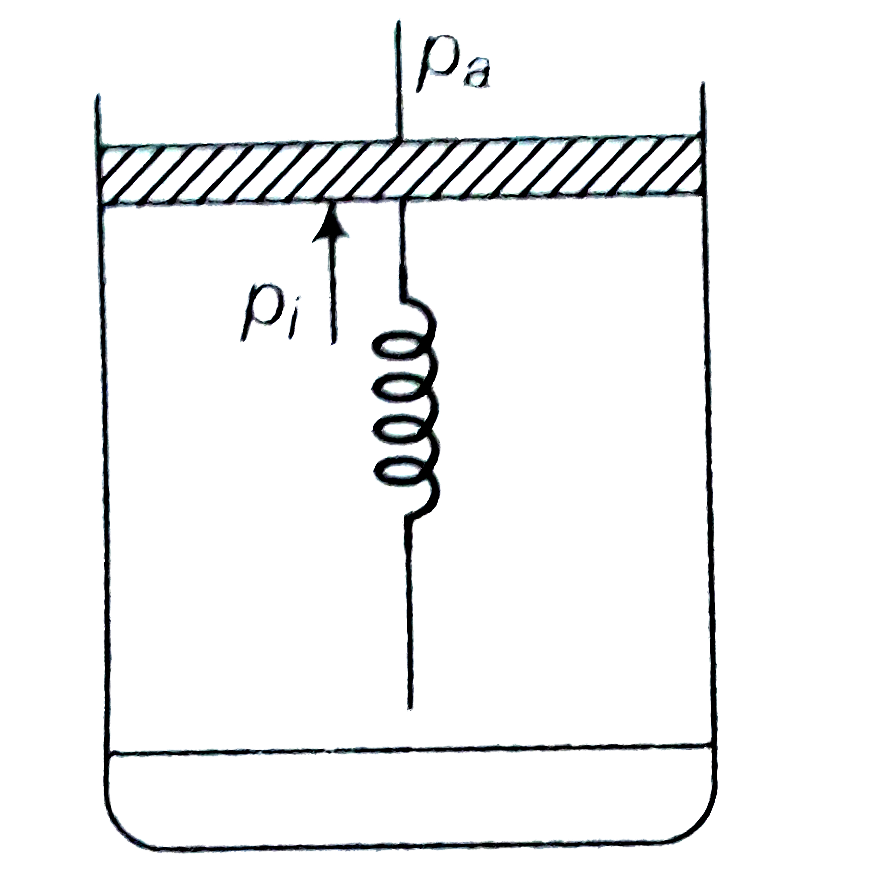
(a) Initially the piston is in equilibrium hence,`p_9i)= p_(a)`

(b) On supplying heat, the gas expands form `V_(0)` to `V_(1)`
`therefore ` Increase in volume of the gas = `V_(1) -V_(0)`
`x = (V_(1) - V_(0))/("Area") = V_(1)-V_(0)`
`therefore ` Force exerted by the spring on the piston
`= F = kx = (V_(1) - V_(0))`
Hence, Final pressure `= p_(f) = p_(a) + kx `
`= p_(a) + k xx (V_(1) - V_(0))`

(c) From first law of therodynamics dQ = dU + dW
If T is final temperature of hte gas, then increase in the internal energy
`dU = C_(V) (T, T_(0)) = C_(v) (,T_(0))`
We can write , `T= (p_(f) V_(1))/(R) = [(p_(a) + K (V_(1) - V_(0)))/(R)](V_(1))/(R)`
Work done by the gas = pdV + increase in PE of the spring
`p_(a) (v_(1) -V_(0)) +(1)/(2)kx^(2)`
Now, we can write dQ = dU + dW
`C_(v) (T- T_(0)) + p_(a) (V - V_(0)) + (1)/(2)kx^(2)`
`=C_(v) (T- T_(0)) + P_(a) (V- V_(0)) +(1)/(2)(V_(1) - V_(0))^(2)`
This is the required relation .
Promotional Banner

Topper's Solved these Questions

  • THERMODYNAMICS

    NCERT EXEMPLAR ENGLISH|Exercise SHORT ANSWER TYPE QUESTIONS|6 Videos
  • THERMAL PROPERTIES OF MATTER

    NCERT EXEMPLAR ENGLISH|Exercise Very short Answer type Questions|15 Videos
  • UNITS AND MEASUREMENTS

    NCERT EXEMPLAR ENGLISH|Exercise Long Answer Type Questions|9 Videos

Similar Questions

Explore conceptually related problems

A block of mass m having charge q is attached to a spring of spring constant k . This arrangement is placed in uniform electric field E on smooth horizontal surface as shown in the figure. Initially spring in unstretched. Find the extension of spring in equilibrium position and maximum extension of spring.

A spring of spring constant 5 xx 10^(3) N//m is stretched initially by 5 cm from the unstretched position. The work required to further stretch the spring by another 5 cm is .

An ideal spring with spring constant k is hung from the ceiling and a block of mass M is attached to its lower end. The mass is released with the spring initially unstretched. Then the maximum extension in the spring is

An ideal spring with spring constant k is hung from the ceiling and a block of mass M is attached to its lower end. The mass is released with the spring initially unstretched. Then the maximum extension in the spring is

Consider the situation shown in figure. Initially the spring is unstretched when the system is released from rest. Assuming no friction in the puley, find the maximum eleongation of the spring.

An elastic spring of unstretched length L and spring constant K is stretched by a small length x. It is further stretched by another small length y. the work done in second stretcing is

A constant force F is applied on a spring block system as shown in figure. The mass of the block is m and spring constant is k. The block is placed over a smooth surface. Initially the spring was unstretched. Choose the correct alternative(s)

A small ball of mass M=1 kg is attached to two identical springs of constant 100N//m , which are attached to floor and roof. The springs are initially unstretched. By what distance ball comes down to attain equilibrium? (in cm)

A block of mass m is attached to a cart of mass 4m through spring of spring constant k as shown in the figure. Friction is absent everywhere. The time period of oscillations of the system, when spring is compressed and then released, is

A horizontal cylinder has two sections of unequal cross-section, in which two pistons can move freely. The pistons are joined by a string. Some gas is trapped between the pistons . Spring is massless and in natural length. If this gas is heated, the spring will .