Home
Class 9
MATHS
The diagonals of a parallelogram ABCD in...

The diagonals of a parallelogram ABCD intersect at a point O. Through O, a line a drawn to intersect AD at P and BC at Q. Show that PQ divides the parallelogram into two parts of equal area.

Text Solution

Verified by Experts
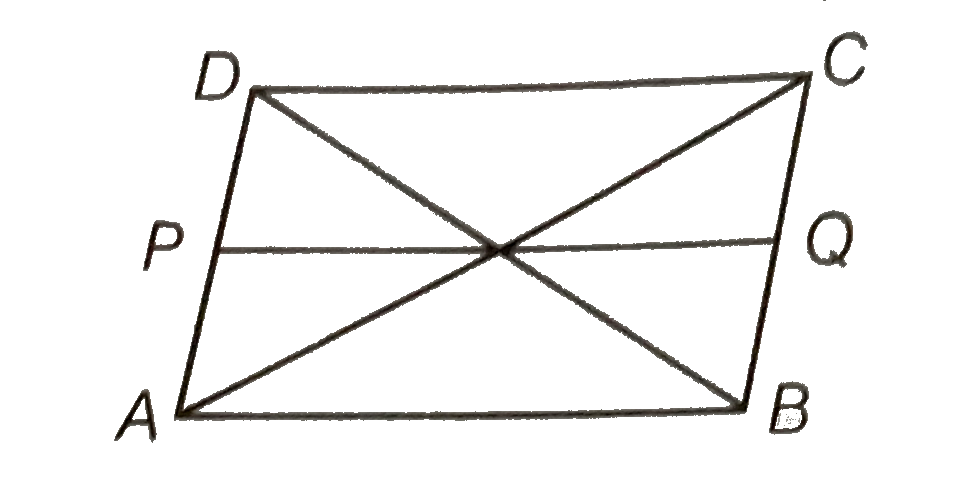
Given In a parallelogram ABCD, diagonals interect at O and draw a line PQ, which intersects AD and BC.
To prove PQ divides the parallelogram ABCD into two parts of equal area.
i.e., `" " ar (ABQP) = ar (CDPQ)`

Proof We know that, diagonals of a parallelogram bisect each other.
`therefore" "` `OA = OC " and " OB = OD" "` ...(i)
In `DeltaAOB` and `DeltaCOD`,
`OA = OC`
`OB = OD" "` [from Eq. (i)]
and `" "angle AOB = angleCOD" "` [vertically opposite angles]
`therefore" "` `DeltaAOB ~= DeltaCOD" "` [by SAS congruence rule]
Then, `" "ar (DeltaAOB) = ar (DeltaCOD)" "` ...(ii)
[since, cogruent figures have equal area]
Now, in `DeltaAOP` and `DeltaCOQ`
`anglePAO = angleOCQ" "` [alternate interior angles]
`OA = OC" "` [from Eq. (i)]
and `" " angleAOP = angleCOQ" "` [vertically opposite angles]
`therefore" "` `DeltaAOP ~= DeltaCOQ" "` [by ASA congruence rule]
`therefore" "` `ar (DeltaAOP) = ar (DeltaCOQ)" "` ...(iii)
[since, congruent figures have equal area]
Similarly, `" " ar (DeltaPOD) = ar (DeltaBOQ)" "` ...(iv)
Now, `" " ar (ABQP) = ar (DeltaCOQ) + ar (DeltaCOD) + ar (DeltaPOD)`
`=ar (DeltaAOP) + ar (DeltaAOB) + ar (DeltaBOQ)" "` [from Eqs. (ii), (iii) and (iv)]
`rArr" "` `ar (ABQP) = ar (CDPQ)" "` Hence proved.
Promotional Banner

Topper's Solved these Questions

  • Areas of Parallelograms and Triangles

    NCERT EXEMPLAR ENGLISH|Exercise Exercise-9.3 Short Answer Type Questions|9 Videos
  • CIRCLES

    NCERT EXEMPLAR ENGLISH|Exercise Exercise 10.4|14 Videos

Similar Questions

Explore conceptually related problems

The diagonals of a parallelogram A B C D intersect at a point O . Through O , a line is drawn to intersect A D\ at P and B C at Q . Show that P Q divides the parallelogram into two parts of equal area.

The diagonals of a parallelogram A B C D intersect at a point Odot Through O , a time is drawn to intersect A D at P and B C at Q . Show that P Q divides the parallelogram into two parts of equal area.

The diagonals of a parallelogram A B C D intersect at O. A line through O intersects A B\ at X\ a n d\ D C at Y . Prove that O X=O Y .

The diagonals of a parallelogram A B C D intersect at OdotA line through O intersects A B at X and D C at Ydot Prove that O X=O Ydot

ABCD is a parallelogram. A circle through A, B is so drawn that it intersects AD at P and BC at Q. Prove that P, Q, C and D are concyclic.

Show that the diagonals of a parallelogram divide it into four triangles of equal area.

Show that the diagonals of a parallelogram divide it into four triangles of equal area.

Prove that A diagonal of a parallelogram divides it into two triangles of equal area.

The diagonals of a parallelogram A B C D intersect at Odot A line through O meets A B in X and C D in Ydot Show that a r( A X Y D)=1/2(A R ^(gm)A B C D)

The diagonals of a parallelogram A B C D intersect at O . A line through O meets A B\ in X\ a n d\ C D in Y . Show that a r\ (q u a d rilateral A X Y D)=1/2a r(paral l e l ogram\ \ A B C D)

