Home
Class 12
PHYSICS
Can reflection result in plane polarised...

Can reflection result in plane polarised light if the light is incident on interface from the side with higher refractive index?

Text Solution

Verified by Experts

When angle of incidence is equal to Brewster's angle,he transmitted light is unpolarised and reflected light is plane polarised.
Consider the diagram in which unpolarised light is represented by dot and plane polarised light is represented by arrows.
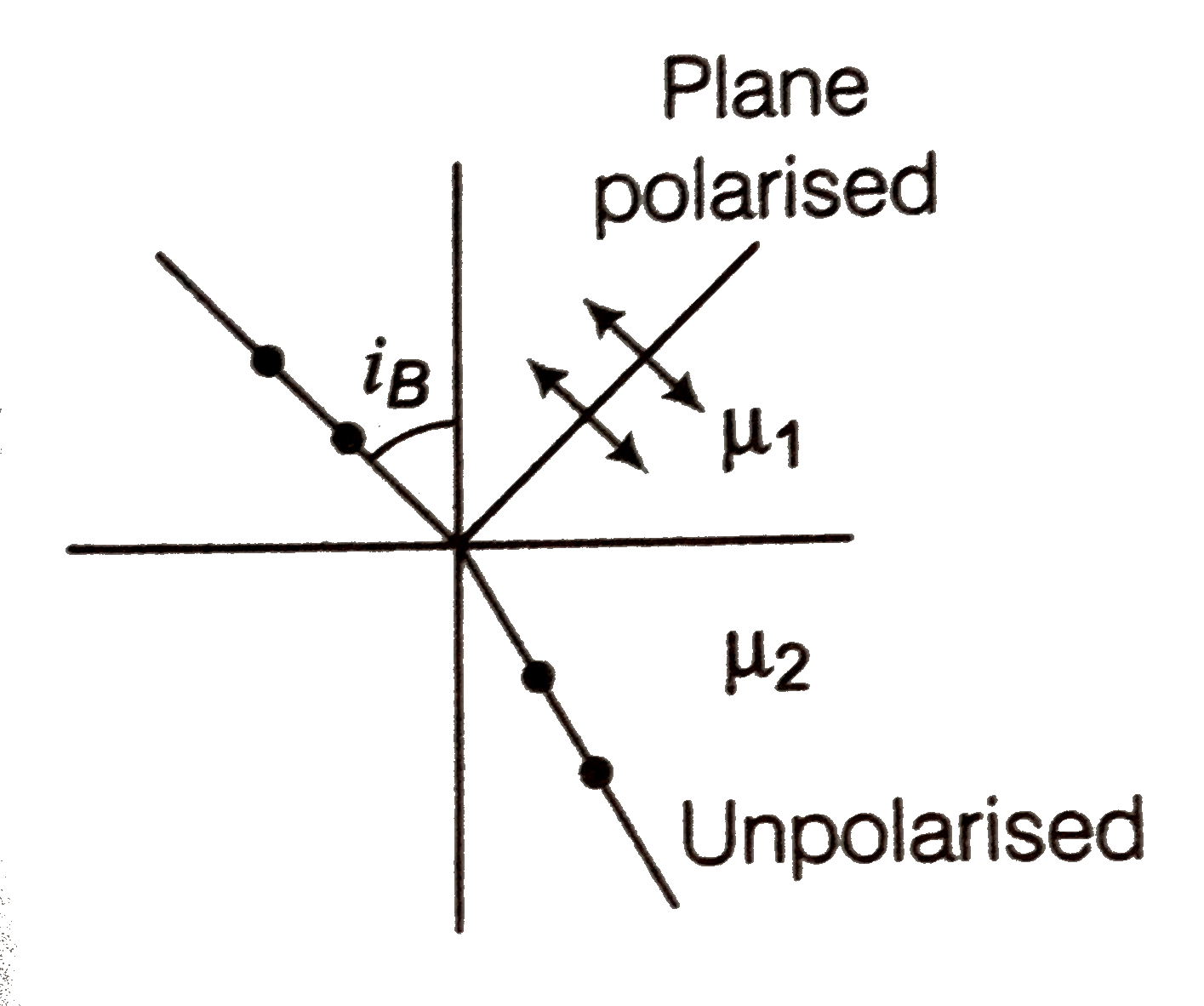
Polarisation by reflection occurs when the angle of incidence is the Brewster's angle
i.e, `tan i_(B)=""^(1)mu_(2)=(mu_(2))/(mu_(1))` where `mu_(2) lt mu_(1)`
when the light rays travels in such a medium, the critical angle is
`Sin i_(C)=(mu_(1))/(mu_(2))`
where `mu_(2) lt mu_(1)`
As `|tan i_(B) | gt |Sin i_(C)|` for large angles `i_(B) lt i_(C)`
Thus, the polarisation by reflection occurs definitely.

Promotional Banner

Topper's Solved these Questions

  • WAVE OPTICS

    NCERT EXEMPLAR ENGLISH|Exercise Long Answer type Questions|5 Videos
  • WAVE OPTICS

    NCERT EXEMPLAR ENGLISH|Exercise Very short Answer Type Questions.|6 Videos
  • SEMICONDUCTOR ELECTRONICS: MATERIAL,DEVICES AND SIMPLE CIRCUIT

    NCERT EXEMPLAR ENGLISH|Exercise Multiplel choice questions|26 Videos

Similar Questions

Explore conceptually related problems

define plane polarised light in short ?

What is the minimum thickness of a soap bubble needed for constructive interference in reflected light, if the light incident on the film is 750 nm? Assume that the refractive index for the film is n=1.33

What is the minimum thickness of a soap bubble needed for constructive interference in reflected light, if the light incident on the film is 750 nm? Assume that the refractive index for the film is n=1.33

A beam of light travelling in water strikes a glass plate, which is also immersed in water. When the angle of incidence is 51^@ , the reflected beam is found to be plane polarised . What is the refractive index of glass if the refractive index of water is (4)/3 ? [tan 51^(@)=1.235]

Distinguish between unpolarised and plane polarised light. An unpolarised light is incident on the boundary between two transparent media. State the consition when the reflected wave is totally plane polarised. Find out the expression for the angle of incidence in this case.

When light of particular wavelength falls on a plane surface at an angle of incidence 60^(@) then the reflected light becomes completely plane polarized Find the refractive index of surface material and the angle of refraction through it.

When light is incident from air to glass at an angle 57^@ , the reflected beam is completely polarised. If the same beam is incident from water to glass, the angle of incidence at which reflected beam is completely polarised will be

One face of a prism with a refrective angle of 30^@ is coated with silver. A ray of light incident on another face at an angle of 45^@ is refracted and reflected from the silver coated face and retraces its path. What is the refractive index of the prism?

One face of a prism with a refrective angle of 30^@ is coated with silver. A ray of light incident on another face at an angle of 45^@ is refracted and reflected from the silver coated face and retraces its path. What is the refractive index of the prism?

A light ray is travelling from air to glass. True reflected and refracted rays are perpendicular to each other. If the angle of incidence in air is I the refractive index of glass is
