Home
Class 11
PHYSICS
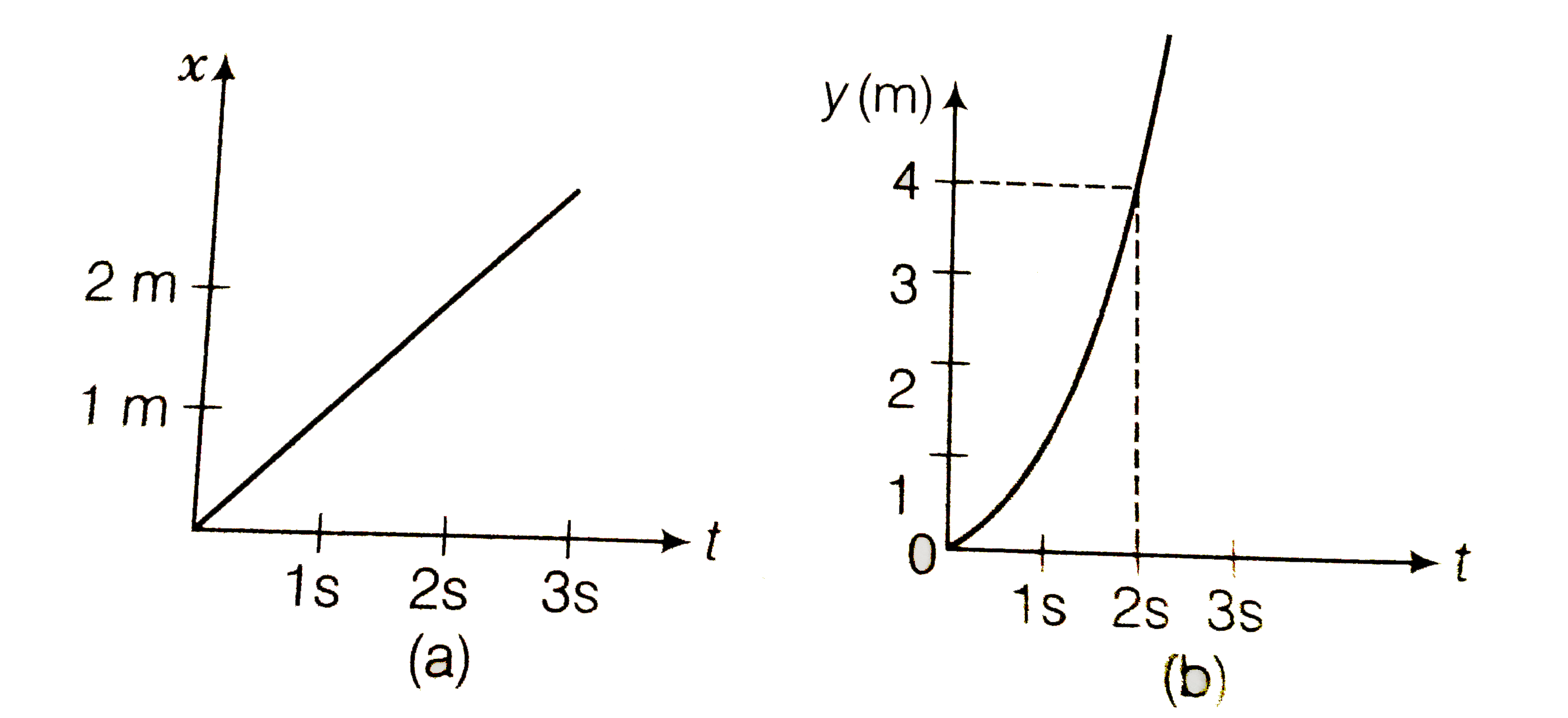
Figure shows (x,t) (y,t) diagram of a p...

Figure shows (x,t) (y,t) diagram of a particle moving in 2-dimensions.

If the particle has a mass of 500 g , find the force (direction and magnitude) acting on the particle .

Text Solution

Verified by Experts

Clearly from diagram (a) , the variation can be related as
x = t `implies (dx)/(dt) = 1` m/s
`a_(x) = 0`
From diagram (b) `" " y = t^(2)`
`implies " " (dy)/(dt) = 2t` or `a_(y) = (d^(2)y)/(dt^(2)) = 2 m//s^(2)`
Hence , `" " I_(y) = ma_(y) = 500 xx 10^(-3) xx 2 = 1N " " (because m = 500 g)`
`F_(x) = ma_(x) = 0`
Hence , net force , `" " F = sqrt(F_(x)^(2) + F_(y)^(2)) = F_(y) = 1N " " `(along y-axis)
Promotional Banner

Topper's Solved these Questions

  • LAWS OF MOTION

    NCERT EXEMPLAR ENGLISH|Exercise Long answer Type Questions|9 Videos
  • LAWS OF MOTION

    NCERT EXEMPLAR ENGLISH|Exercise Very short answer type Questions|12 Videos
  • KINETIC THEORY

    NCERT EXEMPLAR ENGLISH|Exercise Multiple Choice Questions (MCQs)|31 Videos
  • MECHANICAL PROPERTIES OF FLUIDS

    NCERT EXEMPLAR ENGLISH|Exercise Long Answer Type Questions|3 Videos

Similar Questions

Explore conceptually related problems

Figure shows (v_x ,t) and (v_y ,t) diagram for a body of unit mass. Find the force as a function of time.

Figure shows (v_x ,t) and (v_y ,t) diagram for a body of unit mass. Find the force as a function of time.

The motion of a particle of mass m is described by y =ut + (1)/(2) g t^(2) . Find the force acting on the particale .

The motion of a particle of mass m is described by y =ut + (1)/(2) g t^(2) . Find the force acting on the particale .

The velocity-time graph of a particle moving in a straight line is shown in figure. The mass of the particle is 2kg . Work done by all the forces acting on the particle in time interval between t=0 to t=10s is

Figure shows the displacement of a particle going along the X-axis as a function of time. The force acting on the particle is zero in the region

The fig. shows the v-t graph of a particle moving in straight line. Find the time when particle returns to the starting point.

Kinetic energy of a particle moving in a straight line is proportional to the time t. The magnitude of the force acting on the particle is :

The figure shows the position time graph of a particle of mass 40 kg. What is the force acting on the particle of 0lttlt4 s

The acceleration-time graph of a particle moving along x-axis is shown in the figure. If the particle starts with velocity 3 m/s at t = 0, find the velocity of particle at t = 4 s.
