Home
Class 11
PHYSICS
Figure shows (vx,t) and (vy,t) diagram f...


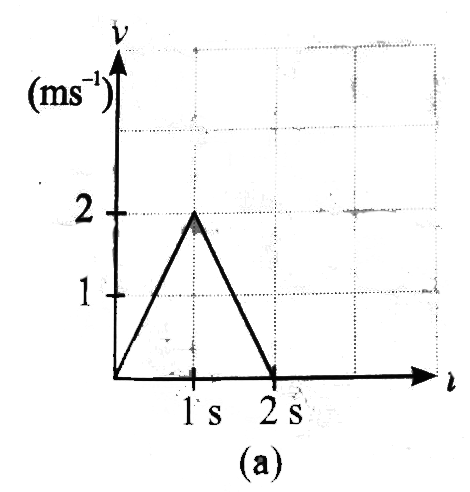
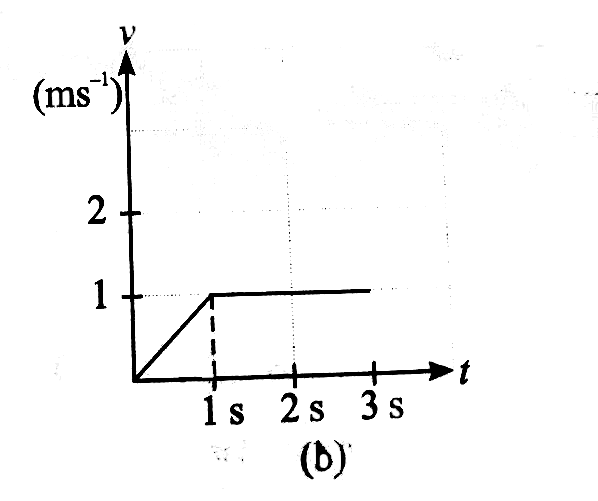
Figure shows `(v_x`,t) and `(v_y`,t) diagram for a body of unit mass. Find the force as a function of time.

Text Solution

Verified by Experts
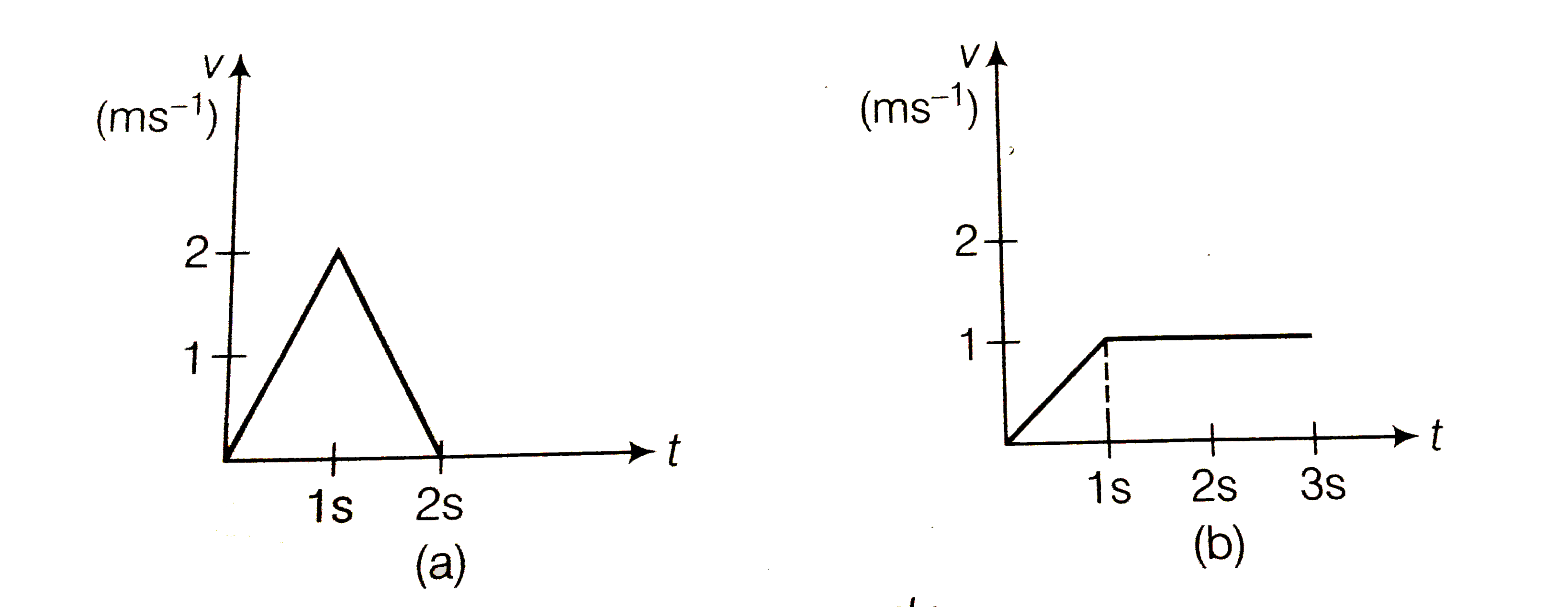
Consider figure(a) `" " v_(x) = 2t` for `0 lt t lt 1s`
= `2(2-t)` for `1 lt t lt 1s`
= 0 for t `gt` 2s.
From figure (b) `" " v_(y) = t ` for `0 lt t lt 1s`
= 1 for t `gt` 1s
`F_(x) = ma_(x) = m (dv_(x))/(dt)`
`= 1 xx 2 " for" 0 lt t lt 1s`
`= 1(-2) " for" 1 lt t lt 2s`
`" for" 2 lt t`

`F_(y)=ma_(y)=m(dv_(y))/(dt)`
`=1xx1 " for " 0 lt t lt 1s = 0 " for " 1 lt t`
Hence, `F= F_(x) hati+F_(y) hatj`
`=2 hati + hatj " for" 0 lt t lt 1s `
`= -2 hati " for " 1 lt t lt 2s`
`=0 " for " t gt 2s `
Promotional Banner

Topper's Solved these Questions

  • LAWS OF MOTION

    NCERT EXEMPLAR ENGLISH|Exercise Short answer type questions|6 Videos
  • KINETIC THEORY

    NCERT EXEMPLAR ENGLISH|Exercise Multiple Choice Questions (MCQs)|31 Videos
  • MECHANICAL PROPERTIES OF FLUIDS

    NCERT EXEMPLAR ENGLISH|Exercise Long Answer Type Questions|3 Videos

Similar Questions

Explore conceptually related problems

Figure shows (x,t) (y,t) diagram of a particle moving in 2-dimensions. If the particle has a mass of 500 g , find the force (direction and magnitude) acting on the particle .

Figure shows (x,t) (y,t) diagram of a particle moving in 2-dimensions. If the particle has a mass of 500 g , find the force (direction and magnitude) acting on the particle .

In the figure show, find v, t_(op) and R .

Figure. Shows the P-V diagram for a Carnot cycle. In this diagram

Work done in time t on a body of mass m which is accelerated from rest to a speed v in time t_(1) as a function of time t is given by

The graph in figure shows the velocity v versus time t for a body. Which of the graphs shown in figure represents the correesponding acceleration versus time graphs ?

A body of mass m is acceleratad uniformaly from rest to a speed v in a time T . The instanseous power delivered to the body as a function of time is given by

In the diagram shown in figure, V function is given. Find other four functions of time I, V_C, V_R and V_L . Also, find power consumed in the circuit, V is given in volts and omega in rad/s.

A body of mass m , accelerates uniformly from rest to V_(1) in time t_(1) . The instantaneous power delivered to the body as a function of time t is.

The motion of a body is given by the equation (dv)/(dt)=4-2v , where v is the speed in m/s and t in second. If the body was at rest at t = 0, then find (i) The magnitude of initial acceleration (ii) Speed of body as a function of time

