Home
Class 11
PHYSICS
A racing car travels on a track (without...

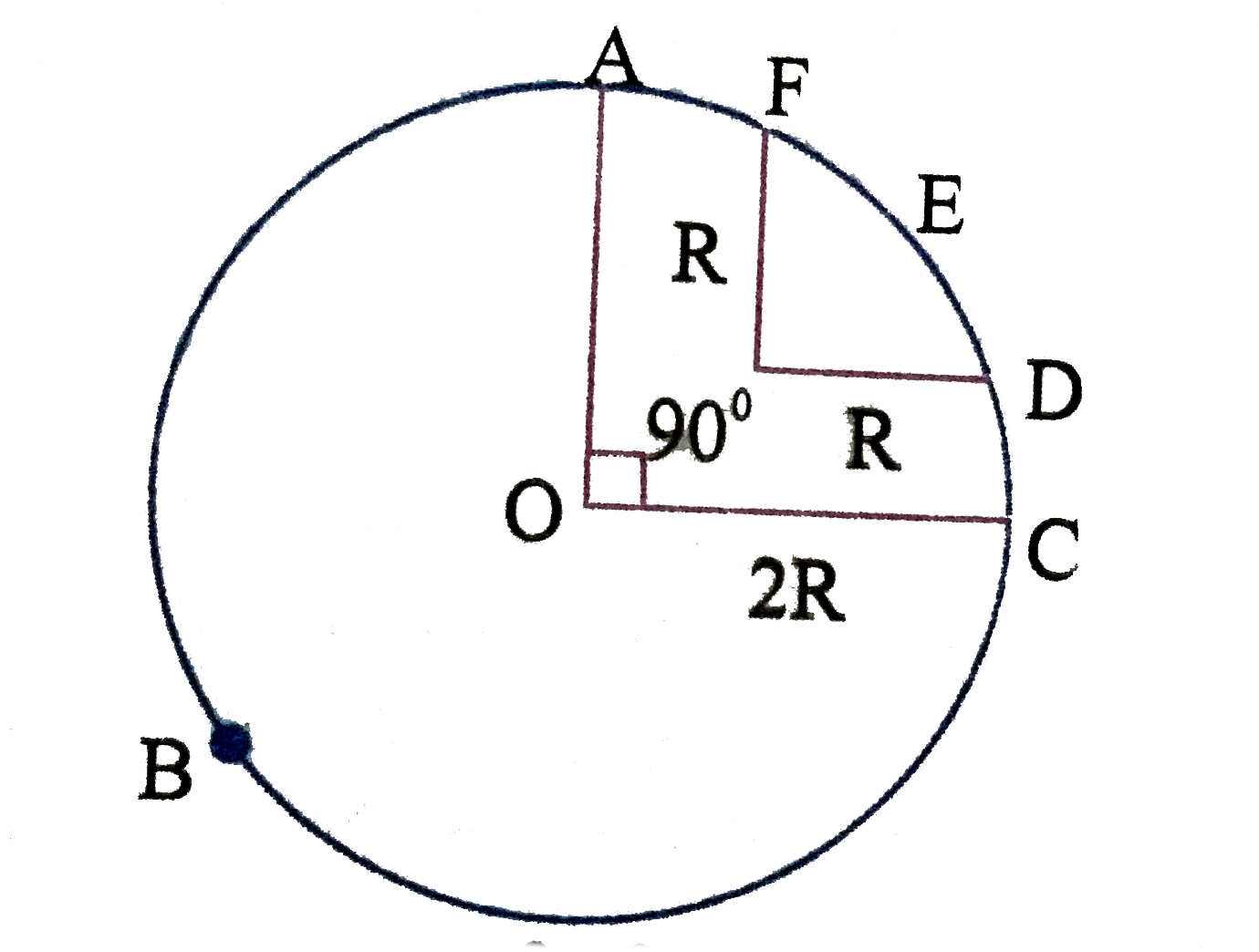
A racing car travels on a track (without banking) `ABCDEFA`.`ABC` is a circular arc of radius `2R. CD` and `FA` are straight paths of length `R` and `DEF` is a circular arc of radius `R = 100m`. The co-efficient of friction on the road is `¼ =0.1`. the maximum speed of the car is `50m s-1`. Find the minimum time for completing one round.
.

Text Solution

Verified by Experts

Balancing frictional force for centripetal force `(mv^(2))/(r) = f = mu N = mu mg`
where N is normal reaction
`therefore " " v = sqrt(murg) " "` (where r is radius of the circular track)
For path ABC `" "` Path length = `(3)/(4)(2pi 2R) = 3pi R = 3 pi xx 100`
=`300 pi m`
`v_(1) = sqrt(mu2Rg) = sqrt(0.1 xx 2 xx 100 xx 10)`
= `14.14` m/s
`therefore " " t_(1) = (300pi)/(14.14) = 66.6 s`
For path DEF Path length = `(1)/(4) (2 pi R) = (pi xx 100)/(2) = 50 pi`
`v_(2) = sqrt(muRg) = sqrt(0.1 xx 100 xx 10) = 10` m/s
`t_(2) = (50 pi)/( 10) = 5 pi s = 15.7 s`
For paths CD and FA
Path length = R + R = 2R = 200 m
`t_(3) = (200)/(50) = 4.0 `s.
Total time for completing one round
`t = t_(1) + t_(2) + t_(3) = 66.6 + 15.7 + 4.0 = 86.3 s `
Promotional Banner

Topper's Solved these Questions

  • LAWS OF MOTION

    NCERT EXEMPLAR ENGLISH|Exercise Short answer type questions|6 Videos
  • KINETIC THEORY

    NCERT EXEMPLAR ENGLISH|Exercise Multiple Choice Questions (MCQs)|31 Videos
  • MECHANICAL PROPERTIES OF FLUIDS

    NCERT EXEMPLAR ENGLISH|Exercise Long Answer Type Questions|3 Videos

Similar Questions

Explore conceptually related problems

A car is taking turn on a circular path of radius R. If the coefficient of friction between the tyres and road is mu , the maximum velocity for no slipping is

A car has to take a safe circular turn on horizontal flat rough road of radius 200 m. If the coefficient of friction between the tyres and road is 0.1 ,then maximum speed of car would be(All are in SI units)

A car has to move on a level turn of radius 45 m. If the coefficient of static friction between the tyre and the road is mu_s=2.0, find the maximum speed the car can take without skidding.

A car is moving on a horizontal circular track of radius 0.2 km with a constant speed. If coefficient of friction between tyres of car and road is 0.45, then maximum speed of car may be [Take g=10 m//s^(2) ]

A car of mass m is moving on a level circular track of radius R if mu_(s) represents the static friction between the road and tyres of the car, the maximum speed of the car in circular motion is given by.

A car is moving on a horizontal circular road of radius 0.1 km with constant speed. If coefficient of friction between tyres of car and road is 0.4, then speed of car may be (g=10m//s^(2))

A car turns a corner on a slippery road at a constant speed of 10 m /s . If the coefficient of friction is 0.5, the minimum radius of the arc in meter in which the car turns is

A car goes on a horizontal circular road of radius R. The speed of car is increasing at constant rate a m/ s^2 . If the friction coefficient between the road and the tyre is mu , then the limiting speed of car is

What will be maximum speed of a car on a curved road of radius 30 m , If the coefficient of friction between the tyres and the road is 0.4? (g=9.8 m//s^(2))

A car is moving on a circular level road of curvature 300m . If the coefficient of friction is 0.3 and acceleration due to gravity is 10m//s^(2) , the maximum speed of the car be a) 90 km/h b) 81 km/h c) 108 km/h d) 162 km/h

